Use the Sunday hours below when the ceremony and the reception share one banquet hall, guests sit down at 4:00 pm, and the music goes off at 11:00 pm. If your door time is different, slide every line by the same amount. Do not keep the ceremony at 4:20 pm and only move dinner.
Most hosts are not running one event. A common weekend in New Jersey, California, Texas, or the Chicago suburbs is a Friday mehendi, a Saturday sangeet, and a Sunday ceremony with the reception in the same hall. Some families add a morning haldi or pithi at the hotel. Each of those needs its own door time, its own guest count, and its own end.
The months of booking the hall, the pandit, and the clothes are a different job from the hours below. This page is only the day.
Start from the three times in the contract
The months of booking the hall, the clothes, and the pandit are on the Indian wedding checklist. This page starts once those are chosen and you are setting the hours.
Before you pick a baraat time, read the rental for three clocks. When guests may enter. When music must stop. When vendors must be loaded out, which is often 30 to 60 minutes after the guests leave. Those three decide the day. Overtime, if the hall even offers it, is a fee written in the contract. It is not a favor you ask for on Saturday night.
A Sunday hall in the United States often gives you something like 3:30 pm to 11:00 pm for guests, with an earlier vendor load-in. A hotel ballroom may also ban a dhol in the porte-cochere, a sparkler send-off, and any car that stops in the fire lane. Ask in writing where the baraat cars can stand, and for how many minutes. In most US cities a street procession is not allowed. Plan a short arrival the building has already approved.
Put local time on anything you send family who are flying in. A 4:00 pm door in New Jersey is 1:30 am in India the next day. "Evening" is not a time. Neither is "after the pheras."
Sunday, ceremony and reception in one hall
This is one sample, not a rule. It assumes makeup at the hotel, a 20-minute drive, milni at the door, a 75-minute ceremony, portraits, a seated dinner, and music off at 11:00 pm. Reception-only guests are invited for 6:45 pm, not for the ceremony.
Getting ready
12:00 pm. Makeup and hair start at the hotel. A lehenga, hair, and jewelry usually need about three hours for one person, and longer if the artist is also doing a parent or a sibling. Book the chair from the time the baraat has to leave, not from the ceremony. If the artist starts at 1:30 pm because "the wedding is at 4," the baraat leaves late and every block after it slides into the music cutoff.
1:30 pm. The groom and the baraat party get ready in one suite, not across three floors. 2:30 pm. The photographer starts at the hotel for details, a few family frames, and the getting-ready photos that will not fit between vidaai and dinner. Name that shot list the day before. An open "we'll see who is around" portrait session is what pushes dinner.
Baraat and milni
3:15 pm. The baraat leaves the hotel. Subtract the real drive, plus ten minutes for people who are still in the lobby. If guests are seated at 4:00 pm, a 30 to 45 minute leave time is the usual gap, not an hour of dancing in the parking lot.
3:45 pm. Cars stop where the venue said they can. Milni at the door, about 15 minutes. Parents, a short greeting, photos of the people on the list, then inside. A milni that turns into a second reception is how a 75-minute ceremony becomes a 40-minute one.
4:00 pm. Ceremony guests are seated. Varmala. If elders need to be in place before the couple walks in, their call time is 3:50 pm, written down, not announced from the mic.
The ceremony
4:20 pm to about 5:35 pm. The ceremony. Book the pandit for 75 to 90 minutes on site, and have them arrive 30 minutes early so the mandap is actually ready. A US banquet hall rarely has the afternoon for every rite a family remembers from India. A week before the wedding, agree what you are keeping. A common short list is a brief Ganesh puja, the varmala if you did not do it at the door, kanyadaan, the pheras, and sindoor. What you drop should be a decision, not something the hall cuts because the caterer is plating.
Tell the photographer and the videographer which moments they cannot miss, and which parts of the mandap are off limits. Some pandits will not work around a boom mic. Settle that in the same conversation as the rite list.
5:45 pm. Vidaai, if you are doing it the same day, then a 15-minute pause before portraits. If vidaai is the next morning at the hotel, do not pretend it fits here. Say so on the schedule so aunties are not waiting in the lobby for a send-off that is not coming.
Portraits, then the reception guests
6:00 pm. Immediate family portraits, from a written list, in a set order. Couple, then both sets of parents, then siblings. Twenty-five minutes is enough if the list is short. It is not enough if every cousin is invited in from the bar.
6:45 pm. Reception guests enter. Put this time on their card if they were not invited to the ceremony. Their count is not the ceremony count. A guest who is coming only for dinner still needs a seat, a meal, and a parking note. They do not need a vara mala explanation from the mic.
7:15 pm. The couple and the parents enter. One or two short speeches, then a first dance set if you want one. Cap speeches at three minutes. A round of unplanned toasts is the second way dinner starts at 9:00 pm.
Dinner and the hard stop
8:00 pm. Dinner. US caterers want a seated start or a buffet line they can staff, not a grazing hour that runs into the last song. Keep Jain, vegetarian, and non-vegetarian counts separate, and separate again for kids if the hall plates them differently. Give the caterer the final per-event counts about two weeks out, then a last change once RSVPs are actually closed. A mehendi guest is not a Sunday guest.
For a room of about 250, a single buffet line can take 40 minutes before the last table is sitting. If you need dancing after dinner and music off at 11:00 pm, you cannot open the buffet at 9:15 pm. That is why dinner is at 8:00 pm in this sample, not "after the entrance."
9:15 pm. Dessert or cake, then the open dance set. 10:40 pm. Last song. 11:00 pm. Music off and guests out. Vendors leave by the load-out time. The DJ, the decorator, and the caterer each need that time on their own page, not buried in a family group chat. If the contract says midnight instead of 11:00 pm, move the last song, dinner, and the entrance together. Do not only add an extra hour of dancing at the end.
Friday mehendi
Mehendi is usually Friday, usually a smaller count, and usually in a hotel suite or a junior ballroom rather than the Sunday hall. It still needs a timeline. Artists, chairs, and a side for the couple are the whole event. Without an end time, it runs until someone has to leave for the sangeet rehearsal.
1:30 pm. Artists arrive and set chairs. One side for the couple, one side for guests, and a table for cones and water that is not the photo background. 2:00 pm. Close family, so the couple's designs start before the room is full. 2:30 pm. Other guests. With three or four artists, plan about two hours of drawing, not an open afternoon. People waiting without a seat will stand in the only path the photographer has.
4:30 pm. Snacks finished and the room cleared if the sangeet uses it later, or if the hotel needs it for a turnover. If mehendi is in a suite and sangeet is in the ballroom, you still need a hard stop. The couple has to eat, and Sunday makeup does not get better because Friday ran long. Write the guest count for this room on its own. Do not hand the hotel the Sunday number.
Saturday sangeet
The sangeet is usually Saturday night in a hotel ballroom, with the same kind of music cutoff as Sunday. The thing that blows it is an uncapped performance list. A long sangeet is also what makes Sunday makeup start late.
4:30 pm. Sound check, and a run of the first two performances. The hotel will not let you test speakers once guests are in the lobby, and a cousin who arrives with a laptop at 6:10 pm does not get a new sound check. Collect tracks the day before.
6:00 pm. Doors. Hold the first performance until both families are seated. Starting the groom's family dance while the bride's parents are still in the valet line is how the first number gets repeated and the dinner slides.
6:20 pm to 8:30 pm. Performances. Give each one a length, about four minutes, and an order. Leave two holds in the list for something that runs over, not ten. The person with the mic needs permission to fade a song. 8:30 pm. Dinner. 9:30 pm. Open dancing, if the cutoff allows it. 10:40 pm. Last song, if music must be off at 11:00 pm. Use the hall's time if the contract disagrees with this one.
The sangeet guest count is often larger than mehendi and smaller than Sunday. Performers who are not staying for dinner still need a seat during the show. Say which it is, so the caterer is not plating for the ceremony headcount.
A morning haldi or pithi, if you are hosting one
Not every US weekend includes a haldi or a pithi. If yours does, it is usually Sunday morning at the hotel, with a small count, and it has to end before makeup. A 10:00 am start and an 11:30 am end is the shape that still leaves a noon makeup call. Yellow on a lehenga is not a timeline problem you fix in the ballroom.
Keep it off the Sunday hall timeline. Different room, different guest count, no DJ, and no overlap with the baraat call. If you are not doing it, leave it off the schedule entirely. A blank line that says "haldi, time TBD" makes people show up.
Two rooms, or a temple in the morning
Some families do the ceremony late morning at a temple or a smaller rented room, then a reception at night in a hall. That is two timelines with a gap, not one long Sunday.
The temple has its own start, often a harder rule on shoes, photography, and how long you may keep the room. Lunch, if you are serving it, needs a count that is not the reception count. Portraits happen in the gap, at a park or the hotel, with an address and an end time so people can check into rooms and rest.
The reception then starts from its own door time. Guests who flew in for dinner only should see 6:30 pm or whatever the hall gave you, not "after the ceremony." The music cutoff still belongs to the hall, even if the pheras happened eight hours earlier. Write both clocks on the same page the DJ, the photographer, and the point person are holding.
Who needs a call time
Makeup starts from the baraat departure, not from the ceremony. The pandit is on site 30 minutes before the rites. The DJ finishes the sound check before doors, at mehendi only if you actually have sound there, and always at the sangeet and the reception. The photographer's day is three call times: hotel, the door, and the portrait list.
Cars have a departure time. "When everyone is ready" is not a time. The caterer gets counts per event, including who arrives only for the reception, and a note if Jain plates are a separate line. One point person per function keeps the timeline and is allowed to cut a song, hold a cousin, and tell the coordinator the last dance is the last dance.
Hand each of those people their own strip of the day, not the whole family spreadsheet. The DJ needs doors, entrance, dinner, last song, and the hard stop. The pandit needs the rite list and the start. The hotel needs load-in, the baraat door, and load-out. The cousin running the mic needs the performance order and the dinner time. From the event you can send that note by email, or schedule it as a text.
Canada and Europe
The order does not change. The clock and the building rules do. This page is still for a wedding hosted outside India. A wedding in India is a different timeline, with a different baraat and usually a longer ceremony.
In Canada, a winter baraat stays indoors, in the hotel lobby or the venue foyer. Some halls around Toronto allow music later than a New Jersey ballroom. Some still stop at midnight on a Sunday, and a Saturday may differ from a Sunday in the same building. Read that contract the same way. Guest counts per function still matter, and so does a hotel block when family are flying into Pearson in January.
In the UK and the rest of Europe, the legal ceremony is often earlier, in a registry office or a hired room, and the reception is a second timeline that evening. A street baraat is rarely permitted. A DJ outside, or fireworks, needs written approval, and many venues will not give it. Use local time on the schedule you send to India or to North America. The hours above are a shape you slide, not a New Jersey clock you copy onto a London booking.
Keep the timeline in one place
The hours fall apart when mehendi lives in one chat and Sunday lives in someone else's head. A host opens their events and then the event itself. Inside that event, the festivity schedule, the menu, the calendar, guests, hotels, RSVP, the budget, vendor quotes, the website, and forms each have a page. Those pages do not have a public address of their own, because each one is tied to the event. The names below are the labels in the event, not links.
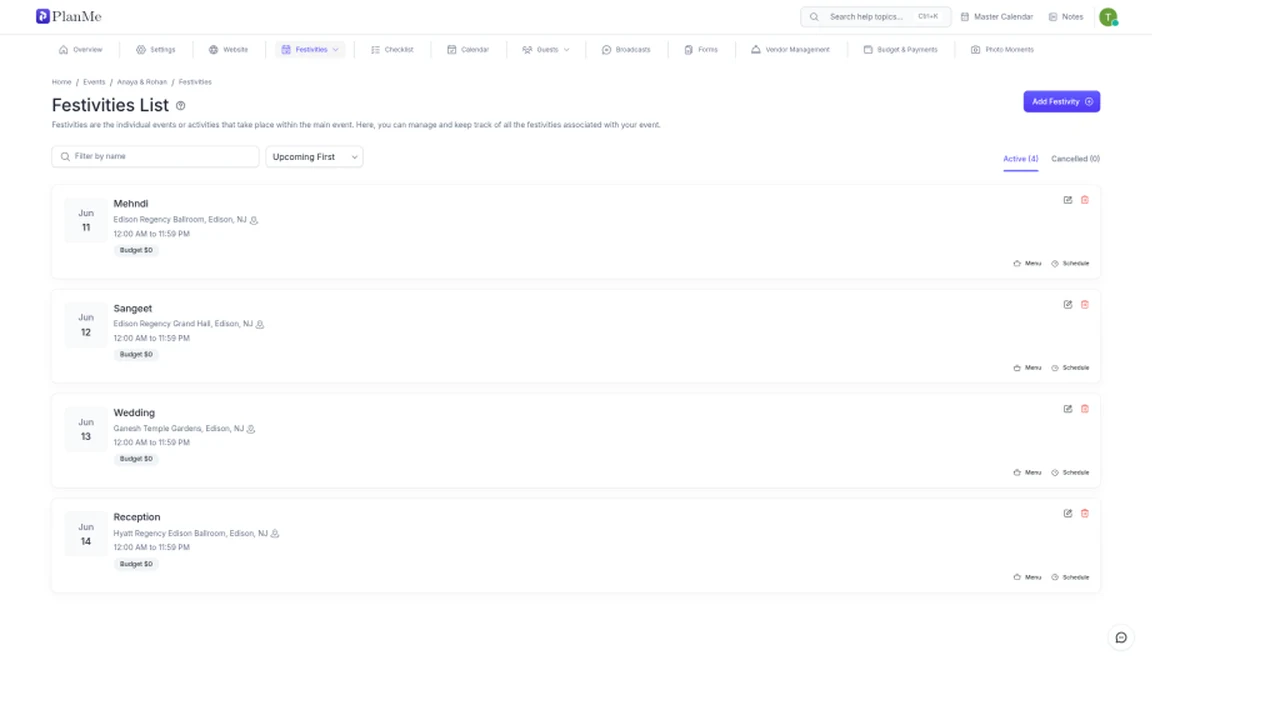
Festivities, then Schedule, is where the run of show for each function goes. Mehendi, sangeet, the ceremony, and the reception are separate festivities, not one note. The list is where you add them, each with its own date, place, and end time. Schedule on that festivity is the hour-by-hour list.
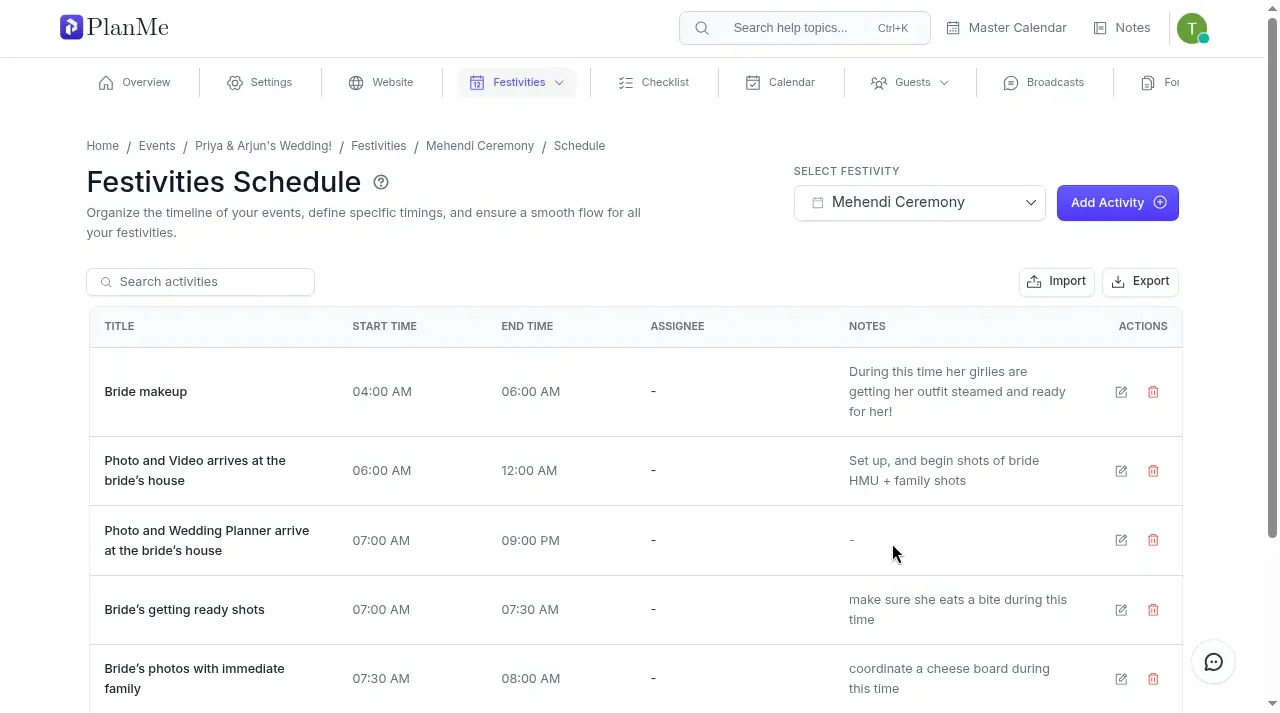
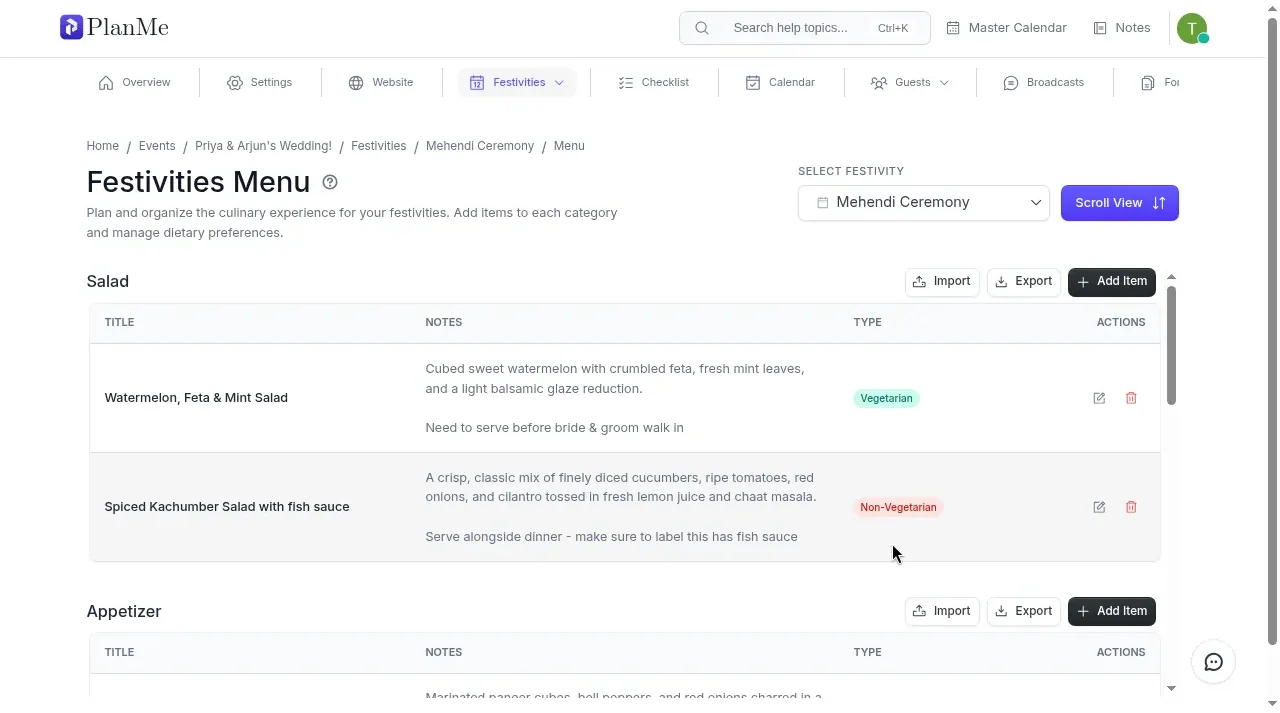
Festivities, then Menu, is where that function's food is listed, including the Jain, vegetarian, and non-vegetarian split you already counted. You pick the festivity first, so Sunday dinner is not the mehendi snack list.
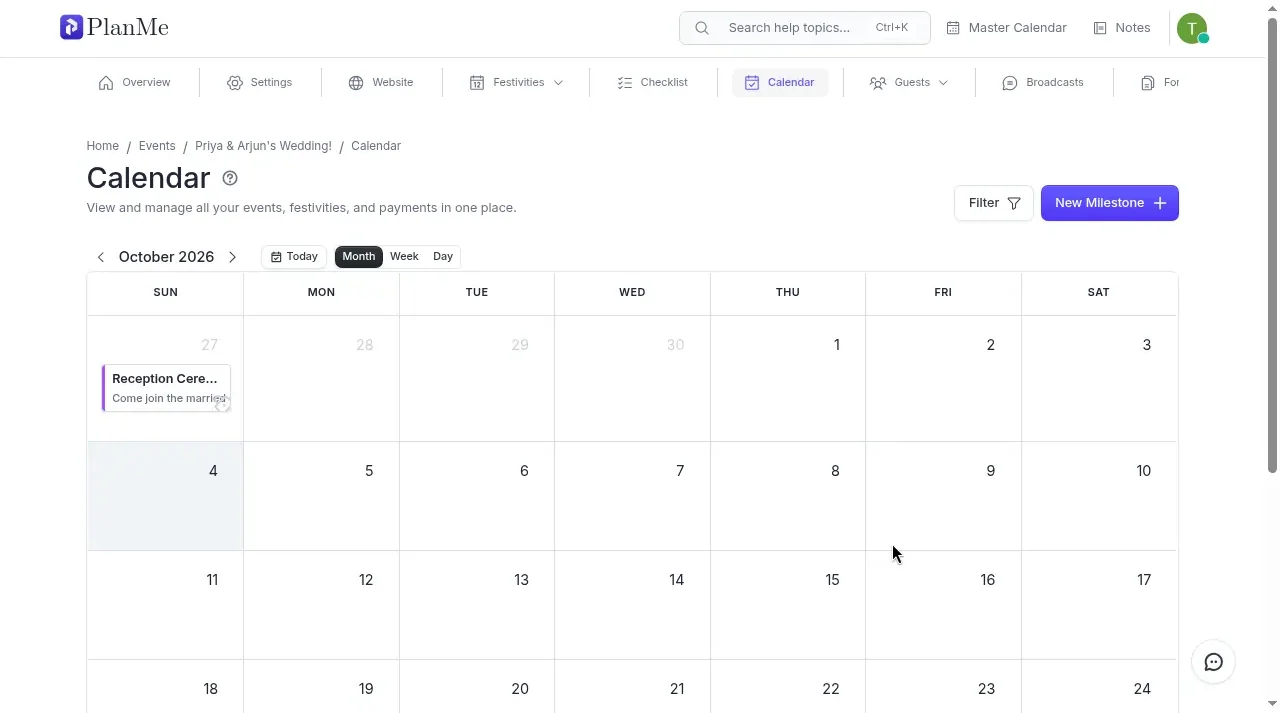
The calendar is where those festivities, and the payments due around them, sit on a date. Month, week, and day are the same events. A milestone is how you mark a hard date, such as the final guest count.
The jobs around those hours still sit on the checklist, with a due date and the person responsible. Baraat leaves and pandit on site are not the same line.
Guests are the guest list. A reception-only guest and a mehendi guest are not the same row.
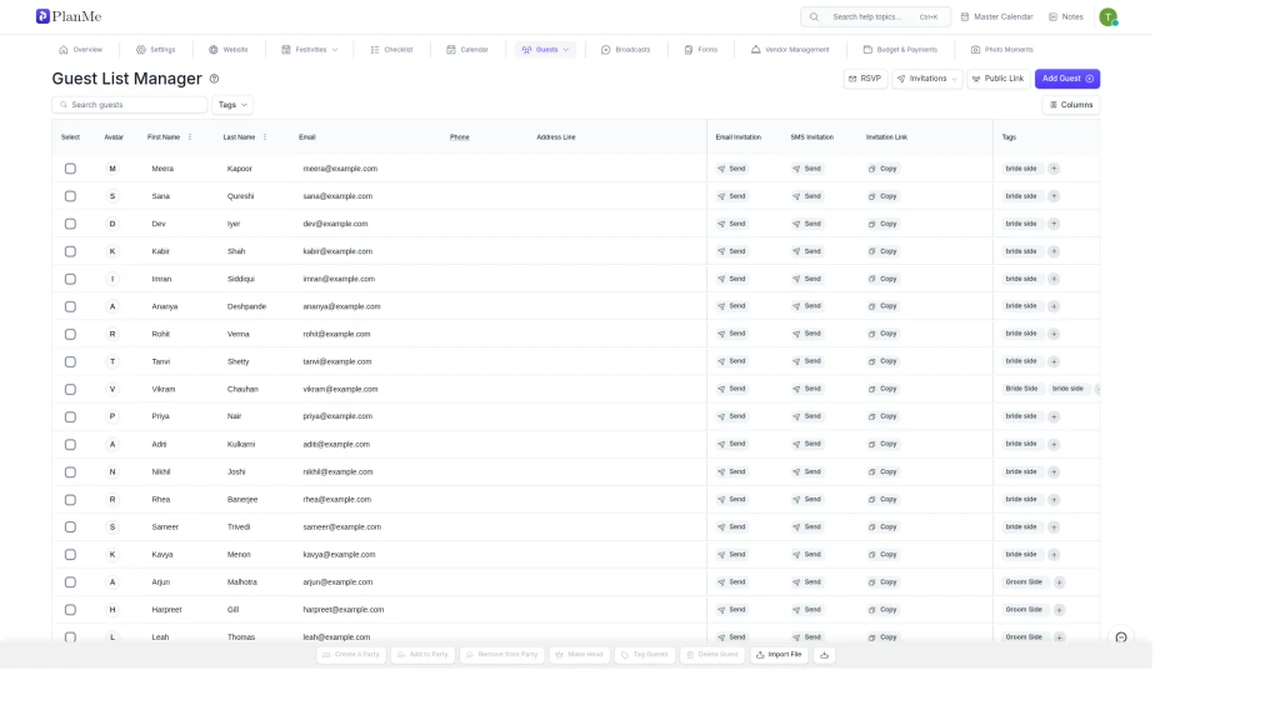
Hotel management is the block and the room list for people flying in.

Invites and RSVP are a separate list from the guest list, one invitation per festivity, so a reception-only yes is not a mehendi yes.
The website is the page guests open. Forms are where you ask for a dietary note, a flight, or a phone number, then send that form to the list.
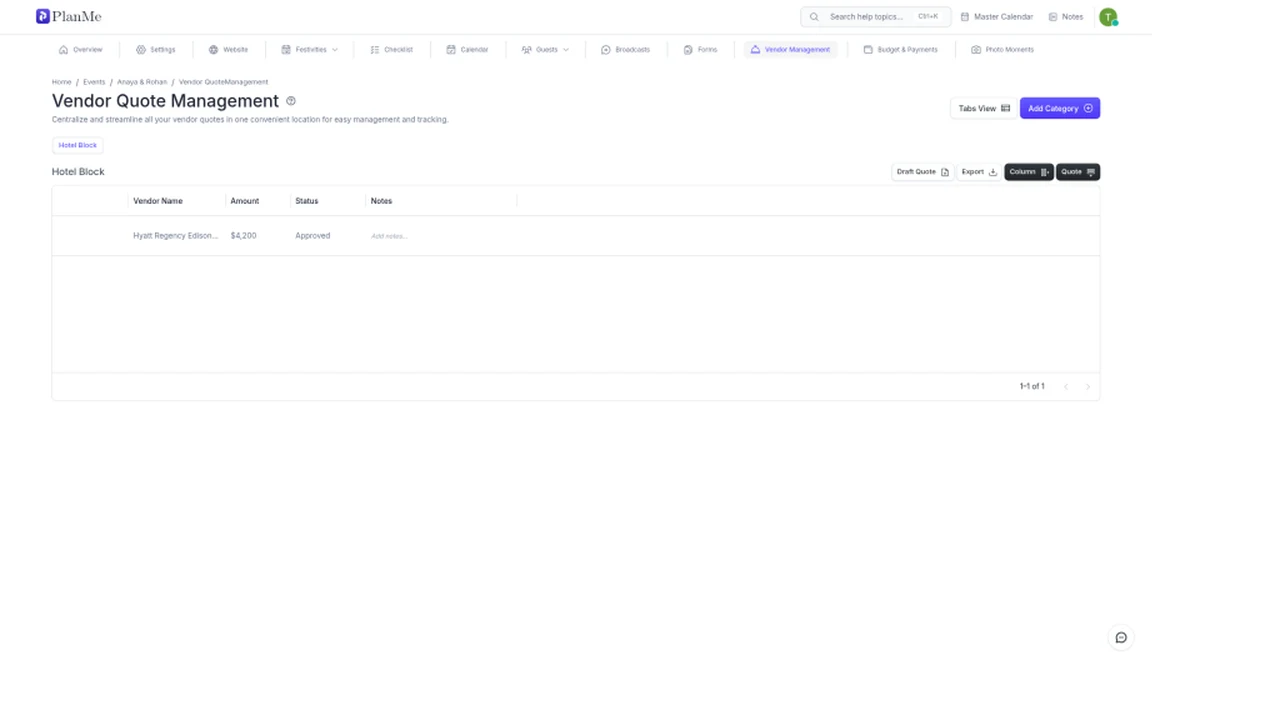
Vendor quotes are where a DJ overtime line lives, if you are even considering one, next to the other categories.
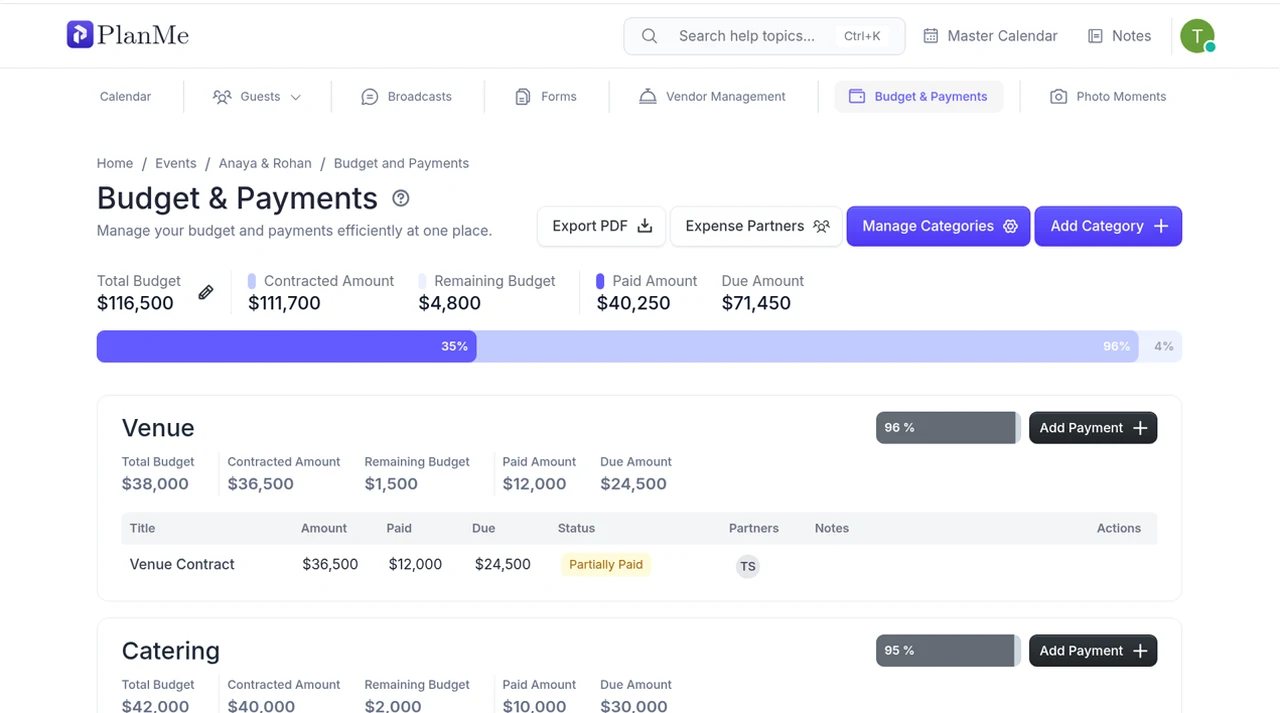
Budget and payments is where that overtime, the extra mehendi artist, and the hall deposit become money, against what is contracted and what is still due. Setting a budget for each function before the quotes come in is covered in how to plan a wedding budget.
None of that replaces the hours on this page. It is where the hours go so the caterer, the cousin with the mic, and both families are looking at the same clock. This page is the wedding day itself; the multi-day weekend order (mehndi, sangeet, ceremony, reception) is on Indian wedding events in order. The month-by-month decisions, from the first budget to the week of the wedding, stay on the wedding planning checklist. PlanMe is free during beta. Read who built it, see pricing, or get in touch.
Common questions
How long is a South Asian wedding ceremony in the United States?
Most halls book 60 to 90 minutes for the ceremony itself. The rites are the ones you and the pandit agree to keep. Getting ready, the baraat, portraits, dinner, and the last song sit outside that block and need their own times.
What time should the baraat start?
Work backward from the door time, then subtract the drive. If guests are seated at 4:00 pm, the baraat usually leaves the hotel 30 to 45 minutes earlier. Confirm where the cars can stop. A street procession is not allowed in most US cities.
Does mehendi or sangeet need its own wedding day timeline?
Yes. Each function has its own door time, its own guest count, and often its own hard stop. A timeline written only for the ceremony does not tell the mehendi artists or the sangeet DJ when to start.
What if the venue turns the music off at 11 pm?
Put the last song 15 to 20 minutes before that time, and start dinner early enough that people are not still eating when the lights come up. Overtime, if the hall offers it, is a fee in the contract. Do not plan on it the week of the wedding.
What if the ceremony is at a temple in the morning and the reception is at night?
Write two timelines. The temple has its own start, its own rules on photography, and usually no dinner. The reception hall still has its own door time and its own music cutoff. The gap between them is when portraits and a family lunch actually happen.