Most wedding budget guides are written for one event: a ceremony and a reception on the same night, for the same guest list. Their percentages are useful, but they assume one venue, one catering bill, and one headcount. A South Asian, Indian, or Desi wedding is usually several events over a long weekend (My Brown Wedding counts three to five separate festivities), often paid for by two families and the couple, with a different guest list at each one.
That changes how the budget should be built. If you split one big number by vendor, the sangeet decor and the reception decor end up on the same line, nobody can say what the mehndi actually cost, and the family paying for the reception cannot see their share. If you split it by event first, every question has an answer: what this festivity costs, who is paying, how many people are coming, and what is still owed.
This page walks through the order to do it in, with worked examples. The dollar amounts in the examples are made up so the math is easy to follow. They are not what a wedding costs in your city. Where a percentage or range comes from a published guide, it is linked.
Where do you start if you don't know what anything costs yet?
This is the most common place people get stuck. A recent r/weddingplanning thread starts with exactly that problem: everyone says to set a budget first, but the couple did not know what anything cost yet, even for a ballpark. The answers in the thread are the right ones. Start with a rough guest count, because it drives the budget more than anything else. Decide how many events you want the weekend to have. Then work out what you can actually contribute and who else is contributing, and when that money arrives.
For a multi-event wedding, do those three things in a slightly different order than a single-event guide suggests.
- List the events you are actually hosting. Roka or engagement, welcome dinner, mehndi, haldi or pithi, sangeet or garba, the ceremony, the reception, a post-wedding brunch. Not every family does all of them. A festivity you are not hosting should not be on the budget at all. For the usual weekend order and what to combine, see Indian wedding events in order.
- Put a rough guest count next to each one. Not one number for the weekend. Mehndi might be 80 people and the reception 350.
- Add up the money. The couple's savings, what each set of parents is putting in, and any gifts set aside for the wedding. My Brown Wedding's budgeting guide lists these funding sources first and says to set the number in the first two to four weeks after the engagement, before you fall in love with a ballroom.
- Ask two or three venues and caterers for real quotes for your biggest event, with taxes and fees included. That one quote calibrates everything else faster than any national average.
Once you have the events, the counts, and the total, you can build the budget. The month-by-month order of bookings, from the first venue tour to the final week, is on the wedding planning checklist.
How much should you hold back before you split the budget?
Take the buffer off the top first. The guides that rank for this question agree on that point, even where their numbers differ:
| Source | What it suggests |
|---|---|
| My Brown Wedding | 10 to 15% of the total, set aside before you allocate anything else |
| Plan A Wedding | 10 to 15% contingency taken from your hard ceiling; the rest is your working budget |
| Aisle (sample spreadsheet) | 5 to 8%, left unallocated on purpose |
| WeddingWire (planner advice) | Plan with 75 to 85% of your do-not-exceed number as the working budget |
Sources: My Brown Wedding, Plan A Wedding, Aisle, and WeddingWire.
With more than one event, lean toward the higher end. Every festivity is another place for the guest count to creep, another set of vendor meals, another chance for a DJ to run into overtime. A buffer that would cover one reception is thin across a whole weekend.
Here is the worked example used on the rest of this page. The total is invented to keep the math clean.
| Line | Amount (example) |
|---|---|
| Total you can fund (couple plus both families) | $200,000 |
| Buffer held back first (10%) | $20,000 |
| Working budget to split across events | $180,000 |
The buffer is not a hidden seventh event. It is the line that absorbs the extra hotel rooms, the second alteration, and the 30 guests who said yes after the cards went out. If you never touch it, it is money back.
How do you split a wedding budget by event?
Split by festivity first, then by vendor inside each festivity. My Brown Wedding recommends exactly this, and gives a starting allocation across ceremonies:
| Event | Share of total budget |
|---|---|
| Reception | 35 to 40% |
| Wedding ceremony | 20 to 25% |
| Sangeet | 15 to 20% |
| Mehndi and haldi | 8 to 12% |
| Miscellaneous (transportation, favors, tips, priest fees) | 5 to 8% |
That is a starting point, not a rule. If the sangeet is the night your family will talk about for years, move money toward it. If you are combining mehndi and sangeet into one evening, they share one line.
In practice, some costs do not belong to any single event. Outfits for four festivities, jewelry, invitations, a photo and video package that covers the whole weekend, a planner, and getting-ready suites are shared. Give them their own bucket instead of forcing them into the ceremony line. Here is the example budget split that way:
| Event | Share (example) | Budget (example) | What usually sits here |
|---|---|---|---|
| Roka, engagement, or welcome dinner | 5% | $9,000 | Restaurant or home catering, a small decor setup, gifts exchanged between families |
| Mehndi and haldi | 10% | $18,000 | Mehndi artists, a hotel suite or small room, snacks or lunch, haldi supplies, a dholki or small sound setup |
| Sangeet | 18% | $32,400 | Ballroom, dinner, DJ and sound, stage and lighting, choreographer if you have one |
| Ceremony | 20% | $36,000 | Mandap, ceremony decor, priest, baraat (dhol, horse or car), lunch or dinner for ceremony guests |
| Reception | 35% | $63,000 | Hall rental, the largest catering bill, decor, DJ, cake or dessert, bar if you are serving alcohol |
| Shared across the weekend | 12% | $21,600 | Outfits and alterations, jewelry, invitations and postage, photo and video package, planner, transport |
| Total | 100% | $180,000 |
If your photographer prices each event separately, move that cost into each event's line instead of the shared bucket. The rule is simple: if a vendor's contract says which event it is for, the cost goes on that event.
What does a standard wedding budget breakdown by percentage miss?
The breakdowns that rank for this keyword are built on single-event weddings. WeddingWire's breakdown, based on a survey of 10,474 recently married US couples, puts venue and event rentals at 29%, catering, dessert, and alcohol at 24%, photography and video at 10%, and florals, lighting, and decor at 9%. Plan A Wedding suggests 45 to 50% for venue, food, and drink combined.
Those numbers are not wrong. They just answer a different question. They describe one evening with one guest list. Spread across a weekend, they hide the fact that you are renting three or four rooms, feeding three or four different crowds, and decorating each one. A wedding that looks reasonable as "venue 29%" can still be short because the sangeet ballroom was never in the plan.
Use those breakdowns inside the big events, as a checklist of categories for the reception or the sangeet. For the smaller events, the room and the food are usually most of the line, and a mehndi does not need a 10% photo allowance of its own if one package covers the weekend.
One more check is worth doing. In the r/weddingplanning thread mentioned above, one commenter suggests that venue, food, and alcohol together should be around half of the total or less. Add up the room and food for every event in your plan and compare it to your working budget. If those alone are already most of it, the guest counts are the place to look, not the favors.
How do guest counts for each event change the catering bill?
Catering is priced per person, so it is the line that moves most when a guest list grows. WeddingWire quotes a planner on why the guest count has to come first: it changes food, drink, rentals, servers, centerpieces, and sometimes the size of the venue. With several events, the mistake is using one count for all of them.
Here is a worked example. The per-person prices are invented for the math, not market rates. Get your own from your caterer. The last column adds 30% for tax, service charges, and gratuity. That is an assumption based on two sources: a planner quoted by WeddingWire says these can add 30% or more to a catering or venue quote, and Plan A Wedding lists service charges of 18 to 22% at most catering venues, separate from gratuity, plus sales tax of typically 6 to 10% depending on the state.
| Event | Guests (example) | Per person (example) | Food subtotal | With 30% for tax, service, and tip |
|---|---|---|---|---|
| Welcome dinner | 60 | $50 | $3,000 | $3,900 |
| Mehndi | 80 | $40 | $3,200 | $4,160 |
| Sangeet | 220 | $55 | $12,100 | $15,730 |
| Ceremony lunch | 250 | $45 | $11,250 | $14,625 |
| Reception | 350 | $70 | $24,500 | $31,850 |
| Total | 960 plates | $54,050 | $70,265 |
Now run the same menus with the reception count, 350, at every event. The food subtotal becomes $91,000, and $118,300 with the same 30%. That is about $48,000 of budget that would be set aside for guests who were never invited to the mehndi. The opposite mistake is just as common: budgeting the reception from the ceremony count and finding 100 more plates in the last month. Those per-event counts come from per-event RSVPs; here is how to collect an RSVP per guest and per festivity. For picking the app itself, see best South Asian wedding planning tools (2026). Comparing PlanMe with the tool most US couples start on? PlanMe vs Zola for multi-event Desi weddings.
It also shows what one more branch of the family costs. Twenty extra guests at the sangeet, the ceremony, and the reception in this example is 20 × ($55 + $45 + $70) = $3,400 in food, or $4,420 with the 30%, before chairs, favors, and invitations. That is the number to have in front of you when someone asks if a few more people "really matter."
Keep vegetarian, Jain, and non-vegetarian counts separate per event too, if your caterer prices them differently. The final count usually goes to the caterer a couple of weeks out. The hours around each meal are on the wedding day timeline.
How do two families split the wedding budget?
There is no single correct split, and it varies by community and by family. My Brown Wedding describes the common approaches: splitting by ceremony (one family hosts the sangeet, the other hosts the wedding ceremony), splitting by percentage of the total, or one family taking the reception while the couple covers attire and invitations. The one mistake every guide agrees on is leaving it undiscussed until a deposit is due.
Here is what each approach looks like on the example budget:
| Approach | Family 1 | Family 2 | Couple |
|---|---|---|---|
| By event | Mehndi and haldi, sangeet, ceremony: $86,400 | Welcome dinner, reception: $72,000 | Shared weekend costs: $21,600 |
| By percentage (40 / 40 / 20) | 40% of every bill: $72,000 | 40% of every bill: $72,000 | 20% of every bill: $36,000 |
Splitting by event is easier to run. Each family pays its own vendors, and each family can make choices about its own event without a group discussion. The trade-off is that the events are not the same size, so the totals will not match unless you move a shared cost to balance them. Splitting by percentage feels even, but every single invoice has to be divided, which is a lot of transfers and a lot of room for confusion.
Whichever you choose, settle these before the first deposit goes out:
- Who pays the deposit when a vendor covers more than one event, such as a decorator for the whole weekend.
- Who owns the buffer, and who can say yes to spending it.
- What happens when one family adds guests to an event the other family is paying for. Use the per-person cost from your catering quote, so it is a number and not a feeling.
- Who has final say on each category. My Brown Wedding suggests one owner per budget category, even when the money is shared. One person signs off on catering, one on decor, one on attire.
Then write it down, even informally, and record the payer on every payment. Six months later, "I thought your side was covering the DJ" is a much easier conversation when the answer is already in the tracker.
When are deposits and balances due?
The total is only half of the budget. The other half is when the money actually leaves. According to My Brown Wedding, Indian wedding vendors typically ask for a 25 to 50% deposit at booking, with the balance due 30 to 60 days before the event, and missing a final payment can mean losing the date. Your contracts are the real answer, so read each one for the schedule.
Here is what that looks like with a handful of vendors from the example. The contract amounts and percentages are illustrations inside that published range.
| Vendor (example) | Contract | Deposit at signing | Balance | Balance due |
|---|---|---|---|---|
| Reception hall | $30,000 | 30%: $9,000 | $21,000 | 60 days before |
| Caterer, all events | $70,000 | 25%: $17,500 | $52,500 | 30 days before, after final counts |
| Decorator, all events | $30,000 | 50%: $15,000 | $15,000 | 30 days before |
| Photo and video, three days | $18,000 | 30%: $5,400 | $12,600 | 30 days before |
| DJ, sangeet and reception | $6,000 | 50%: $3,000 | $3,000 | 30 days before |
| Mehndi artists | $2,000 | 25%: $500 | $1,500 | 45 days before |
| Total | $156,000 | $50,400 | $105,600 |
Two things stand out. If you book all six in the same month, around $50,000 leaves at once. And in the last two months, more than $100,000 in balances is due in a short window, right when families are also buying outfits and flights. My Brown Wedding calls this out as a common mistake: a vendor who looks affordable can still create a cash-flow problem if three deposits land in the same month.
So the tracker needs a due date on every payment, not just an amount, and both families should see the same list of what is coming up. If a caterer bills per plate, record that balance as an estimate until the final count is in.
What do people forget to put in the budget?
Most overruns are not the big contracts. They are the lines that were never in the sheet. Several are worse at a multi-event wedding because they repeat at every event.
| Cost | Why it gets missed | Source |
|---|---|---|
| Sales tax | Often not in the quoted price; typically 6 to 10% depending on the state (US) | Plan A Wedding |
| Service charges or admin fees | 18 to 22% at most catering venues, separate from gratuity (US) | Plan A Wedding |
| Gratuities | Caterers, bartenders, makeup artists, DJ, drivers, at every event | Plan A Wedding |
| Vendor meals | Photographer, DJ, and planner need to eat at each event; Plan A Wedding puts it at $30 to $75 per vendor meal | Plan A Wedding |
| Overtime | A sangeet that runs late; Plan A Wedding cites $500 to $1,500 per extra hour | Plan A Wedding |
| Delivery, setup, and cake-cutting fees | Not always in the quote; many caterers charge a per-slice fee for a cake brought in from outside. Ask venues about outside caterers too | Aisle |
| Alterations | Several outfits, often altered more than once | My Brown Wedding, Aisle |
| Extra hotel rooms for family | Out-of-town relatives who were not in the first room count | My Brown Wedding |
| Vendor travel fees | Specialist Desi vendors often travel from another city | My Brown Wedding |
| Favors and welcome bags | They scale with the guest count, which keeps growing | My Brown Wedding |
| Priest fees, transportation, and tips | Easy to leave as cash on the day | My Brown Wedding |
| Postage | Depending on size and shape, an invitation can cost an extra dollar or so in stamps, for every card you mail | WeddingWire |
| Wedding insurance | Many venues ask for proof of liability coverage before load-in | Aisle |
Sources: Plan A Wedding, Aisle, My Brown Wedding, and WeddingWire.
Add a few lines most generic guides do not have at all: gifts exchanged between families at the roka or milni, shagun envelopes, return gifts for guests, the dhol and the baraat car or horse, and the cost of separate Jain or kids' plates if your caterer prices them on their own line. None of these is large alone. Together, across a weekend, they are what eats a buffer.
Does the answer change in Canada or Europe?
The method does not change. The tax and fee lines do. The sales tax and service charge figures above are from a US guide, and in the United States sales tax depends on the state, so a quote from New Jersey and one from Texas are not directly comparable until you add it.
In Canada, check whether each quote shows GST or HST, and provincial sales tax where your province charges it, and whether gratuity or a service charge is already in the per-person price. In the UK and the rest of Europe, ask whether a quote includes VAT before comparing two suppliers. In every country, ask what the quote does not include. That question is in every guide on this page for a reason.
There is also a cost that is specific to families spread across countries. If parents in Canada, the UK, or India are paying vendors in another currency, exchange rates and transfer fees become a budget line. Plan A Wedding gives the example of a 3% bank fee on $30,000 in vendor payments, which is $900. Decide which account each payment comes from, and record the amount in the vendor's currency so the totals still add up.
How do you make a wedding budget spreadsheet for several events?
Use one row per payment, not one row per vendor. A decorator with a deposit and a balance is two rows. That is what lets the sheet show what is due next month. Both Aisle and Plan A Wedding recommend separate columns for the planned amount, the contracted price, what is paid, and what remains, with due dates. For a multi-event wedding, add two more: the event and the payer.
| Column | What goes in it |
|---|---|
| Event | Roka, Mehndi, Sangeet, Ceremony, Reception, or Shared |
| Category | Venue, Catering, Decor, DJ, Photo, Attire, and so on |
| Vendor | The business name, as it appears on the contract |
| Payment | What this row is: deposit, second installment, balance |
| Budgeted | Your allowance for this line before quotes |
| Contracted | The signed amount, with tax and fees |
| Paid | What has actually left the account |
| Due | Contracted minus paid |
| Due date | From the contract, not from memory |
| Paid by | Family 1, Family 2, the couple, or a split |
| Notes | Penalties, what is included, who to call |
With that layout, the totals you need are simple filters. In Google Sheets or Excel, if the Event column is A and the Paid column is G, then =SUMIFS(G:G, A:A, "Sangeet") gives what has been paid toward the sangeet. Swap column A for the Paid by column to see what each family has paid so far. A pivot table on Event and Paid by gives both at once.
Update the sheet every time you sign a contract or send a payment, not at the end. My Brown Wedding suggests a running "committed versus actual" comparison, because the gap between what you planned for a category and what you have signed is where most couples get surprised. Plan A Wedding suggests reviewing it weekly and using a separate account or card for wedding spending, so you can check the sheet against real statements.
How should a planner present a multi-event budget to a family?
If you are a planner, the budget is also how you keep two families aligned. A few habits make it easier.
- Show it by event first. A family can say yes to a sangeet number. Nobody can say yes to "decor, 9%" across four events.
- Ask, before you send a single quote, who is paying for which event and who signs off on each category. A WeddingWire contributor makes the point that a planner cannot help fully if the couple is not clear about the budget and who is contributing.
- Send each family the part they are paying for, with what is contracted, what is paid, and what is due next. Then send the full picture to the couple.
- Compare quotes in one table with the same questions for each vendor: what is included, whether there is a charge for outside food, overtime rates, and the payment schedule.
Do you need a wedding budget planner app, or is a spreadsheet enough?
A spreadsheet is enough if one person owns it and keeps it current. It gets harder when both families are paying vendors, someone pays a deposit from their phone, and the sheet lives in one person's Drive. That is where a tracker built around payments helps.
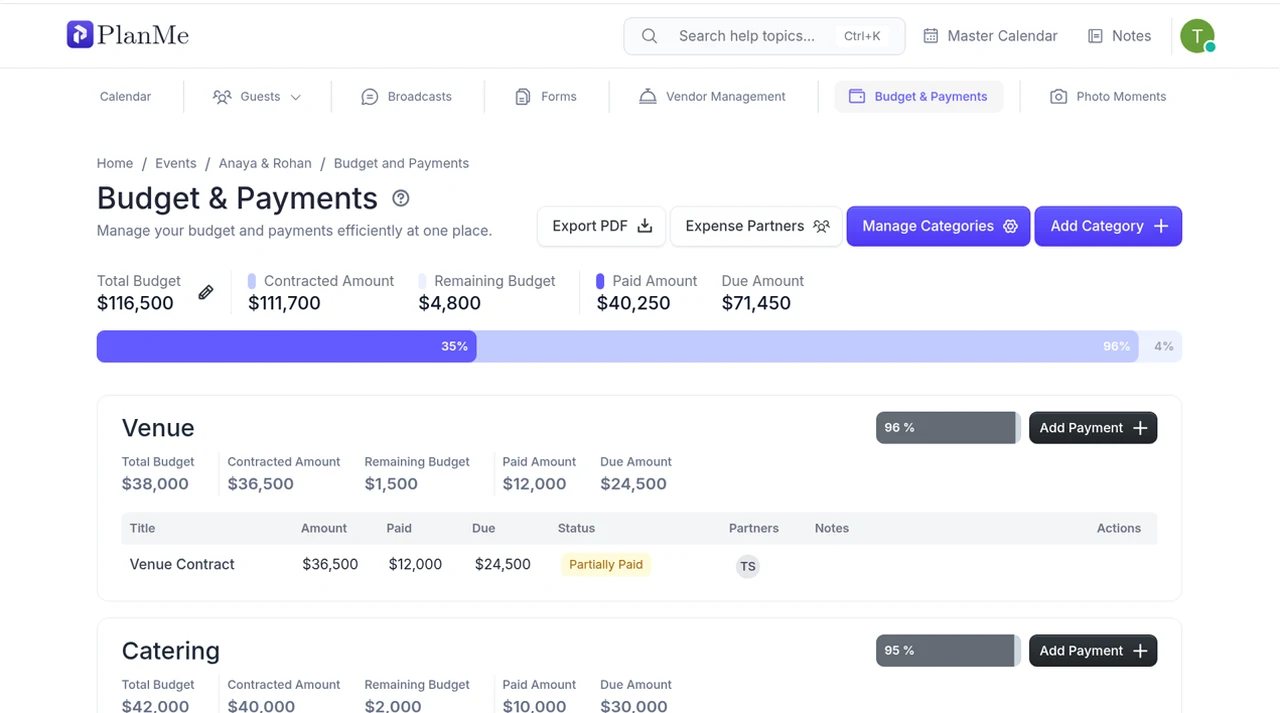
PlanMe is one option. In an event, Budget and Payments shows the total budget, the contracted amount, the remaining budget, what is paid, and what is due, with a progress bar. The budget is organized into categories you name and size yourself, so a host can make a category per festivity, such as Sangeet or Reception, or per vendor type. It does not split one payment across events for you, so a weekend-wide decorator still goes in one category. Each category shows its own budget, contracted, remaining, paid, and due amounts, and flags when it is over budget.
Each payment has a title, a contracted amount, a due date, and notes. It shows whether it is Paid or Partially Paid, and flags what is still due. Expense Partners are the people paying, such as each family and the couple. On every payment you can record how much each partner paid, and the partner list shows each one's total paid. Both the budget and the partner totals export as a PDF, which is the easy way to send a family their share. Payments with a due date also sit on the event calendar next to the festivities.
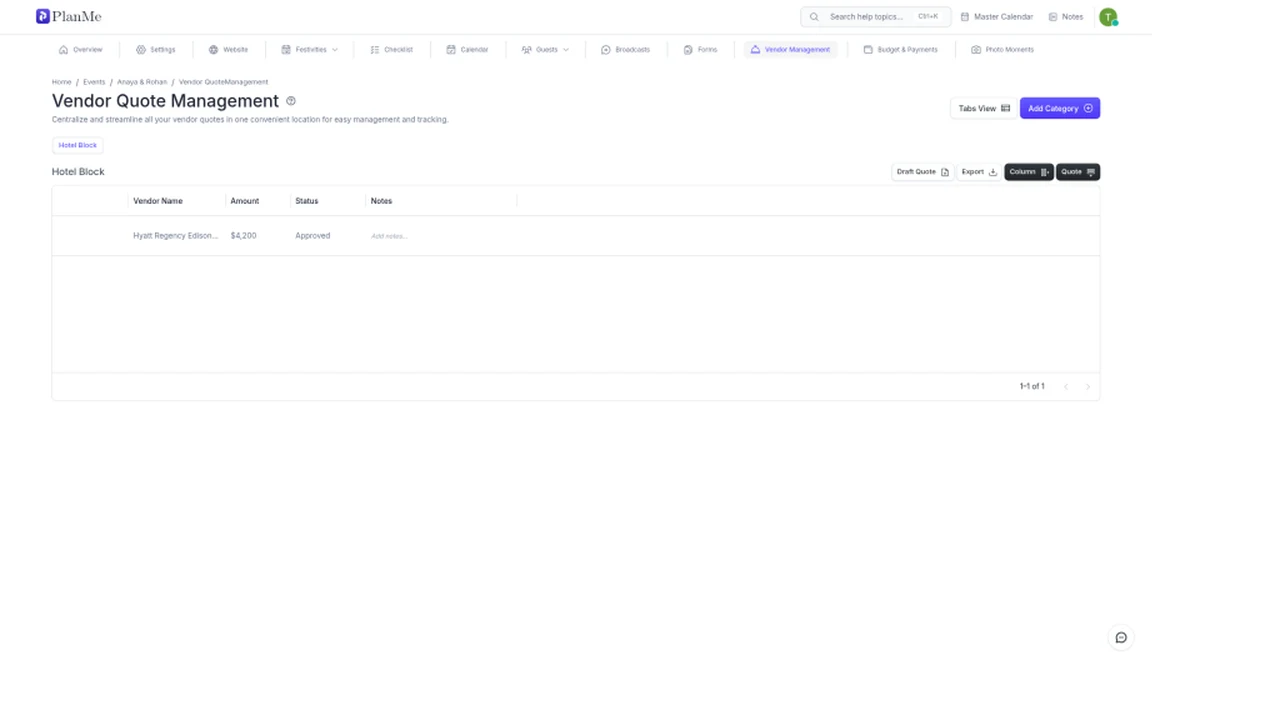
Before anything is signed, Vendor Quote Management keeps quotes side by side, with a tab per vendor type, each vendor's amount, a status such as Pending or Negotiating, notes, and your own question columns so every venue answers the same questions.
The same event also holds the festivities, each festivity's schedule and menu, guests, hotels, forms, the checklist, and email or SMS broadcasts, so the guest count you budgeted for each event is the one you are actually inviting, with a separate RSVP count for every festivity. PlanMe is live in beta and free. See pricing, or start with the wedding planning checklist, the wedding day timeline, and Indian wedding events in order for the weekend structure.
Common questions
What is the best way to plan a wedding budget when you have several events?
Set one total you can actually fund, hold back a buffer, then give each festivity its own budget: roka or engagement, mehndi, haldi, sangeet, ceremony, and reception. Split each festivity by vendor after that. Give every event its own guest count, and write down which family is paying for each line.
What percentage of an Indian wedding budget goes to each event?
There is no fixed rule. My Brown Wedding suggests starting near 35 to 40 percent for the reception, 20 to 25 percent for the ceremony, 15 to 20 percent for the sangeet, 8 to 12 percent for mehndi and haldi, and 5 to 8 percent for miscellaneous costs such as transportation, tips, and priest fees. Move money toward the event your family cares about most.
How much contingency should a wedding budget have?
My Brown Wedding and Plan A Wedding both suggest setting aside 10 to 15 percent before you allocate anything else. Aisle's sample spreadsheet uses 5 to 8 percent. With several events, aim for the higher end, because guest counts can grow at every event, not just one.
How do two families split wedding costs?
The common approaches are splitting by event (one family hosts the sangeet, the other the reception), splitting by percentage of the total, or one family taking the reception while the couple covers attire and invitations. Agree on it before the first deposit, put it in writing, and record who paid on every payment.
When are wedding vendor deposits and balances due?
It depends on the contract. My Brown Wedding says Indian wedding vendors typically ask for a 25 to 50 percent deposit at booking, with the balance due 30 to 60 days before the event. With several events and vendors, many balances land in the same two months, so plan the cash for that.
Is a spreadsheet good enough for a wedding budget?
Yes, if it has one row per payment and columns for the event, the vendor, the contracted amount, what is paid, what is due, the due date, and who is paying. The hard part is keeping it current after every contract and every payment, especially when both families are paying vendors.