Guides that rank for "Indian wedding events in order" often list rituals in a North Indian sequence and stop there. That is useful for meaning, but it is not the planning job. The planning job is deciding which events you are actually hosting, which day each one lands on, who is invited to which night, and what the venue will and will not allow (open flame for a mandap, a baraat route, a hard stop at 11 p.m.).
Maharani Weddings' planning guide notes that Indian weddings typically span two to five days with three to seven events. Cordially Wed, Invyt, Weddingkart, and The Nyota walk through similar lists. What those pages still miss for hosts in the United States and Canada is the weekend math: different headcounts per event, hotel blocks for multi-night guests, and the permits and hard stops that turn a beautiful order of rituals into a workable run of show.
This page is that weekend hub. For the month-by-month booking order, use the wedding planning checklist. For the hour-by-hour wedding day itself, use the wedding day timeline. For money split by function, use how to plan a wedding budget.
The short version: common weekend shapes
There is no single correct order. Region, religion, and how far guests are flying all change the shape. For a Hindu-leaning North Indian–style weekend in North America, these three patterns show up again and again in planning guides and in r/DesiWeddings keep-skip-combine threads:
| Shape | Typical days | What usually happens | Who it fits |
|---|---|---|---|
| 2-day | Sat–Sun or Fri–Sat | Combined mehndi + sangeet one evening; ceremony + reception the next day (or same day if the ceremony is short) | Tight budgets, local guests, fusion weekends |
| 3-day | Fri–Sun | Friday mehndi (or mehndi + sangeet); Saturday sangeet or ceremony; Sunday reception — or Friday mehndi, Saturday sangeet, Sunday ceremony + reception | Most common diaspora weekend when out-of-town guests can take Friday off |
| 4–5 day | Thu–Mon | Separate mehndi, haldi, sangeet, ceremony, reception; sometimes a welcome dinner on arrival day | Large guest travel, families who want every event its own night |
Maharani Weddings frames the full arc as two to five days and three to seven events. Zivaara Studio's US timeline describes a common diaspora compression: Day 1 mehndi (or mehndi + haldi), Day 2 sangeet, Day 3 ceremony and reception. WedPlan's multi-day schedule notes that a three-day format often combines mehndi and sangeet, and that the wedding-day risk is stacking morning haldi too close to an evening ceremony without enough glam time in between.
Sikh weekends often center on a morning Anand Karaj at a gurdwara, then a reception; Pakistani Muslim weekends often center on mehndi, nikah, and walima. Those are not the same sequence as the table above. We will cover them on dedicated pages later so this hub does not try to be every tradition at once. Mention them to your families early if one side follows a different faith, so nobody assumes the Hindu-leaning Friday–Sunday map applies.
Typical event order, one by one
Below is the backbone most hosts mean when they search "Indian wedding events in order." Names and inclusions shift by community — Gujarati families may add garba or raas; Punjabi families may include choora or jaggo; South Indian weekends emphasize different pre-wedding rites. Treat this as the shared spine, then add what your family actually does.
| Order | Event | When it usually falls | Guest list vs others | Logistics note |
|---|---|---|---|---|
| 0 | Roka / engagement / sagai | Months before the weekend | Small to medium | Often its own night; not part of the wedding weekend hotel block |
| 1 | Mehndi (mehendi) | 1–3 days before the ceremony | Smaller — close family and friends | Long henna time for the bride; easy at home or a suite |
| 2 | Sangeet (or garba) | 1–2 evenings before the ceremony | Large — both families and friends | Performances, DJ, late night; do not stack before a 9 a.m. ceremony |
| 3 | Haldi (pithi / vatna) | Day before or morning of ceremony | Smallest — immediate family, close friends | Messy turmeric; yellow clothes; often at home |
| 4 | Baraat + milni | Wedding day, before the ceremony | Groom's side, then both families | Needs a route, sound rules, and venue permission |
| 5 | Ceremony (pheras under the mandap) | Wedding day | Full invite list for that day | Fire/havan rules; 1–3 hours with a pandit |
| 6 | Vidaai | After the ceremony | Ceremony guests who stay | Emotional send-off; build photo time into the day timeline |
| 7 | Reception | Same evening or next day | Often the largest list | Entrance, dinner, speeches, dancing; venue hard stop matters |
Sources for the spine and guest-size pattern: Cordially Wed's order guide, Invyt's checklist, The Nyota's ritual order, and Joy's multi-event guest-list guide (which puts typical ranges at roughly 30–60 for haldi, 50–100 for mehndi, 150–250 for sangeet, and 300–500+ for ceremony and reception — ranges, not rules).
Roka, engagement, or sagai
This is the families' formal yes, often months before the wedding weekend. Guest counts are smaller than the reception. It usually does not share the wedding hotel block. Put it on the calendar so deposits and travel for the main weekend are not confused with it.
Mehndi
Henna for the bride (and often guests), music, and snacks. Traditionally intimate and women-centered; many modern parties invite everyone. Plan several hours for the bride's design to dry. A home living room or a hotel suite is enough for a small list; a ballroom is overkill unless you have already combined it with sangeet.
Sangeet
The music-and-dance night. Family performances, DJ, dinner, and the first real mix of both sides. It is often the most expensive pre-wedding night after the reception. Start choreography weeks ahead if cousins are performing. Do not schedule a late sangeet the night before an early-morning Anand Karaj or a tight muhurat.
Haldi
Turmeric paste applied for blessing and glow — joyful and messy. Usually the smallest guest list. Hold it at home or in a space you do not mind staining. If it shares a day with the ceremony, leave three to four hours (WedPlan's guidance) between the end of haldi and the start of glam so the couple is not still yellow when the photographer arrives.
Baraat and milni
The groom's procession (horse, car, or on foot) with dhol and dancing, then the formal greeting of the two families. This is where US and Canadian venues get specific: noise ordinances, parking lot routes, and whether a horse is allowed at all. Ask in writing when you tour. Build the milni into the schedule so the ceremony does not start while half the guests are still outside.
Ceremony
Under the mandap with a pandit for a Hindu ceremony — ganesh puja, jaimala, kanyadaan, pheras around the sacred fire, sindoor and mangalsutra, in an order your priest confirms. Length is often one to three hours. Open flame for the havan is a venue question, not a decoration question. The minute-by-minute version of this day lives on the wedding day timeline, not on this weekend page.
Vidaai and reception
Vidaai is the farewell after the ceremony. The reception is usually the largest celebration: entrance, dinner, speeches, dancing. Some families hold it the same evening; others the next day so ceremony guests can rest and a wider community list can join. Same-day ceremony-plus-reception only works when the ceremony is not three hours long and the venue can flip the room — or you have two spaces.
Worked example: a New Jersey four-event weekend
Meet Anika and Rohan (fictional names). They are hosting a Hindu-leaning weekend in central New Jersey in late spring. Out-of-town guests fly into EWR and stay two or three nights. Both families are contributing. They kept four events and combined nothing, because Rohan's parents wanted a full sangeet and Anika wanted a quiet home mehndi.
| Day | Event | Where | Invite list | Expected headcount |
|---|---|---|---|---|
| Friday 4 p.m. | Mehndi | Parents' home, Edison | Close family + friends (mostly women + a few cousins) | 85 |
| Friday 8 p.m. | Sangeet | Hotel ballroom, Iselin | Both families + friends | 240 |
| Saturday 10 a.m. | Haldi | Same home as mehndi | Immediate family + out-of-town cousins | 55 |
| Saturday 4 p.m. | Baraat, milni, ceremony | Banquet hall with outdoor approach | Full weekend list | 320 |
| Saturday 8 p.m. | Reception | Same banquet hall, flipped room | Full list + colleagues | 360 |
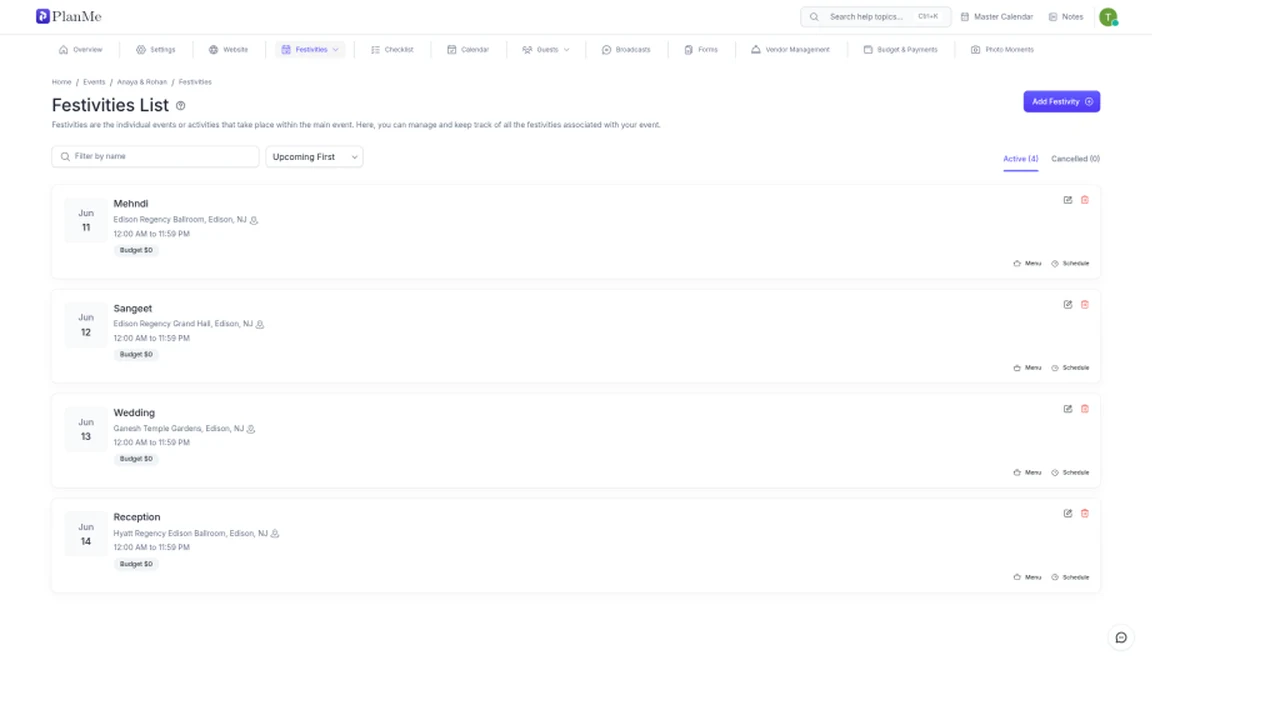
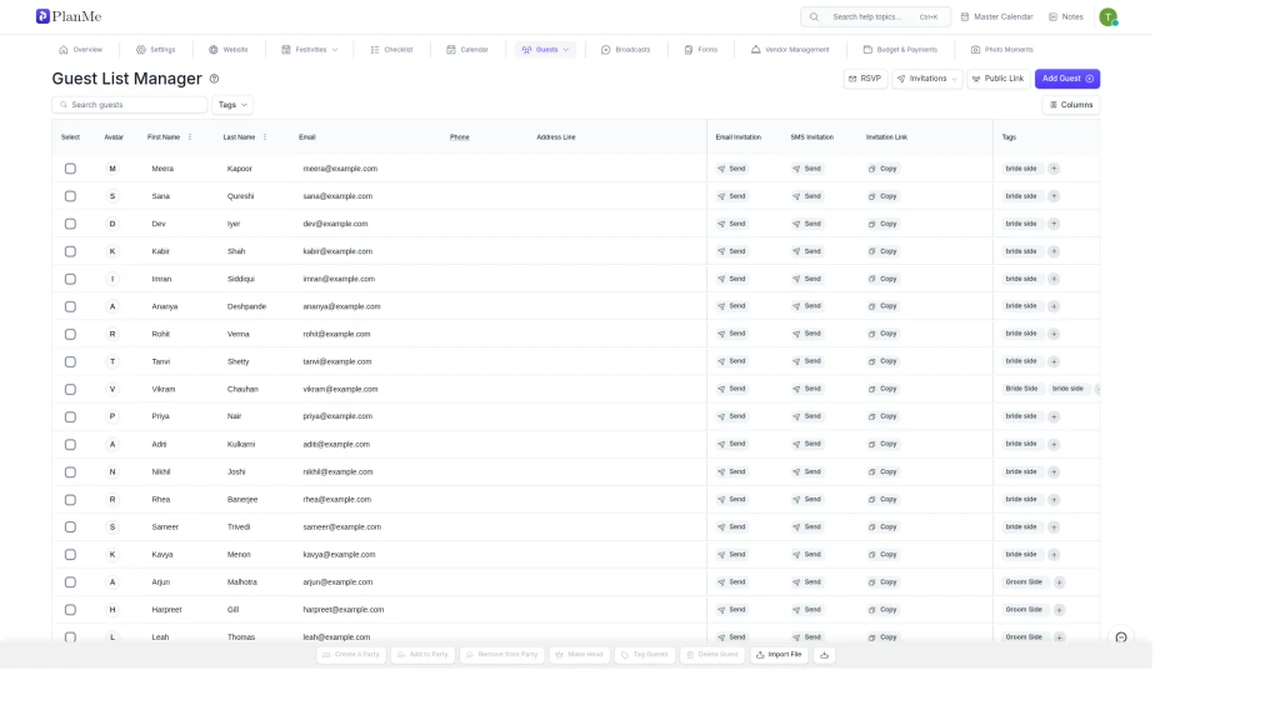
Notice the headcounts are not one number. Catering, seating, and favors follow the column for that event, not the reception total. Joy's multi-event guide makes the same point: a master list with tags per event beats five spreadsheets that disagree on spelling. In PlanMe, those tags are festivities — each with its own guests and schedule.
Hotel math for this weekend (still example numbers): about 90 out-of-town households, most staying Friday and Saturday nights, a few staying Thursday for early mehndi prep. That is a courtesy block conversation at two nearby hotels, not a single Saturday-night room count. Put the block on the calendar next to the festivities so cousins stop texting "which hotel again?"
A Bay Area version of the same four-event shape often looks identical on paper and different on permits: outdoor baraats compete with neighborhood noise rules, and hotel blocks in San Mateo or Fremont book early for peak weekends. Swap the town names; keep the per-event headcounts.
What people forget (the weekend hard stops)
Ritual order is the easy part. These are the items that show up in venue walkthroughs and in Reddit threads after someone has already signed a contract:
- Venue hard stops. Ballrooms that must be clear by 11 p.m. or midnight will cut a same-day ceremony-plus-reception short if pheras run long. Put the hard stop on the schedule before you lock the muhurat.
- Fire for the mandap. Many halls allow a contained havan with a permit or a specific burner; some ban open flame indoors entirely. Ask in the first tour, in writing. This is one of the few places local rules change the answer — Maharani's venue checklist calls out fire permits explicitly.
- Baraat permits and routes. Horses, dhol, and parking-lot dancing need the venue's yes, and sometimes a municipal noise or animal rule. Have a car backup if the horse is cut the week of.
- Hotel blocks for multi-night stays. Desi weekends are rarely one night. Courtesy vs attrition contracts are a US and Canadian hotel norm — say so when you negotiate. Families often pay for elders' rooms; track that as its own line, not as "misc."
- Combined mehndi + sangeet tradeoffs. One venue fee and one travel day for guests, but the bride's henna needs drying time before dances, and the room must work for both a relaxed afternoon and a loud night. r/DesiWeddings abbreviation threads are full of couples who combined happily and couples who wished they had kept a quiet home mehndi.
- Glam buffers after haldi. Turmeric plus a two-hour pheras prep is a real clock. If haldi ends at noon and the ceremony is at 4 p.m., someone is stressed. Move haldi earlier or to the day before.
- Different RSVPs per event. A single yes/no for "the wedding" under-counts the mehndi and over-counts the reception. Per-event RSVPs are the difference between ordering 80 thalis and 300. How to set up per-guest RSVPs for each festivity, with a free invite matrix. Choosing software? See best South Asian wedding planning tools (2026) or the best wedding website for multiple events. PlanMe vs Zola for that weekend: PlanMe vs Zola for multi-event Desi weddings.

Keep, skip, or combine
Autocomplete and Reddit ask this constantly: what did you keep, skip, or combine for a US Indian wedding? There is no purity test. Patterns that come up often:
- Keep ceremony and some form of large celebration (reception or sangeet-style reception).
- Make mehndi small and at home; hire one artist for the bride and a second for guests if the list grows.
- Combine mehndi and sangeet into one evening when guests can only travel for one pre-wedding night.
- Fold a short garba or two group dances into the reception and skip a separate sangeet when nobody wants to choreograph for months.
- Hold haldi only for immediate family the morning of the wedding, or merge it with a welcome dinner the night before.
Evidence: Indian wedding in the US — keep, skip, or combine and How have you abbreviated your wedding and functions? on r/DesiWeddings. Your families' non-negotiables beat any blog's default order — write those down first, then fit the weekend around them.
Does this change in Canada or the UK?
The ritual order is largely the same. What changes is logistics. In Canada (especially the GTA), gurdwara morning ceremonies and large banquet halls in the suburbs shape many Sikh and Hindu weekends the same way New Jersey and the Bay Area do in the US — multi-night hotel stays, winter weather buffers, and venue curfews. Noise and fire rules are still a venue-by-venue question; ask explicitly.
In the UK, licensed venues, council noise limits, and smaller average homes push more mehndi and haldi into hired halls even when the guest list is intimate. Travel between cities (London, Leicester, Birmingham) can make a two-day compression more attractive than a five-day spread. The event names and sequence stay familiar; the calendar gets tighter.
How to put the weekend on one plan
Once you know which events you are hosting:
- List every festivity with a draft day and start time, including baraat as its own block if the venue needs it.
- Put a guest count next to each one — rough is fine — before you ask for catering minimums.
- Ask every venue the hard-stop, fire, and baraat questions on the first tour and save the answers next to that festivity.
- Build the hotel block from nights × out-of-town households, not from the reception headcount alone.
- Share one calendar with both families so the sangeet DJ and the pandit are not holding conflicting assumptions.
The month-by-month booking order (venue, caterer, priest, outfits) sits on the Indian wedding planning checklist. Money per function sits on how to plan a wedding budget. The hour-by-hour wedding day sits on the South Asian wedding day timeline.
Plan the weekend in PlanMe
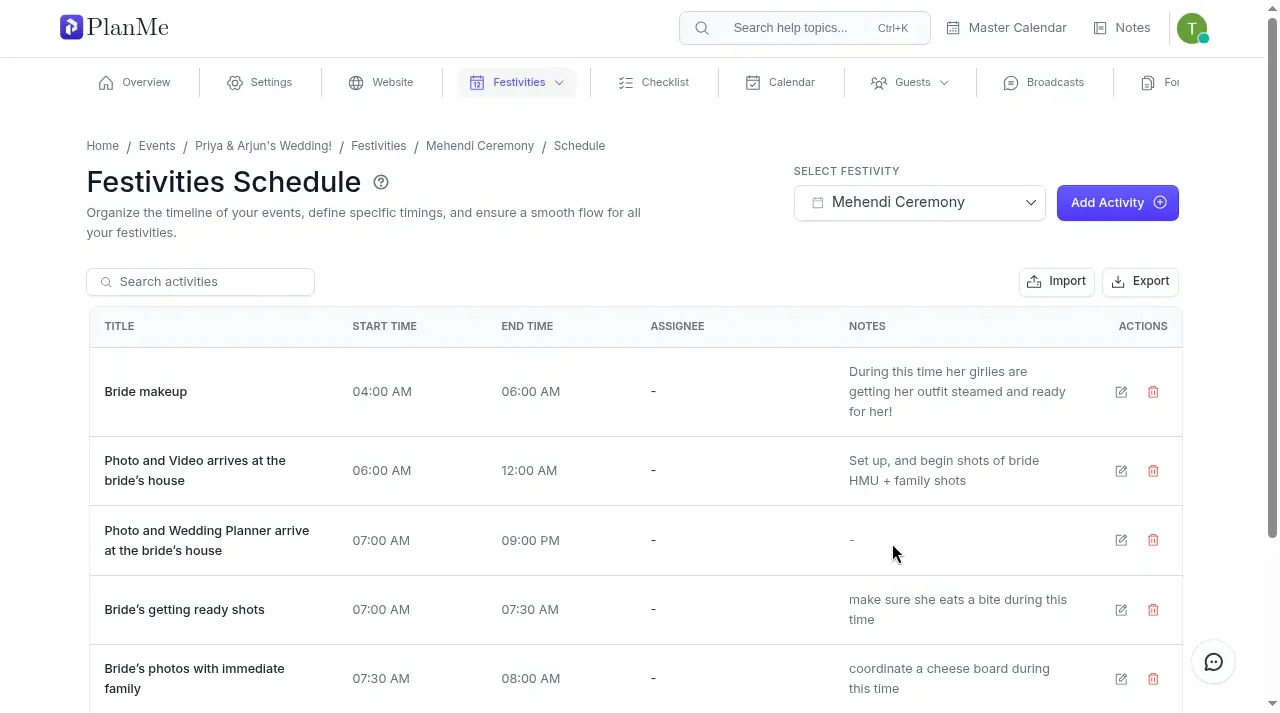
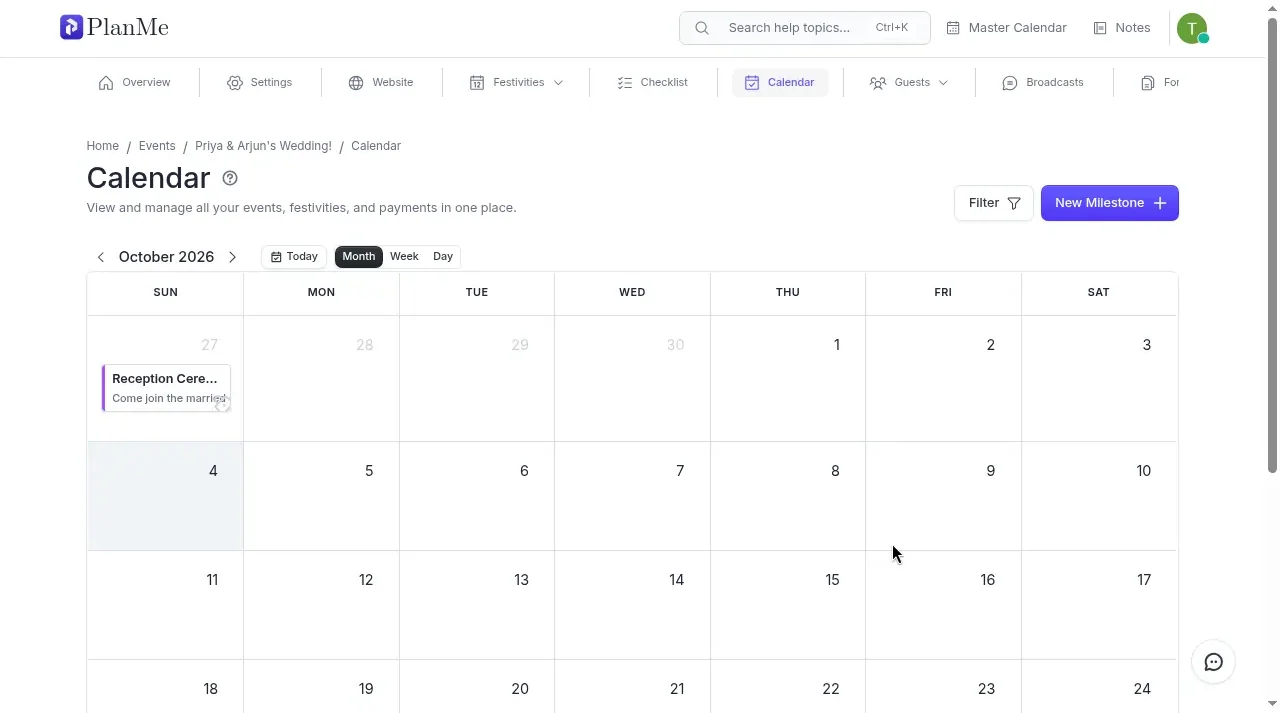
PlanMe is built around festivities — each event with its own schedule, guest list, menu, and budget line — because that is how Desi weekends actually run. Add mehndi, sangeet, ceremony, and reception as separate festivities, hang a schedule under each one, and keep hotels and RSVPs beside the same plan, with one wedding website where each guest sees only the events they're invited to. Soft ask only: if you want one workspace instead of five group chats, try it while it is free in beta.
See pricing, read who built it, or get in touch.
Sources
- Maharani Weddings — How to Plan an Indian Wedding
- Cordially Wed — Order of Indian Wedding Events and Timeline
- Invyt — Indian Wedding Planning Checklist: 7 Events, One List
- The Nyota — Order of Indian Wedding Rituals
- Weddingkart — Indian Wedding Timeline: Day-by-Day Guide
- Joy — How to Manage Multiple Wedding Events with Different Guest Lists for Indian Weddings
- WedPlan — Multi-Day Indian Wedding Schedule
- Zivaara Studio — Indian Wedding Timeline in the USA
- r/DesiWeddings — Indian wedding in the US: what did you keep, skip, or combine?
- r/DesiWeddings — How to plan a multi-event wedding in the…
- r/DesiWeddings — How have you abbreviated your wedding and functions?
Common questions
How many days is an Indian wedding?
Most families host three to five days of celebrations. In North America, a Friday-to-Sunday weekend is common: one or two pre-wedding nights, the ceremony day, and sometimes a reception the same evening or the next day. Some families stretch to four or five days when out-of-town guests arrive early; others compress everything into two days.
What is the typical order of Indian wedding events?
A common Hindu-leaning order is roka or engagement first (often months earlier), then mehndi, then sangeet, then haldi, then the wedding day with baraat and milni before the ceremony, then vidaai, then the reception. Families swap mehndi and sangeet, combine them, or move haldi to the morning of the wedding. Sikh and Pakistani weekends follow different ceremony shapes; treat those as their own plans.
What is the full list of Indian wedding events?
For a Hindu-leaning weekend, the usual list of festivities is: roka or engagement, mehndi, sangeet, haldi, the wedding day (baraat, milni, the ceremony with pheras, then vidaai), and the reception. Some families add a ganesh puja, a chooda or tilak ceremony, or a welcome dinner for travelling guests. Most US and Canadian hosts pick three to five of these and plan each one as its own event with its own guest list.
Can you combine mehndi and sangeet?
Yes. Many US couples put henna and a shorter dance program into one evening to save a venue night and a guest trip. Tradeoffs: the bride needs time for henna before performances, the guest list is usually larger than a home mehndi, and the night runs long. Keep a quiet room for elders if the DJ is loud.
What comes first, mehndi or haldi?
Mehndi usually comes one to three days before the wedding. Haldi is usually the day before or the morning of the ceremony so the couple does not wash the turmeric off before pheras. If both fall on the same day, do haldi in the morning and mehndi in the afternoon so yellow paste is not sitting under fresh henna all evening.
Do all guests go to every event?
No. Haldi and a home mehndi are often thirty to eighty people. Sangeet is larger. Ceremony and reception are usually the full list, and the reception is sometimes bigger still if colleagues and community contacts are added. Guests generally understand different invites; the hard part is tracking RSVPs per event, not explaining the rule.
What is the difference between a sangeet and a reception?
The sangeet is the music-and-dance night before the wedding, often with family performances. The reception is the large formal celebration after the ceremony, with a grand entrance, dinner, speeches, and open dancing. Some families skip a separate sangeet and fold a few performances into the reception; others keep both nights.
How do Sikh and Pakistani wedding weekends differ?
A Sikh Anand Karaj is usually held in the morning at a gurdwara, with langar afterward, then often a reception later. Pakistani Muslim weekends commonly include mehndi, a nikah (sometimes earlier or same day), and a walima hosted by the groom's side. Those orders deserve their own pages; this guide focuses on the Hindu-leaning multi-event weekend most US hosts ask about first.