On this page
If you plan South Asian weddings in New Jersey, Houston, the Bay Area, Toronto, London or Birmingham, you have probably noticed that the software marketing never quite describes your week. US planner tools talk about leads, proposals and one timeline. India-market tools talk about WhatsApp and rupee pricing. Neither talks about a mehndi with 120 guests, a sangeet with 280 and a reception with 380, all drawn from one master list that two families keep changing.
PlanMe.Club is our product, and it appears in this guide. We are not going to tell you it replaces your CRM, because it doesn't. We will tell you where every tool here, including ours, is the better choice. Prices and features checked October 18, 2026, on each company's own pricing or product page.
The short version: run the business in a CRM, run the wedding in a shared event workspace, and don't make the families learn your CRM. The rest of this page explains how to choose both halves.
The short answer
Recommended stack: one business tool (HoneyBook if you want the simplest CRM and invoicing, Aisle Planner if you want wedding-specific project tools in the same login) plus one shared workspace per client wedding where the couple, both families, your team and vendors work from the same festivities, guest list, RSVPs, quotes and budget. PlanMe.Club is built for that second job and is free during beta.
- Best for the shared festivity workspace: PlanMe.Club (ours).
- Best simple CRM and invoicing: HoneyBook.
- Best wedding-specific all-in-one for planners: Aisle Planner.
- Best for firms that also run venues or corporate events: Planning Pod.
- Best for guest texting and WhatsApp: Cordially Wed.
- Best if you run the weekend on the ground in India: WedVista or Planno.
Want to see the shared workspace with a real festivity setup? Start free on PlanMe.Club and create one client event; it takes about as long as a kickoff call.
What a South Asian wedding adds to a planner's software
Most planner software assumes one event with one guest list. A South Asian client wedding breaks that assumption in five predictable ways. If a tool can't handle these, you end up back in spreadsheets, however nice the CRM looks.
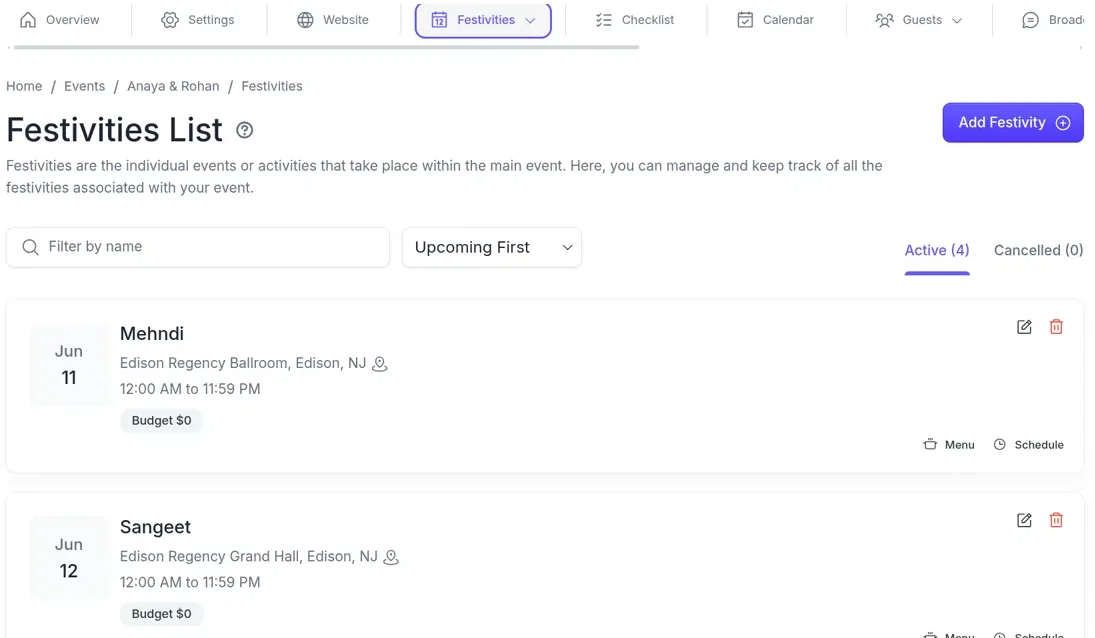
- Several festivities, each its own event. Mehndi, haldi, sangeet, ceremony, reception, sometimes a welcome dinner or a walima. Each has its own venue, start time, vendors, menu and budget. If you need a refresher on order and typical guest counts, see Indian wedding events in order.
- Different guest lists per festivity. Close family at the haldi, everyone at the reception. The caterer needs a real number for each night, and a reception-only colleague should never see the mehndi details. Our guide to RSVPs for multiple events shows the invite matrix in detail.
- Two families, both editing. The bride's side and the groom's side each own their list, their aunties' spellings and often their share of the bill. They want to see progress without emailing you for an export.
- Guests in other countries. Relatives fly in from India, Pakistan, Bangladesh, the UK or the Gulf. They need the travel details, the hotel block and the schedule for the festivities they are invited to, and they may not check email every day.
- Vendor sprawl. Mehndi artist, dhol, DJ, decor and mandap, priest or granthi, caterer per night, hotel block, transport. Quotes arrive by WhatsApp, email and voice note, and someone has to keep the approved number next to the budget.
Two jobs, two tools
When planners ask each other what they use, the answers split along this line. In a January 2026 thread titled "What portals do you use?" on r/EventPlanners, a newer wedding planner asked whether others run client portals in Aisle Planner, Planning Pod or Notion, or just a shared Google Drive. Replies were split: several planners stick with shared Google Drive and Sheets because clients already know them and everyone sees updates in real time; one uses Aisle Planner because tracking every client by hand across email, texts, Drive and floor-plan software was frustrating; another pointed out that clients care more about clarity than about features.
Both camps are right, because they are describing two different jobs:
| Job 1: run your business | Job 2: run the wedding with the family | |
|---|---|---|
| Who uses it | You and your team | You, your team, the couple, both families, some vendors |
| What lives there | Leads, proposals, contracts, invoices, payments to you, your own calendar | Festivities, master guest list, per-festivity invites and RSVPs, vendor quotes, budget, checklist, website |
| What matters most | Getting paid, automations, a professional look | Low friction for the family, one live list, right headcount per festivity |
| Typical tools | HoneyBook, Aisle Planner, Planning Pod | Google Drive and Sheets, Aisle Planner's project tools, PlanMe.Club, Cordially Wed for messaging |
Some products try to do both. Aisle Planner and Planning Pod bundle CRM and project tools. HoneyBook's own HoneyBook vs Aisle Planner comparison says HoneyBook leans toward end-to-end business management and Aisle Planner toward event planning and production. The question for a South Asian planner is not "which one does everything" but "where will two families and 300 guests actually be managed without me re-typing it."
Comparison table
PlanMe.Club is our product. Each competitor row links to that product's own pricing or product page. We don't mark a competitor "no" on anything their own pages don't confirm.
| Tool | Main job | Best for | Family / client access | Price (checked) |
|---|---|---|---|---|
| PlanMe.Club (ours) | Shared event workspace | Multi-festivity weddings where the couple, both families and vendors work in one plan | Invite anyone by email; roles you define, set per area of the event | Free during beta; paid plans planned, pricing not final |
| HoneyBook | Business ops (CRM) | Proposals, contracts, invoices and automations with the least setup | Client portal on every plan | From $29/mo billed yearly (Starter); Essentials $49/mo, Premium $109/mo billed yearly; 30-day trial; card fees from 2.7% + 10¢ |
| Aisle Planner | CRM + wedding project tools | Wedding-only studios that want leads, timelines, guests, layouts and seating behind one login | Client portal on project plans | Sales Essentials $49.99/mo (no project tools); up to 15 projects $69.99/mo; 16–25 $109.99/mo; 26–50 $164.99/mo; 51–100 $229.99/mo; 10% off yearly; 30-day trial |
| Planning Pod | Event management suite | Firms that also run venues, corporate or ticketed events | Client portals | No price list on its site on our check date; demo-led |
| Cordially Wed | Guest messaging | SMS and WhatsApp to guests from a wedding number, Wallet passes | Partner and planner access to one inbox | Per wedding from $69 one-time; Planner Pro $79/mo, Studio $149/mo (per their own comparison guide) |
| WedVista | Guest hospitality (India) | Big Indian and destination weddings run on the ground in India | Family can view details; volunteers get logins | ₹60,000/year for 10 weddings; WhatsApp charged per message |
| Planno (Wedence) | Planner workspace (India) | India-based planners who invite and remind guests on WhatsApp | Both-family logins; team roles | Free for 2 months, then ₹7,999 per wedding or ₹59,999 for 10 |
Google Drive and Sheets aren't in the table because they're free and everyone has them. They are still the baseline many planners use, and the bar every tool here has to beat.
The tools, one by one
1. PlanMe.Club: the shared workspace for the festivity side
Best for: planners whose clients have several festivities with overlapping guest lists, and who want the couple and both families in the same live plan instead of in forwarded spreadsheets.
Each client wedding is its own event in your account, with its own festivities, guests, budget, vendor quotes, checklist and website, so one client's data never shows up in another's. A Master Calendar puts every client's festivities, payment due dates and task due dates on one calendar. You can save a finished setup as a template and start the next client from it.
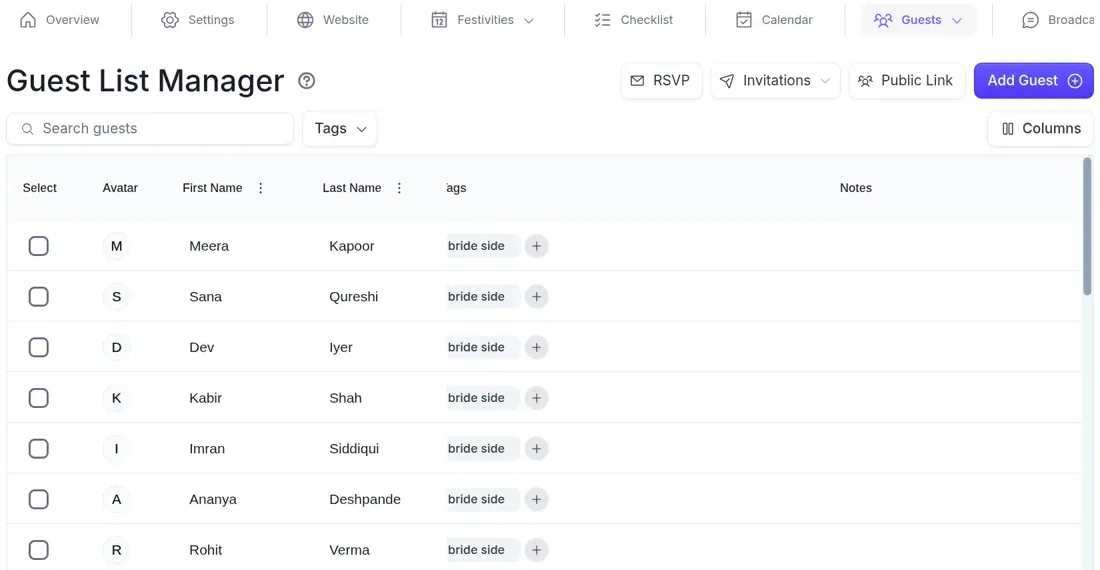
Inside an event, you import both families' lists from CSV or Excel, group guests into households with a head guest, tag them (for example by family side), and invite each guest per festivity. Guests never log in: each gets a private RSVP link by email or SMS that shows only the festivities they're invited to, and replies per festivity. The event website also has an RSVP lookup where a guest finds their name. SMS and email broadcasts go to everyone or to a group picked by guest tag or RSVP status, which is how you chase the people who haven't replied. Forms collect meal choices or dietary needs.
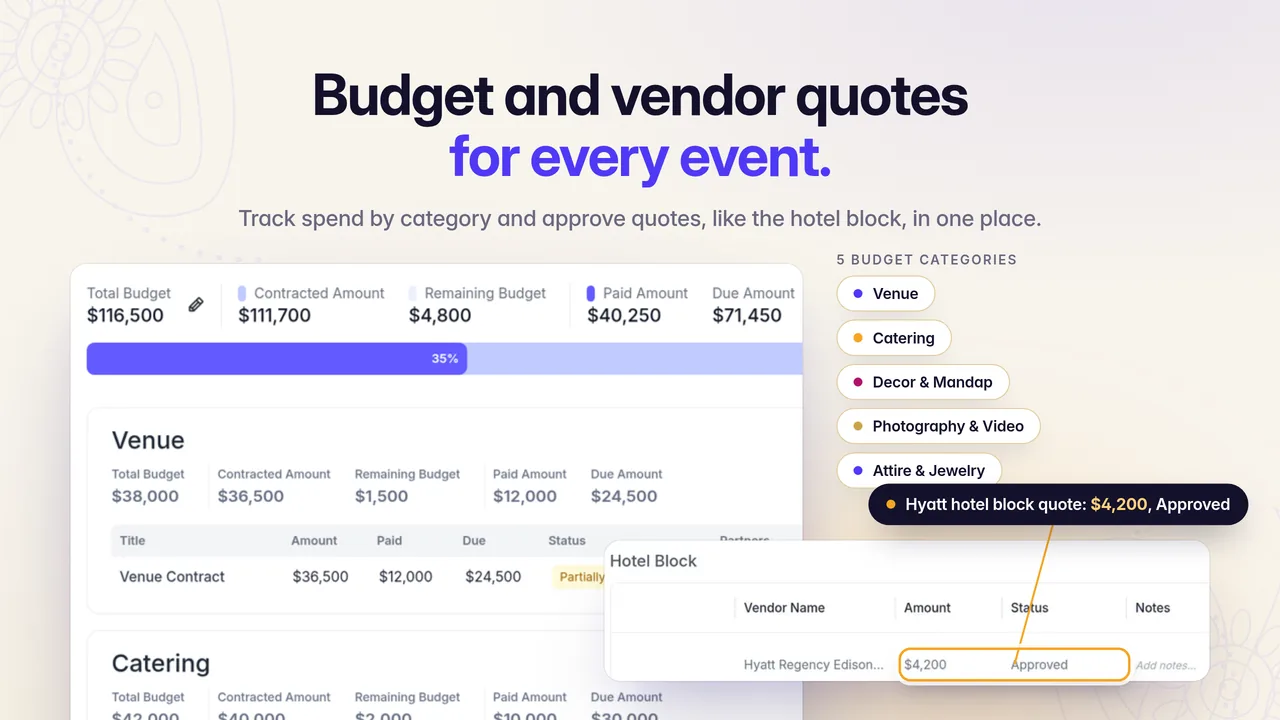
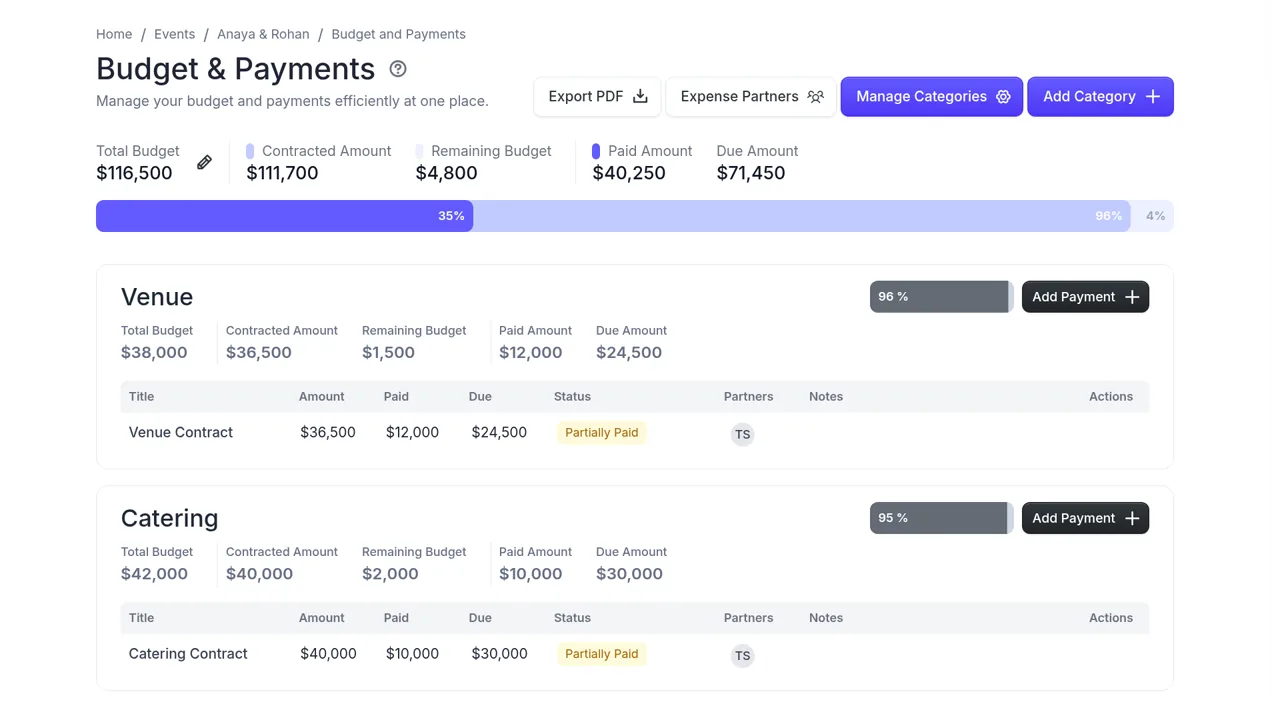
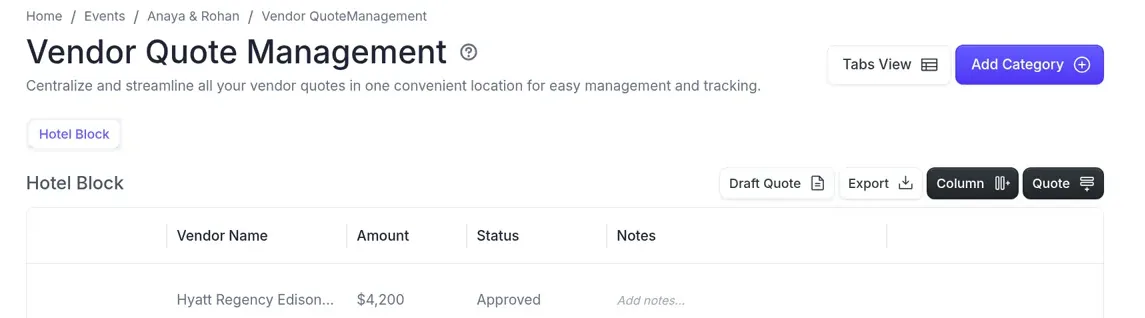
On the money side, vendor quotes sit in categories with the vendor name, amount, notes and a status (pending, negotiating, approved or rejected). The budget has categories, a budget per festivity, payments with paid and due amounts, and Expense Partners for recording who paid what when two families split costs.
Where other tools beat PlanMe.Club
- No CRM, proposals, contracts, invoicing or client payments. Keep HoneyBook or Aisle Planner for that.
- No white-label branding or separate client portal; clients join the event itself.
- Seating charts are not live yet. Aisle Planner, Planning Pod and Cordially Wed all have seating.
- No WhatsApp sending; Cordially Wed, WedVista and Planno send on WhatsApp.
- No per-festivity access for vendors (more on that below), and no custom domain for the website.
- It's new: founded in 2024 and launching in 2026, without the track record of the tools below.
2. HoneyBook: best simple CRM and invoicing
Best for: solo planners and small teams who want inquiries, proposals, contracts, invoices and automations working quickly, and don't need wedding-specific guest tools in the same login.
HoneyBook's pricing page lists Starter at $29/month, Essentials at $49/month and Premium at $109/month when billed yearly (US version, checked October 18, 2026; monthly billing and promotions change the number). Every plan includes unlimited clients and projects, invoices and payments, proposals and contracts, and a client portal. Essentials adds scheduling, automations, QuickBooks Online and up to two team members; Premium adds unlimited team members. Card payments start at 2.7% + 10¢ and bank transfers are 1.5%. There is a 30-day free trial.
HoneyBook is industry-agnostic, so it has no festivity or per-event guest model of its own. That's fine: it isn't trying to be the wedding workspace.
Where HoneyBook beats PlanMe.Club
- Getting paid: invoices, payment schedules, autopay and contracts with e-signatures.
- Lead capture, scheduling and automations that save hours of admin every week.
- A mature product with email and live-chat support seven days a week.
3. Aisle Planner: wedding-specific CRM and project tools in one login
Best for: studios that only do weddings and want sales tools and project tools (checklists, timelines, budgets, guest management, layouts and seating, event website and online RSVP) behind one login.
Aisle Planner prices by active projects. Its pricing page lists Sales Essentials at $49.99/month (sales tools only, no project tools), then $69.99/month for up to 15 projects, $109.99 for 16–25, $164.99 for 26–50 and $229.99 for 51–100, with 10% off yearly billing and a 30-day free trial that needs a credit card. Project plans include proposals, contracts and e-signatures, invoicing and online payments, a client portal, guest management and messaging, layouts and seating, and an event website with online RSVP.
If Aisle Planner's guest manager already handles your festivity matrix and your families are happy in its client portal, you may not need a second tool. Before you commit, test one real four-festivity client: invite a reception-only household and an all-festivities household, and check what each sees.
Where Aisle Planner beats PlanMe.Club
- A real planner CRM with proposals, contracts and invoicing in the same product as the wedding.
- Layouts and seating for professionals (PlanMe.Club seating is not live).
- Years of use by wedding planners, and capacity for studios running dozens of projects.
4. Planning Pod: the broad event management suite
Best for: firms that plan weddings alongside corporate, venue or ticketed events and want one configurable system for all of it.
Planning Pod's wedding planning firms page describes collaborating with clients online on budgets, guest lists, RSVPs and wedding websites, and its feature overview lists client portals, vendor management, seating and floor plans, event websites, registration forms, payment processing, workflows and onsite check-in. On our check date its site showed no public price list; the route in is a demo.
Where Planning Pod beats PlanMe.Club
- Breadth: floor plans, seating, onsite check-in, registration and ticketing, plus event CRM tools.
- Built for teams running many event types, not only weddings.
- Onboarding and customer support as part of a sales-led setup.
5. Cordially Wed: guest texting and WhatsApp
Best for: planners whose main pain is guest communication, especially WhatsApp for relatives abroad, from a number that isn't their personal phone.
Cordially Wed's planner page is explicit that it doesn't replace your planner software: keep HoneyBook, Aisle Planner, spreadsheets or Notion, and start with one wedding from a $69 one-time payment. On its home page, the guest list, per-event RSVPs, wedding website, seating charts and Wallet passes are free, and texting is priced by unique phone numbers: $69 (up to 50), $119 (51–100), $169 (101–200) and $249 (201–400), with unlimited SMS, MMS and WhatsApp. Its own Wedd.ai comparison guide lists Planner Pro at $79/month and Planner Studio at $149/month.
Where Cordially Wed beats PlanMe.Club
- WhatsApp plus SMS from a dedicated wedding number, with replies in one inbox.
- Apple and Google Wallet passes that update when the venue or time changes.
- Seating charts in its free tools.
6. WedVista and Planno: India-market planner tools
Best for: planners running the weekend on the ground in India, including destination weddings for diaspora families, where WhatsApp invitations, rooming lists, airport pickups and QR entry are the daily work.
WedVista covers guest lists, WhatsApp invitations, RSVPs per function, rooming, transport and QR entry, with a guest app. It lists ₹60,000 a year for 10 weddings, with WhatsApp messages prepaid and charged per message, and says guest data is stored in India. Planno (from Wedence) combines enquiries, client weddings, vendors, payments and team roles with a per-function RSVP invitation for each couple, sent on WhatsApp. It is free for two months, then ₹7,999 per wedding or ₹59,999 for 10.
Both are priced in rupees and use India-market language ("functions", ₹ pricing). For a planner in London or Toronto whose clients and guests are mostly local, they are a reasonable choice only if WhatsApp-first guest operations matter more than everything else. For a destination weekend in Udaipur or Goa, they solve hospitality problems that US tools don't touch.
Where they beat PlanMe.Club
- WhatsApp invitations and reminders built in.
- Rooming, transport and QR entry for large guest movements in India.
- Planno includes an enquiry pipeline; WedVista includes a guest app.
Opinion pieces from vendors are useful for perspective, not as product facts. For example, That's The One's HoneyBook vs Aisle Planner post argues for its own planner platform. We rely on each company's own pricing and product pages above, which is also why our disclosure sits at the top of this page. The PlanMe.Club comparison hub has the couple-facing version of this table (Zola, Joy, The Knot and others).
Recommended stacks by planner size
This is our worked recommendation, not a ranking. Prices are from the table above and change often, so re-check before you buy. "Active weddings" means weddings you're working on at the same time.
| Planner size | Business side | Wedding side | Add if needed | Software cost to plan for |
|---|---|---|---|---|
| Solo or part-time, 1–5 active weddings | HoneyBook Starter (or invoices from your accounting tool) | PlanMe.Club, one event per client | Cordially Wed per wedding if the family wants WhatsApp blasts | About $29/mo billed yearly, plus $69+ per wedding only if you add texting |
| Growing studio, 6–15 active weddings | HoneyBook Essentials, or Aisle Planner up to 15 projects | PlanMe.Club for the family-facing festivity plan (skip it if Aisle Planner's guest tools already cover your matrix) | Cordially Wed for messaging | About $49–$70/mo for the business tool |
| Full-service firm, 16+ active weddings and a team | Aisle Planner 16–25 or 26–50 projects, HoneyBook Premium, or Planning Pod | PlanMe.Club per wedding so each family has its own workspace and roles | Cordially Wed Planner Pro for guest comms; a seating tool if yours lacks one | About $109–$165/mo for the business tool, or Planning Pod's quote |
| Any size, running a destination weekend in India | Your usual CRM | PlanMe.Club for the plan and both families | WedVista or Planno for on-the-ground hospitality | About ₹6,000 per wedding on their 10-wedding packs, plus WhatsApp usage on WedVista |
Two rules keep any stack sane. First, one master guest list: decide which tool owns it and import from there; never let two tools both hold the "real" list. Second, the family should only ever need one login, and it should be for the wedding, not for your business tool.
Onboarding a client family in PlanMe.Club
Here is the workflow we'd use for a real client, using our fictional Anaya & Rohan showcase: a four-festivity weekend in Edison, New Jersey (mehndi, sangeet, wedding and reception). The headcounts below are an example, not data.
- Kickoff call (week 1). Agree the festivities, dates, venues and a rough headcount for each: say 120 at the mehndi, 280 at the sangeet, 320 at the wedding and 380 at the reception. Agree who owns which part of the guest list on each side.
- Create the event. Start from your saved template if you have one, then add the four festivities with venues and times. Switch off modules this client won't use so the family sees less clutter.
- Create roles and invite people. Make roles such as Couple, Bride's family, Groom's family and Coordinator, tick the areas each can use (see the matrix below), and invite each person by email. Unaccepted invitations can be resent or revoked, and they expire.
- Import both lists. Each family sends a CSV or Excel file. Import them, group guests into households with a head guest, and tag by side so you can filter later.
- Build the invite matrix. Invite each household to the festivities it's attending. This is the step that sets the per-festivity headcount your caterer will ask for.
- Draft the website. Add the schedule, travel details and the hotel block on the travel page, keep it in draft until the couple signs off, then publish at a planme.club address.
- Send RSVP links. Send each guest their private RSVP link by email or SMS. Overseas relatives who prefer WhatsApp can get the same link pasted into a WhatsApp message.
- Chase and count. Each week, broadcast a reminder to guests whose RSVP is still pending, and check each festivity's accepted, declined and pending counts. Add a form if you need meal choices or dietary needs.
- Quotes and money. Log vendor quotes by category and mark the approved one; record payments against budget categories and use Expense Partners to show what each family has paid.
For the per-festivity budget side, see how to budget a multi-event wedding. For how guests see their invitations, see RSVP for multiple events.
Role matrix you can copy
In PlanMe.Club you create the roles and tick the areas each role can use. Access is per area of the whole event, not per festivity, so think about what each area reveals before you tick it. This is the starting point we'd suggest for a South Asian client wedding:
| Role | Tick these areas | Leave these off | Why |
|---|---|---|---|
| Coordinator (your team) | Everything they work on: festivities, guests, RSVPs, forms, messaging, vendors, budget, checklist, calendar, website | Members, unless they manage invitations | They run the day-to-day; you keep control of who's in the event |
| Couple | Festivities, guests, RSVPs, website, checklist, calendar; budget if they're paying | Members, messaging (if you send all broadcasts) | They see the whole plan without being able to message 380 guests by accident |
| Bride's family / Groom's family | Guests, RSVPs, checklist | Budget and vendor quotes, unless that family is paying and wants to see them | Each side manages its own list; the money conversation stays with you |
| Day-of vendor (e.g. decor lead) | Festivities and calendar only | Vendor quotes, budget, guests | A vendor with access to vendor quotes would see every vendor's quote, and festivity access shows every festivity |
Inviting someone to one client's event doesn't give them access to your other clients, because roles are set per event. More answers on roles, templates and running several clients are in our event planner FAQ, and the full list of what's live is on the features page.
Choosing tools for a couple rather than for your business? Our best South Asian wedding planning tools roundup and Joy vs Zola vs The Knot for multi-event weddings cover the couple-facing side, including registries.
Start free on PlanMe.Club during beta and set up your next client's festivities, or see pricing.
Sources
Pricing and product pages checked October 18, 2026. PlanMe.Club capabilities checked against the product.
- r/EventPlanners: What portals do you use? (January 2026)
- HoneyBook pricing · HoneyBook vs Aisle Planner (HoneyBook blog)
- Aisle Planner pricing
- Planning Pod for wedding planning firms · Planning Pod event planning features
- Cordially Wed for planners · Cordially Wed pricing · Cordially Wed: Wedd.ai vs Cordially Wed
- WedVista wedding planner software · Planno by Wedence
- That's The One: HoneyBook vs Aisle Planner (vendor opinion)
Common questions
What software do Indian and South Asian wedding planners use?
Usually two kinds of tool. A business tool for leads, proposals, contracts and invoices (HoneyBook, Aisle Planner or Planning Pod are common in the US, UK and Canada), and a shared place for the wedding itself: festivities, both families' guest lists, per-festivity RSVPs, vendors and budget. Many planners still run that second part in a shared Google Drive and Sheets, as planners describe on r/EventPlanners. Planners based in India often use India-market tools such as WedVista or Planno, which are priced in rupees and built around WhatsApp. PlanMe.Club (our product) is a free-during-beta shared workspace for the festivity, guest and family side.
Can my clients' families collaborate in the same tool?
In PlanMe.Club, yes. You invite the couple, each family and your team to the client's event by email, and give each person a role you create, such as Couple, Bride's family or Coordinator. Each role can use only the areas you tick, for example the guest list and RSVPs but not budgets. Access is set per area of the event, not per festivity. Aisle Planner, HoneyBook and Planning Pod also include client portals; check how many family members each plan allows before you rely on it.
Is there free software for wedding planners?
PlanMe.Club is free during beta, with every feature, no credit card and no limit on events or guests; paid plans are planned but pricing isn't final. Google Drive and Sheets are free and familiar to clients. Cordially Wed's guest list, per-event RSVPs and website are free, with paid texting. HoneyBook and Aisle Planner are paid, with 30-day free trials. Prices checked October 18, 2026.
Does PlanMe.Club replace my CRM or invoicing?
No. PlanMe.Club has no lead pipeline, proposals, contracts, invoicing or client payments, and no white-label client portal. Keep HoneyBook, Aisle Planner, Planning Pod or whatever runs your business, and use PlanMe.Club as the shared event workspace with the couple, both families and vendors.
Can vendors access only their own festivities?
Not in PlanMe.Club today. There is no separate vendor account and no per-festivity access. You can invite a vendor to the event by email with a role limited to certain areas, such as festivities and the calendar, but a role that can see festivities sees every festivity in the event. Many planners simply send vendors the run of show for their festivity instead.
Does PlanMe.Club do seating charts or WhatsApp?
Not yet for seating: seating charts are not live, so use a dedicated seating tool for floor plans. Every festivity already keeps its own accepted, declined and pending RSVP counts. PlanMe.Club sends invitations and broadcasts by email and SMS, not WhatsApp; you can paste a family's private RSVP link or the website link into WhatsApp yourself.