On this page
- Why one yes/no breaks for a multi-event wedding
- Households vs individuals: pick your RSVP unit
- Map who’s invited to which festivity: the invite matrix
- Questions to ask per festivity
- Deadlines and reminders: an email and SMS cadence
- Reading the per-festivity headcount for caterers
- Tools compared honestly
- Running the matrix in PlanMe.Club
- Sources
- Common questions
The question comes up on r/weddingplanning again and again, in slightly different words. One couple wants two invitation tiers with separate RSVP options. Another has a welcome party, a wedding and a brunch, and asks whether any website lets them say which events each guest can RSVP to. A bride planning an Indian wedding asks for a site where guests only see the events they’re invited to. And a host juggling a mehndi, a sangeet and the ceremonies says they ended up with four separate guest lists and are chasing RSVPs event by event in spreadsheets.
Software is only half the answer. The other half is a plan: what one RSVP unit is in your family (a person or a household), who is invited to which festivity, what each festivity needs to ask, when reminders go out, and how replies turn into a number a caterer can use. That plan works with paper cards, a spreadsheet, or any wedding website, so most of this page is about the plan. Tools come near the end, compared fairly. PlanMe.Club is our product, and we say so again right before that comparison.
If you have not decided which festivities you are hosting yet, start with Indian wedding events in order, then come back. If you are ready to set this up in an app instead of a sheet, the short product pages are RSVP for multiple events and wedding website for multiple events.
Why one yes/no breaks for a multi-event wedding
Most RSVP cards and online forms were built for a ceremony and a reception on the same day, for the same people. Joy’s guide to multiple events with different guest lists for Indian weddings says it plainly: most tools assume one event, one guest list and one RSVP, and that falls apart with a haldi, mehndi, sangeet, ceremony and reception. Invyt’s Indian wedding RSVP guide makes the same point a different way: an Indian wedding doesn’t have one RSVP problem, it has five.
Here is what a single yes/no hides, using one example household of five:
- Different people come to different nights. Both parents and the teenager come to everything, the college-age son flies in only for the ceremony, and the youngest skips the late reception. “Yes, 5” is wrong for at least two festivities.
- Different festivities have different hosts. The bride’s side may be paying for the mehndi and the groom’s side for the reception. Each host wants their own count, and neither wants to read the other’s spreadsheet.
- Different festivities have different caterers. The haldi lunch might be a home caterer, the sangeet the hotel’s banquet kitchen, the reception a separate Indian caterer. Each one prices per plate and wants a final number by its own date.
- Some festivities are deliberately small. If a guest invited only to the reception can see the haldi on your website, you get the “Should we come to this too?” text, or a hurt aunt. Visibility is part of the RSVP problem, not a separate one.
The fix is the same in every tool: stop asking “Are you coming to the wedding?” and start asking “Who from your household is coming to each festivity you’re invited to?”
Households vs individuals: pick your RSVP unit
Desi families reply as households. One person, often the mother or the eldest son, answers for everyone, and frequently by phone or WhatsApp rather than on a form. Caterers, chairs, shuttles and name cards count people. So the rule that works is: invite and remind by household, count by person. Joy’s Indian-wedding guide lists the same need as household RSVP, where a family of four answers together without four accounts.
Rules that save arguments later
- Name every invited person. “Mr and Mrs Shah and family” is how a household of three becomes seven at the reception. Write the names on the household record, even if the envelope stays traditional.
- Give adult children their own row once they live separately or have a partner. They will RSVP on a different timeline from their parents, and they may be invited to the sangeet when their parents are only invited to the reception.
- Pick one RSVP contact per household and record how they actually reply: email, text, or “phone via Hema Masi.” Elders without email still count; someone in the family just has to answer for them.
- Decide plus-ones per festivity. A friend’s partner may be welcome at the reception and not at a family haldi. Joy’s guide calls this out too: make plus-ones event-specific.
- Treat children as their own count. The Knot’s guide to the final headcount suggests noting children separately because they usually get different meals. On a Desi weekend they also change transport and late-night plans.
Map who’s invited to which festivity: the invite matrix
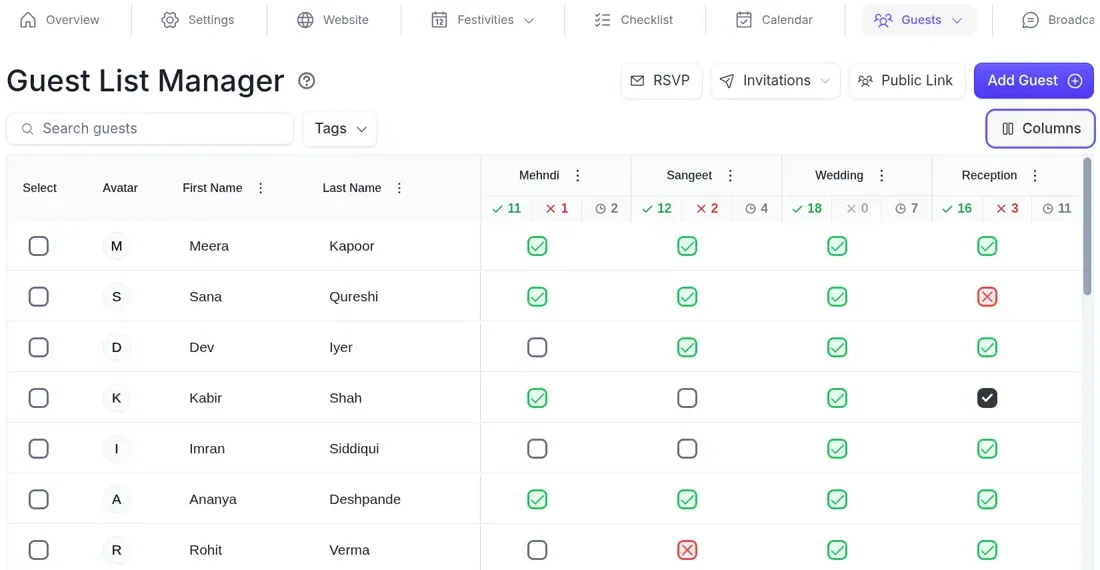
The invite matrix is one table: households down the side, festivities across the top. Each cell answers two questions for that household and that festivity: how many of its people are invited, and how many said yes. One reply in the “4 separate guest lists” thread on r/weddingplanning describes exactly this layout: one master table, one row per household, an invited and a status column for each event, and a reminder list that is simply “invited, but status still blank.” It is the opposite of four spreadsheets that disagree on spelling.
Worked example: a four-festivity weekend in Edison, New Jersey
Meet a fictional couple hosting a Hindu–Gujarati weekend in central New Jersey in June: a haldi at the bride’s parents’ house, a combined mehndi and sangeet at a hotel ballroom, the ceremony, and a reception. Most guests drive in from the Northeast; a few dozen fly in from Texas, California, Canada, the UK and India. Between the two families they invite 380 people in 146 households. Every number below is example data, not a benchmark.
| Tier (households / people) | Haldi | Mehndi + sangeet | Ceremony | Reception |
|---|---|---|---|---|
| A: immediate family, closest friends, most fly-ins (38 / 120) | ✓ | ✓ | ✓ | ✓ |
| B: extended family and friends (60 / 160) | – | ✓ | ✓ | ✓ |
| C: parents’ friends, wider family (18 / 40) | – | – | ✓ | ✓ |
| D: colleagues, neighbours, community (30 / 60) | – | – | – | ✓ |
| People invited (146 households, 380 people) | 120 | 280 | 320 | 380 |
That gives four different invited totals: 120 for the haldi, 280 for the mehndi and sangeet, 320 for the ceremony and 380 for the reception. The haldi is large for a haldi because this family counts every out-of-town aunt and cousin as immediate family. Your tiers will look different, and that is the point of writing them down: the tier decides the invitation, not who happens to ask.
Now look at how one household moves through the matrix. The Shahs (example) are a tier A household of five from Houston. Their row says: haldi 5 invited, mehndi and sangeet 5, ceremony 5, reception 5. When they reply, the attending cells become 5, 5, 5 and 4, because their 6-year-old will stay at the hotel with a sitter on reception night. The Qureshis (example), tier B from Jersey City, have a 0 under haldi, so they never see it, never get a haldi reminder and never appear in the haldi count. The Reillys, two of the groom’s father’s colleagues, have zeros everywhere except the reception.
Here is how the same weekend might stand on RSVP deadline day (still example numbers):
| Festivity | Invited people | Yes | No | Still pending |
|---|---|---|---|---|
| Haldi | 120 | 108 | 6 | 6 |
| Mehndi + sangeet | 280 | 236 | 22 | 22 |
| Ceremony | 320 | 268 | 30 | 22 |
| Reception | 380 | 309 | 41 | 30 |
Nothing about this is exotic. It is four columns that add up separately. What it prevents is the classic mistake from the multi-event budget guide: pricing every festivity at the reception count, or worse, pricing the reception at the ceremony count and discovering 60 more plates in the last month.
Download the invite matrix (free)
One row per household, an invited and an attending column for each festivity, a Headcounts sheet with the formulas already in place (invited, yes, declined, households pending), and a Reminder copy sheet with the messages below. Twelve example households are filled in and clearly marked EXAMPLE; a blank sheet sits next to them. Rename the festivity columns for a nikah, walima, Anand Karaj or garba.
If your weekend is in Toronto, Brampton, London or Leicester
The matrix is the same everywhere. What changes is who is travelling and how early you need to know.
- New Jersey and most US weekends: many guests travel regionally, by car or a short flight, and decide late. A deadline about four weeks before the first festivity usually works for them. Overseas relatives are a smaller group you handle earlier, by name.
- Toronto and Brampton: lists often mix a large local community, family driving up from the US, and more relatives flying in from India. Add a travel column (local, cross-border, international) and ask the international households for a soft “we’re planning to come” months before the formal RSVP, so flights, visas and hotel nights aren’t waiting on the invitation.
- London and Leicester: the UK habit of day guests and evening guests maps neatly onto tiers; your evening-only guests are tier D. For relatives who need a UK Standard Visitor visa, GOV.UK says the earliest they can apply is 3 months before travel, with a decision usually within 3 weeks. So their “yes” has to be firm well before your RSVP deadline. The Indian wedding checklist has the visa timing for the US, UK and Schengen countries.
Questions to ask per festivity
Every question you add costs replies, so ask only what a vendor or a host will use. Joy’s guide has the rule that saves the most time: collect dietary needs once, per person, and reuse them for every festivity. Invyt makes the same point and adds that each caterer should get its own breakdown. So split questions into three levels.
| Level | Ask | Who uses it |
|---|---|---|
| Per person, once | Meal: vegetarian, non-vegetarian, Jain (no onion, garlic or root vegetables), halal, vegan, allergies. Accessibility: wheelchair, step-free seating, a quiet room. | Every caterer; the venue |
| Per person, per festivity | Attending yes/no. Children attending. Named plus-one, if offered for that festivity. Needs the hotel shuttle. | That festivity’s caterer, venue and transport |
| Per household, once | Arrival and departure dates, staying in the hotel block or not, best phone number for day-of texts. | Hosts, hotel, airport pickups |
Festivity-specific questions that are worth it
- Haldi: usually none beyond attending. It’s small and the hosts know everyone. Put the “wear old yellow clothes” note in the details, not a question.
- Mehndi: “Would you like henna?” if you are paying artists by the hour or by the number of hands. That count is for the artist, not the caterer.
- Sangeet: “Is anyone in your family performing?” It gives the choreographer and the DJ a list weeks earlier than a group chat would.
- Ceremony: shuttle needs, especially if there is a baraat departure point and a separate venue. For a gurdwara ceremony, put the head-covering and shoes note in the details.
- Reception: children yes/no if it runs late, and the meal choice if the reception is plated rather than a buffet.
One more question to skip: alcohol. Bartenders count adults over the legal drinking age (21 in the US, 18 in the UK, 18 or 19 in Canada depending on the province), and the venue will handle ID at the bar.
Deadlines and reminders: an email and SMS cadence
The Knot’s RSVP timeline for a single-day wedding sets the deadline about three to four weeks out, sends a reminder about a week before it, starts phone calls about a week after it, and gives vendors final numbers around the two-week mark. Joy’s Indian-wedding timeline starts earlier, with invitations about three months out and a first RSVP deadline around six weeks, and warns that Indian wedding RSVPs are slow. Invyt suggests a deadline about three weeks before each event.
For a weekend with several festivities, the simplest plan for guests is one deadline for all festivities, about four weeks before the first one. Separate deadlines per festivity sound tidy, but they mean four sets of reminders landing on the same households. The exception is overseas guests, who need a firm answer much earlier for flights and visas.
| When | Channel | Who gets it |
|---|---|---|
| About 12 weeks out | Email (plus paper card with a QR code if you’re printing) | Every household, with its own festivities listed |
| About 8 weeks out | SMS | Households that haven’t answered anything yet |
| About 5 weeks out | SMS, one per festivity | Households invited to that festivity and still pending |
| Deadline, about 4 weeks out | Anyone still pending | |
| About 3 weeks out | Phone calls, split by family side | The last stragglers; mark their answer yourself |
| About 2 weeks out | Final numbers to each caterer | Check each contract; some want it earlier |
| About 1 week out | SMS, one per festivity | Confirmed guests only: time, venue, dress note, parking or shuttle |
Two habits make this work. First, send each reminder only to the people it applies to. A sangeet reminder that reaches reception-only guests is how the “Are we invited to the sangeet?” calls start. Second, split the phone calls between the two families. Aunties answer their own side’s calls, and Invyt notes that many older relatives treat a call or a WhatsApp message to the bride’s mother as their RSVP. Accept that, and type the answer in for them.
Keep texts short. A standard SMS segment is 160 characters, and emoji or non-Latin script cut that to 70, so a long message may arrive as several parts. Put the link last, sign it with your names, and only text people who gave you their mobile number for the wedding.
Copy you can paste
These are written for the fictional Anaya and Rohan; swap in your names, dates and link. They are also in the Reminder copy sheet of the invite matrix download.
Invitation email, about 12 weeks out
Subject: Anaya & Rohan, June 11–14: your invitation and RSVP
Hi {first name}, we would love to celebrate with your family in Edison this June. Your invitation is for {list of festivities}. Please RSVP for each one, for everyone in your household, by {deadline}: {link}. You can tell us about meals (vegetarian, Jain, halal, allergies) on the same form. With love, Anaya & Rohan
First nudge, SMS, about 8 weeks out
Hi {first name}! Anaya & Rohan’s RSVP is open. Please reply for each festivity you’re invited to by {deadline}: {link}
Per-festivity reminder, SMS, about a week before the deadline
Hi {first name}, we’re finalising the {festivity} on {date}. Is your family coming? RSVP by {deadline}: {link} – Anaya & Rohan
Deadline-day email
Subject: Last day to RSVP for the {festivity}
Hi {first name}, today is our RSVP deadline. If plans are still uncertain, reply with your best guess and we can update it later. It helps us give the caterer the right numbers: {link}
Phone script, about 3 weeks out
“Hi Masi, calling about the wedding! We’re giving the caterer final numbers this week. Is it you and Masaji for the sangeet and the reception? Any Jain meals?” Then update their row yourself.
Logistics text to confirmed guests, about 1 week out
See you at the {festivity} on {date}, {start time}, at {venue, town}. Dress: {dress note}. Parking/shuttle: {note}. Details: {link}
Reading the per-festivity headcount for caterers
A caterer does not want your RSVP spreadsheet. They want a short sheet per festivity: adults, children, meals by type, allergies by name, and vendor meals. The Knot’s headcount guide reminds couples to count themselves, to include vendors who will be fed during the event, and to ask each vendor how late it can add plates; a planner it quotes says it is common for a few guests to turn up without an RSVP.
Here is the reception sheet from the example weekend once the phone calls are done:
| Line | Count | Notes |
|---|---|---|
| Confirmed guests | 322 | 309 by the deadline plus 13 from phone calls (includes the couple) |
| Adults / children under 12 | 294 / 28 | Children’s menu for the under-12s |
| Vegetarian | 151 | Includes Jain |
| Jain (no onion, garlic or root vegetables) | 11 | Prepared and labelled separately |
| Halal | 24 | Confirm the meat supplier in writing |
| Vegan | 5 | |
| Named allergies | 7 | Names and allergens listed on a separate page |
| Vendor meals | 14 | Photo, video, DJ, dhol, planner team, priced at the vendor rate |
Two judgement calls sit on top of this sheet. First, the pending households you could not reach: count them in or out, but decide deliberately and note it. Second, a small buffer. Joy and Invyt both suggest planning for some confirmed guests not showing and some unconfirmed family arriving anyway; they give rough ranges, not rules. Agree with the caterer how many extra plates they can produce on the night and at what price, rather than padding every festivity by habit.
Then repeat the sheet per festivity, because the mix changes. In this example the haldi lunch is small and almost entirely vegetarian, the sangeet has the most children, and the reception has the most non-family guests with allergies you have never heard about. A ceremony lunch and an evening reception on the same day are two numbers, not one. If the order of your festivities puts the ceremony and reception on the same day, send both caterers their own sheet anyway.
Tools compared honestly
PlanMe.Club is our product. We built it for weekends like the one above, so read this section with that in mind. Every claim about another product links to that product’s own help or product page. Features checked October 12, 2026; products change, so confirm on their pages before you choose.
The good news first: per-event RSVPs are not rare any more. Joy, Zola and The Knot all let you invite guests to specific events and collect RSVPs only from invited guests. On Reddit, commenters report using each of them for this, and others report problems with each; your mileage depends on your list. The differences are in who sees what on the website and in everything around the RSVP.
| Tool | Best for | Per-event invites and visibility | Where it’s stronger than PlanMe |
|---|---|---|---|
| Joy (WithJoy) | Couples who want a polished, free website with a personalized schedule | Guest tags or individual selection decide which events and RSVP questions each guest sees, on the schedule and in the RSVP (Joy help center). | A widely used free website builder (Joy says 2 million+ couples) with hundreds of templates (Joy) and a registry whose cash funds are free when guests pay via Venmo, PayPal or Cash App; card gifts carry a 3.5% processing fee (Joy registry, fees; checked Oct 2026). |
| Zola | Couples who want registry, website and guest list in one place | Guests are invited per event, and only “Definitely Invited” guests can RSVP (Zola help). Private events are hidden from the Schedule page and appear on the RSVP page for invited guests; Zola says it can’t yet show an event to select guests on the Schedule page (Zola help). | A registry that takes gifts from any store, with cash funds that are free when guests pay via Venmo; card gifts carry a 2.5% processing fee (Zola registry, fees; checked Oct 2026) and free websites with password protection and custom domains (Zola websites). |
| The Knot | Couples who want matching stationery and The Knot’s wider planning tools | Guests are marked invited per event in the Guest List Manager (The Knot help). “Open to select guests” hides an event from the website so it appears only in the RSVP form (The Knot help). New events must be switched on in RSVP settings. | 100+ free website designs, most with coordinating invitations and save the dates, and an optional custom domain bought through The Knot (The Knot websites). |
| Spreadsheet | Small lists, or the planning draft before you pick a tool | Anything you can model: the invite matrix above is a spreadsheet. Guests can’t RSVP into it, so you type every reply. | Free, private, and completely flexible. Nothing to learn, nothing to migrate. |
| PlanMe.Club | Multi-festivity weekends planned by several people: both families, a planner, vendors | One guest list with an RSVP column per festivity and accepted, declined and pending counts. The wedding website shows each guest only the festivities they’re invited to. | Where PlanMe is weaker: it is newer and in beta, with no registry, no vendor marketplace and no printed stationery, and seating charts aren’t live yet. |
For a typical Desi weekend, the questions that separate these tools are practical. Can a reception-only guest see the haldi anywhere on the site? Can you send a message to just the sangeet guests? Can both mothers edit the list without sharing one login? Does the tool hold the budget and vendor quotes too, or only the website? Test those with three or four real households before you send a single invitation.
WhatsApp deserves an honest note. Invyt argues that WhatsApp reaches older Desi relatives better than email. PlanMe.Club sends email and SMS, not WhatsApp. Whatever tool you use, if your family lives on WhatsApp, paste the RSVP link into individual chats (Invyt also advises against the big family group, where it gets muted) and type in the replies that come back by message or call.
For a full dated roundup of PlanMe against Cordially Wed, Joy, Zola, The Knot and Aisle Planner, see best South Asian wedding planning tools (2026). If the website is the deciding piece, see best wedding website for multiple events (2026). Started on Zola? The Zola alternatives for South Asian weddings guide shows how to move an existing guest list. Weighing PlanMe against Zola specifically? See PlanMe vs Zola for multi-event Desi weddings. There is also a shorter PlanMe.Club comparison page.
Running the matrix in PlanMe.Club
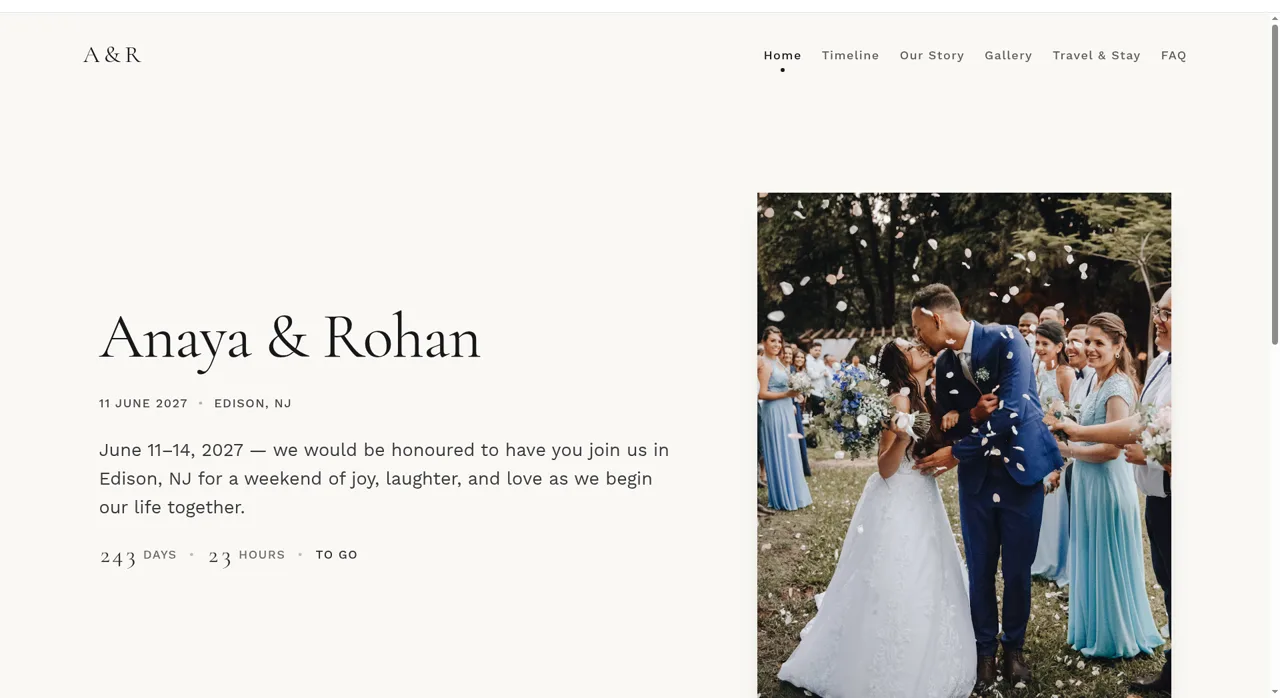
If you would rather not type every reply into a sheet, this is how the same weekend runs in PlanMe.Club. Add each festivity with its own date and venue. Invite guests per festivity on one guest list, so each festivity gets its own RSVP column with accepted, declined and pending counts. Share the wedding website: each guest sees only the festivities they’re invited to. Use forms for meals, dietary needs and arrival dates. Send email or SMS broadcasts to everyone, or only to the guests of one festivity, such as a reminder to the sangeet list alone.
Because it is a shared workspace, both families, your planner and your vendors can work in the same plan instead of forwarding spreadsheets. The checklist, calendar, budget, vendor quotes and photo moments sit next to the guest list. PlanMe.Club is free during beta.
The short version of the product is on RSVP for multiple events and wedding website for multiple events. For the rest of the weekend, the South Asian wedding checklist puts invitations in month-by-month order, the multi-event budget guide prices each festivity by its own guest count, and Indian wedding events in order helps you decide which festivities you are hosting in the first place. See pricing or get in touch.
Sources
Product pages and help articles checked October 12, 2026.
- r/weddingplanning: Wedding website with multiple RSVP options and two categories of invite
- r/weddingplanning: What wedding website to use when you have multiple events to RSVP to (and not everyone is invited to all of them)
- r/weddingplanning: Website for Indian wedding
- r/weddingplanning: Anyone else end up with 4 separate guest lists (and RSVP lists) for one wedding?
- Joy: How to Manage Multiple Wedding Events with Different Guest Lists for Indian Weddings
- Joy Help Center: Managing RSVPs and schedules when not everyone is invited to every event
- Invyt: Indian Wedding RSVP Guide: How to Handle 5 Ceremonies
- Zola Help Center: How do I choose who’s invited to my events?
- Zola Help Center: What is a private event, and who can see it on my website?
- The Knot Help Center: How do I add guests to an event?
- The Knot Help Center: How do I add/edit events on my Wedding Website?
- The Knot: When Should RSVPs Be Due for a Wedding?
- The Knot: When Is the Final Headcount for Your Wedding Due?
- GOV.UK: Apply for a Standard Visitor visa
- Product pages: Joy websites, Joy registry, Zola websites, Zola registry, The Knot websites
Common questions
How do you handle RSVPs for a wedding with several events?
Keep one master guest list with one row per household, and mark which festivities each household is invited to. Send one invitation and one RSVP link per household, and collect a separate yes or no, with a number of people, for every festivity on that household's invitation. Your headcount for each festivity is then a sum of that one column, and your reminder list is everyone invited to it who hasn't answered.
Should RSVPs be per household or per person?
Both. Invite and remind by household, because that is how families reply, but count by person, because caterers, chairs and shuttles are per person. Name every invited person on the household record instead of writing 'and family', and let the household say which people are coming to which festivity.
When should the RSVP deadline be for a multi-day wedding?
The Knot puts the RSVP deadline for a one-day wedding about three to four weeks out, and Invyt suggests about three weeks before each Indian wedding event. For a weekend with several festivities, one deadline about four weeks before the first festivity is simplest for guests, and it leaves time to chase stragglers before caterers want final numbers, which is often around two weeks out. Check each caterer's contract for its own cut-off.
How do I stop guests seeing festivities they aren't invited to?
Use a wedding website that personalizes the schedule or the RSVP form by guest. Joy, Zola and The Knot each have a way to keep an event off the public schedule and show it only to invited guests in the RSVP flow; their help pages describe the differences. On PlanMe.Club, the wedding website shows each guest only the festivities they're invited to.
How many RSVP reminders should I send?
A workable rhythm is the invitation, one nudge a few weeks later, a reminder about a week before the deadline, a deadline-day note, then phone calls to anyone still pending. Send each reminder only to households that are invited to that festivity and haven't answered, so people who already replied don't get chased.
What should a per-festivity RSVP ask?
For each festivity: is each named person coming, are children coming, and do they need the shuttle. Once per person: meals and dietary needs such as vegetarian, Jain, halal, vegan or allergies, plus accessibility needs. Once per household: arrival and departure dates and whether they are in the hotel block. Ask only what a vendor or a host will actually use.
Is there a free invite matrix template?
Yes. This article links a free spreadsheet (XLSX, plus CSV versions) with one row per household and an invited and attending column for each festivity, a headcount sheet with the formulas filled in, and the reminder email and SMS copy. The filled-in rows are clearly marked example data.