On this page
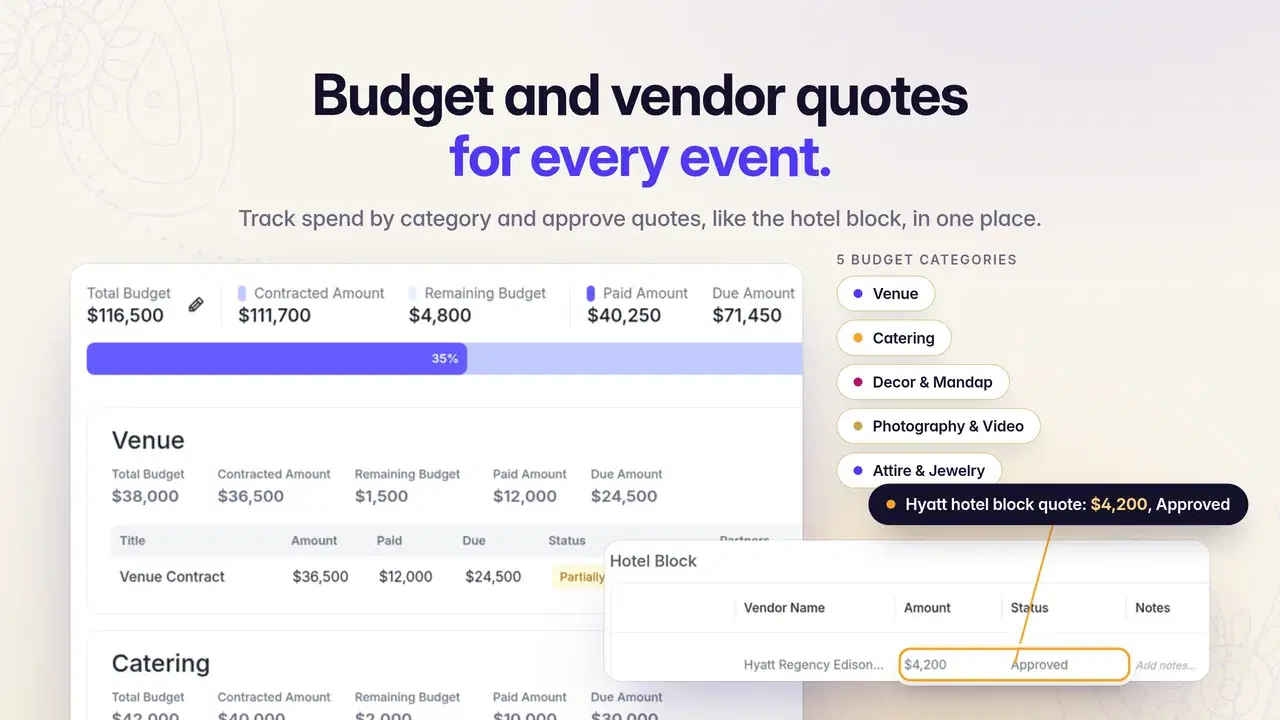
Most "alternatives" lists treat every tool as a one-for-one swap. That's how planners end up paying for a second CRM and still texting headcounts out of a spreadsheet. HoneyBook's own wedding planners CRM page positions it for inquiries, bookings, contracts, timelines, invoices and communication. Aisle Planner, Dubsado, 17hats and Planning Pod compete on that business side. PlanMe.Club is our product; it's built for the shared wedding plan with the couple and both families, not for replacing your invoices. Prices and features checked October 25, 2026.
The short answer
Pick by the job you're replacing:
- Need a cheaper or more automated CRM than HoneyBook: look at Dubsado (Starter from $35/mo or $335/yr; Premier $55/mo or $525/yr) or 17hats ($60/mo, $600/yr, or $800 for two years).
- Need wedding project tools in the same login as sales: look at Aisle Planner (Sales Essentials $49.99/mo; full project plans from $69.99/mo for up to 15 active projects, up to $229.99/mo for 51–100).
- Need a shared plan for a multi-event weekend (mehndi, sangeet, ceremony, reception) with both families editing one guest list: use PlanMe.Club alongside your CRM. It is free during beta.
- Need venue-heavy or high-volume event ops: look at Planning Pod (demo-led on its own site; third-party listings commonly show event-management plans from about $74/mo — confirm on a demo).
- HoneyBook is fine for billing, and the pain is family access and per-event RSVPs: keep HoneyBook; add a shared workspace. See our guides to software for South Asian wedding planners and wedding planner client portals.
Want the shared weekend workspace? Start free on PlanMe.Club and create one client wedding.
Why wedding planners look past HoneyBook (and when you shouldn't)
Three search intents show up again and again: “cheaper than HoneyBook,” “HoneyBook alternatives Reddit,” and “HoneyBook vs Dubsado / Aisle Planner.”
Price. HoneyBook’s pricing page lists Starter at $29/mo, Essentials at $49/mo and Premium at $109/mo when billed yearly (monthly is $36 / $59 / $129). Card fees start at 2.7% + 10¢; ACH is 1.5%. A 30-day free trial is available. Those numbers are fine for many studios; they aren't “free,” which is why “HoneyBook alternatives free” is a real autocomplete.
What HoneyBook is for. On its wedding planners CRM page, HoneyBook highlights lead tracking, proposals, contracts, invoices, scheduling, automations and a client portal for timelines, invoices and documents. That's business ops. It doesn't claim a per-event guest model for a four-event Desi weekend.
What still lives in Sheets. On r/EventPlanners, planners still describe shared Google Drive and Sheets for the live client plan because families already know them. Photographers and creatives debating leaving HoneyBook on Reddit (for example “How do you feel about the HoneyBook price change?” and “For those who left HoneyBook”) mostly compare CRMs and galleries, not multi-event guest logistics. If your pain is Anaya and Rohan's 120 / 280 / 320 / 380 headcounts across four events, swapping CRM for CRM won't fix it.
When to stay. Stay on HoneyBook if proposals, contracts and getting paid already work, your team likes the portal for files and invoices, and you only need a better place for the weekend plan. Replacing a working billing stack mid-season usually costs more grief than adding a second tool for guests and events.
CRM vs wedding workspace: two jobs
| Item | Job 1: run your business | Job 2: run the wedding with the family |
|---|---|---|
| Who uses it | You and your team | You, your team, the couple, both families, sometimes vendors |
| What lives there | Leads, proposals, contracts, invoices, payments to you | Events (functions), master guest list, per-event invites and RSVPs, vendor quotes, budget, checklist, website |
| Typical tools | HoneyBook, Dubsado, 17hats, Aisle Planner sales tools, Planning Pod | PlanMe.Club, Aisle Planner project tools, Sheets/Drive, Cordially Wed for guest messaging |
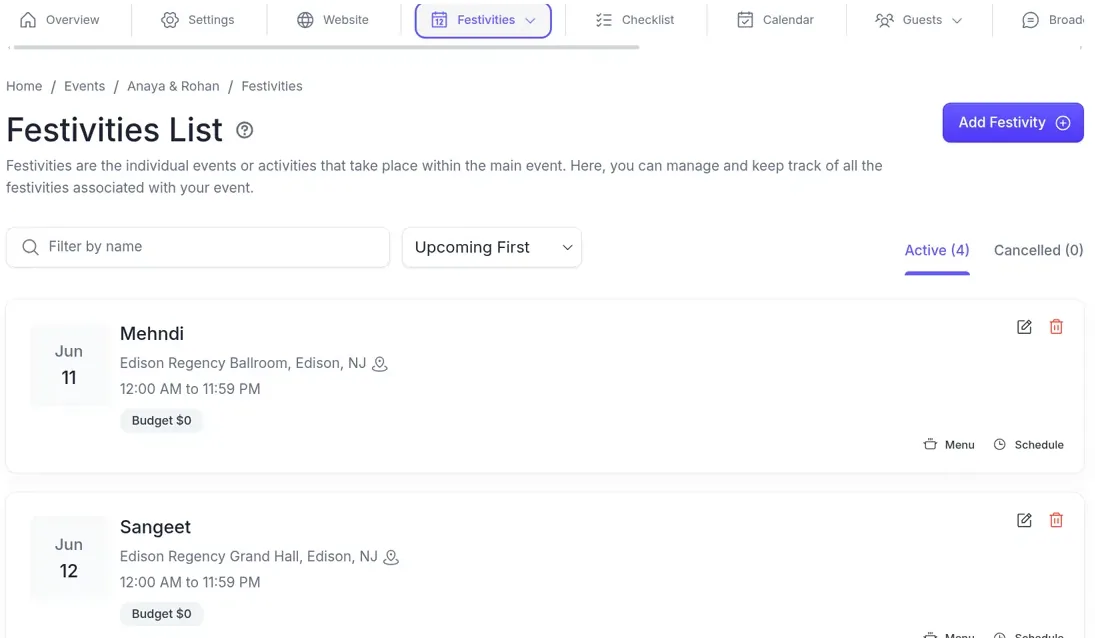
In PlanMe.Club, each client wedding is one event made of festivities (the in-app name for each function on the weekend: mehndi, sangeet, ceremony, reception). That's the one place this guide uses the product word; everywhere else we say events or functions.
Comparison table
PlanMe.Club is our product. Each competitor row links to that product’s own pricing or product page. We don’t mark a competitor “no” on anything their own pages don’t confirm.
Highlighted = PlanMe matches or beats the other options on that row.
| Feature | PlanMe.Club (ours) | Dubsado | Aisle Planner | 17hats | Planning Pod | HoneyBook | Cordially Wed |
|---|---|---|---|---|---|---|---|
| Main job | Shared wedding workspace | CRM + workflows | CRM + wedding project tools | All-in-one small-business CRM | Event / venue suite | Client-flow CRM (baseline) | Guest messaging |
| Best for | Multi-event weekends where the couple and both families share one live plan | Planners who want deep automation and forms, often for less than HoneyBook Essentials | Wedding-only studios that want sales and planning behind one login | Solo planners who want one inclusive plan and Knot/WeddingWire lead handling | Firms that also run venues or high event volume | Fast proposals, contracts, invoices, portal | SMS / WhatsApp to guests, Wallet passes |
| Starting price (checked) | PlanMe highlight: better than the other options on this row. Free during beta; paid plans planned, pricing not final | Starter $35/mo or $335/yr; Premier $55/mo or $525/yr; 21-day trial | Sales Essentials $49.99/mo; full plans $69.99–$229.99/mo by active projects; 10% off yearly; 30-day trial | $60/mo, $600/yr, or $800/two years; 7-day trial | Demo-led on its site; review listings often from ~$74/mo — confirm on demo | From $29/mo yearly (Starter); Essentials $49/mo; Premium $109/mo yearly | Per-wedding messaging from about $69 one-time; planner plans on their site |
| Replaces HoneyBook? | No — pair it with a CRM | Yes, for CRM/invoicing | Partially — stronger on wedding production | Yes, for CRM/invoicing | Sometimes, for ops-heavy firms | — | No — different job |
The alternatives, one by one
1. PlanMe.Club — best shared workspace for multi-event weekends
Best for: planners whose clients have several events with overlapping guest lists, and who want the couple and both families in one live plan instead of forwarded spreadsheets.
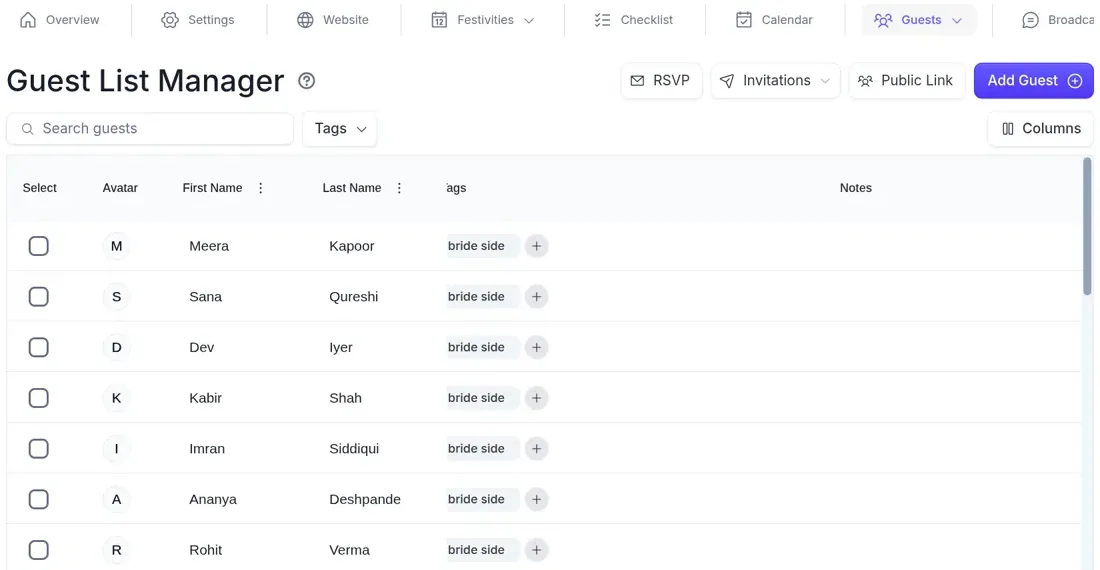
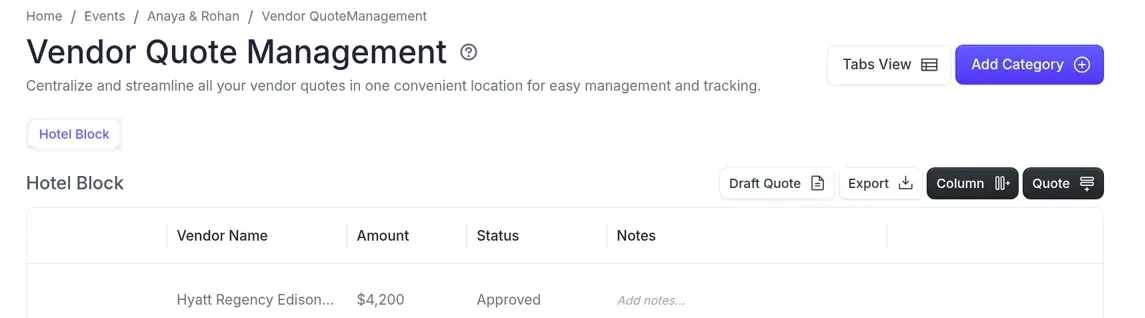
Each client wedding is its own workspace with events, one master guest list, per-event invites and RSVPs, vendor quotes, budget, checklist, seating charts, registry on the wedding website, and templates you can reuse. Guests never log into the planner workspace; each household gets a private RSVP link by email that shows only the events they're invited to. Vendor management means quotes stored inside the wedding (amount, status, notes), not a vendor marketplace.
Price: Free during beta. Paid plans are planned; pricing is not final. No credit card required to start.
Where it is not a HoneyBook alternative: No lead pipeline, proposals, contracts, invoicing, client payments or white-label portal. Keep HoneyBook, Dubsado, 17hats or Aisle Planner for getting paid.
Example: For a fictional Anaya & Rohan weekend in Edison, NJ (haldi 120, mehndi/sangeet 280, ceremony 320, reception 380), you import both families' lists once, tag by side, and track RSVPs per event so the caterer gets four numbers, not one.
2. Dubsado — best cheaper CRM with deep workflows
Best for: planners leaving HoneyBook primarily for price or automation, who are willing to invest setup time in forms and Flows.
Per Dubsado’s pricing page, both plans include unlimited projects and clients, invoicing and payment plans, form and email templates, client portals, calendar connection and a mobile app. Starter includes one active lead capture form. Premier adds scheduling, automated workflows, public proposals, unlimited lead forms, Zapier and bookkeeping integrations. Annual billing is $335 (Starter) or $525 (Premier); monthly is $35 / $55. Trial: 21 days, no card required (per their FAQ).
Where Dubsado beats PlanMe.Club: contracts, invoices, payment plans, lead forms and workflow automation: the CRM job PlanMe doesn't do.
Watch-outs: No wedding-native multi-event guest model. Steeper setup than HoneyBook for many users, a common Reddit theme when people compare the two.
3. Aisle Planner — best wedding-specific CRM + planning suite
Best for: wedding-only studios that want leads, proposals, invoices and project tools (checklists, timelines, budgets, guests, layouts and seating, event website and RSVP) in one product.
Aisle Planner pricing starts at Sales Essentials $49.99/mo (sales tools only, no project management). Full project plans scale by active projects: up to 15 for $69.99/mo, 16–25 for $109.99/mo, 26–50 for $164.99/mo, 51–100 for $229.99/mo, with about 10% off on annual billing and a 30-day trial (card required). Client portal and wedding production tools sit on the project plans. Couples no longer buy Aisle Planner on their own; they join when a planner invites them.
Where Aisle Planner beats PlanMe.Club: built-in sales tools, invoicing, layouts/seating maturity, and one login for sales plus production. See also PlanMe vs Aisle Planner.
Watch-outs: Cost rises with active project count. Multi-event Desi guest logistics still deserve a careful trial before you assume the portal replaces a shared family workspace.
4. 17hats — simple all-inclusive CRM
Best for: solo planners who want one published plan price and wedding-marketplace lead handling.
17hats pricing advertises an all-inclusive plan at $60/mo, $600/yr, or $800 for two years, with a 7-day trial. Features include contacts, projects, quotes, contracts, invoices, questionnaires, client portal, email tools and lead capture, with add-ons (extra users, brands, bank connect, QuickBooks, advanced scheduling) billed separately. Their site also calls out The Knot / WeddingWire lead handling for wedding businesses.
Where 17hats beats PlanMe.Club: the full CRM and payment stack.
Watch-outs: Confirm current document limits and package names on their pricing grid before you commit; the page mixes “all features” messaging with leveled document caps. Not a multi-event guest workspace.
5. Planning Pod — event and venue operations
Best for: firms that book venues, corporate events or high monthly event volume alongside weddings.
Planning Pod markets venue and event management (bookings, BEOs, floor plans, proposals, contracts, payments). Its public site is demo-led rather than a simple self-serve price list. Third-party 2026 listings commonly show event-management Planner plans from roughly $74/mo with event caps. Treat those as unverified until you get a quote from Planning Pod.
Where Planning Pod beats PlanMe.Club: venue ops, BEOs and high-volume event business tooling.
Watch-outs: Overkill if you only need a CRM plus a family wedding workspace.
6. Cordially Wed — guest messaging, not a CRM swap
Best for: studios that need SMS or WhatsApp blasts to guests and Wallet passes.
Guest list, per-event RSVPs and website tools with paid messaging. Planner-facing plans are listed on Cordially Wed's own site and comparison guides (re-check before buying).
Where it beats PlanMe.Club: WhatsApp and paid guest texting. PlanMe doesn't send WhatsApp.
Watch-outs: Does not replace HoneyBook invoicing.
7. When to keep HoneyBook
Keep HoneyBook when:
- Your proposals and payment collection already convert cleanly.
- Your team is trained on its automations and portal.
- Your real gap is the wedding weekend plan with two families. Add PlanMe or tighten Sheets, rather than migrating CRM mid-book.
HoneyBook still wins on polished client-flow, mature support and “unlimited clients and projects on every plan” messaging on its pricing page. Its client portal help article covers what clients can see for files, invoices and project details.
Cheaper stacks that still get you paid
| Goal | Stack | Rough monthly (yearly billing where offered) |
|---|---|---|
| Lowest CRM bill + multi-event workspace | Dubsado Starter + PlanMe | ~$28–35 CRM + PlanMe free during beta |
| One wedding-specific login | Aisle Planner project plan alone | from $69.99 |
| HoneyBook stays; fix family access | HoneyBook Essentials + PlanMe | ~$49 + PlanMe free during beta |
| Solo CRM, simple pricing | 17hats | $60 (or $50 effective on annual) |
Processing fees still apply on whichever CRM collects card payments. Compare fee schedules on each site. Don't assume “cheaper subscription” means lower total cost at high invoice volume.
Switching checklist
- Write down the job you're replacing. CRM only, wedding workspace only, or both.
- Export what you own. Client contact list, open invoices, contract templates, and any guest CSVs still living in Sheets.
- Run one active wedding in parallel. Don't cut over every client in peak season.
- Re-create roles before inviting parents. Use an access map (who sees budget vs guest list). Our client portal guide has a worksheet.
- Keep payment links working until the last deposit clears on the old system.
- Tell clients once, in plain language, which login is for contracts/invoices and which is for the weekend plan.
For RSVPs across several events on one weekend, see wedding RSVP for multiple events. Planner overview: wedding planner software.
Start free on PlanMe.Club during beta and set up your next client’s weekend plan.
Sources
Checked October 25, 2026. Product facts link to each company’s own pages. Reddit threads are opinions, not benchmarks.
- HoneyBook pricing · HoneyBook CRM for wedding planners · HoneyBook client portal help · HoneyBook vs Aisle Planner
- Dubsado pricing
- Aisle Planner pricing
- 17hats pricing
- Planning Pod
- Cordially Wed
- r/EventPlanners: What portals do you use?
- r/weddingvideography: HoneyBook price change
- r/WeddingPhotography: For those who left HoneyBook
Common questions
What is the best HoneyBook alternative for wedding planners?
It depends which job you're replacing. For a cheaper CRM with automation, Dubsado is the usual shortlist pick (from $35/mo or $335/yr). For wedding production plus sales in one login, Aisle Planner. For a shared multi-event plan with both families, PlanMe.Club (our product, free during beta) paired with whatever CRM already gets you paid. Checked October 25, 2026.
Is there a free HoneyBook alternative?
There's no full free clone of HoneyBook's CRM, invoices and payment processing. Google Drive and Sheets are free for the shared plan. PlanMe.Club is free during beta for the wedding workspace (not for invoicing). Joy is free for couples and can add a coordinator as a collaborator, but it isn't a planner CRM. HoneyBook, Dubsado, 17hats and Aisle Planner are paid products with trials.
Is Dubsado cheaper than HoneyBook?
Often, yes on subscription list price: Dubsado Starter is $35/mo or $335/yr; HoneyBook Essentials is $49/mo yearly ($59 monthly). HoneyBook Starter at $29/mo yearly can undercut Dubsado Starter. Compare the plan features you need and card/ACH fees on each site. Prices checked October 25, 2026.
Does PlanMe.Club replace HoneyBook?
No. PlanMe.Club has no proposals, contracts, invoicing or client payment processing. Keep HoneyBook (or Dubsado, 17hats, Aisle Planner) for business ops. Use PlanMe for events, guest lists, per-event RSVPs, vendor quotes, budget and the shared family workspace.
Can I keep HoneyBook and add something for guest lists?
Yes. That's the stack we recommend most often for multi-event South Asian weekends: HoneyBook for getting paid, PlanMe.Club for the live wedding plan. See software for South Asian wedding planners.
What about Aisle Planner vs HoneyBook?
HoneyBook leans toward polished client-flow CRM for many creative industries. Aisle Planner is wedding-specific and includes project tools (timelines, guests, layouts, seating, website/RSVP) on its project plans. HoneyBook's own comparison content frames that split similarly. Re-check both pricing pages before you switch.