On this page
By the second day of a wedding weekend, the most-asked questions are not about rituals. They are “What time do we leave?”, “Is lunch served?”, “Can I wear white to the haldi?” and “Which hotel is the shuttle from?”. A guest itinerary answers them once, in writing, before anyone has to call the bride’s mother.
Desi wedding guides have started publishing guest itinerary templates, and they agree on the format. Mandap Chat’s template is one row per function with the guest time, venue, dress code, food and transport. ShaadiPath and Weddingkart lay out similar three-day schedules. What matters most for a diaspora weekend is the last step: different households are invited to different events, so the itinerary is not one document for everyone.
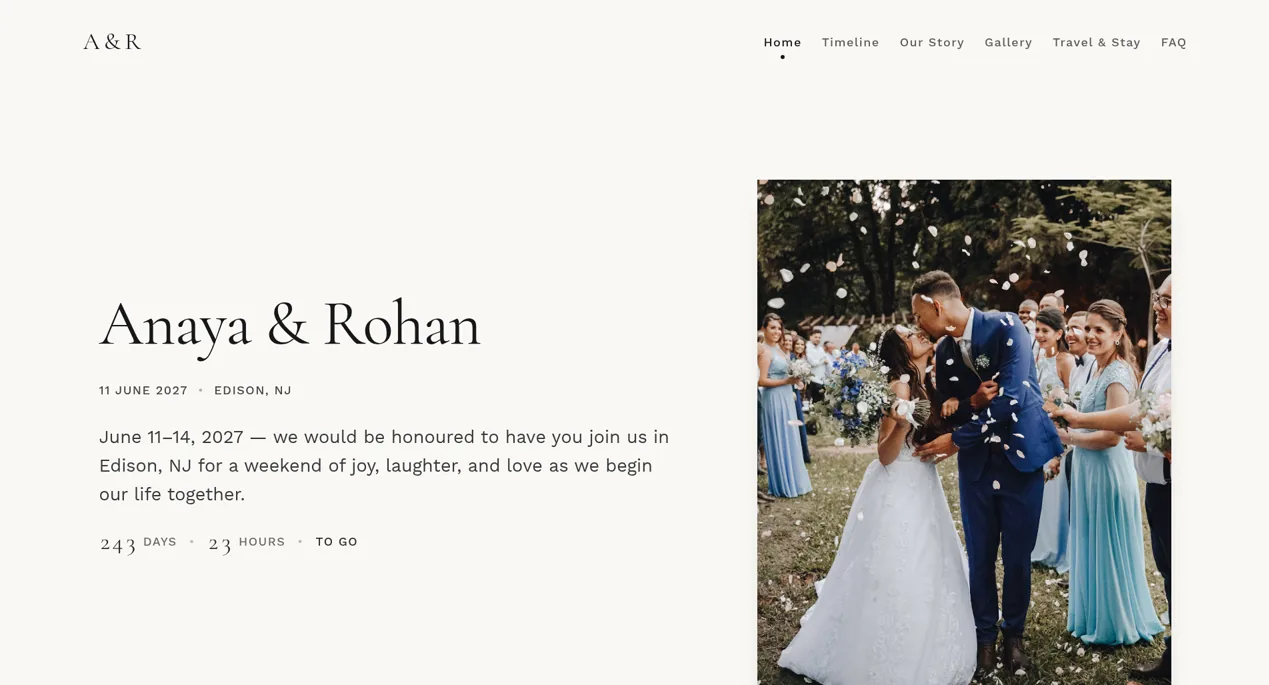
The example below uses our fictional showcase couple, Anaya and Rohan, in Edison, New Jersey. The times follow the shape of our wedding day timeline and are a sample, not a rule. Swap in your own venues and the hours your contracts allow.
What goes on a wedding itinerary for guests?
For every event: the time guests should arrive, the venue with its address, the dress code, whether food is served, and how to get there and back. Put a short header on top with the RSVP link, the hotel block and one person to call all weekend.
Mandap Chat's guest itinerary template makes a point worth copying: the planner may have a 30-column run sheet, but guests should get a short version that reads on a phone. Leave out vendor load-in, the photographer's shot list and the pandit's arrival. Guests need four things per event: when, where, what to wear, and how they get there.
- Time. The time to arrive, not the muhurat. If the pheras start at 4:20 pm and guests must be seated by 4:00 pm, the itinerary says 4:00 pm.
- Venue. Name, full address, which entrance, and where to park. A hotel with three ballrooms needs the room name.
- Dress code. Colours if you have a theme, plus the practical note: flats on grass, clothes that can take turmeric, a head covering at a gurdwara.
- Transport. Shuttle departure and return times, or valet and parking. Note the last ride back.
- Food. One line: snacks, lunch, or a full dinner and when it starts. Elders and guests with kids plan around it.
What does a 3-day Indian wedding itinerary look like?
A common three-day shape is a welcome lunch and the mehndi on day one, a morning haldi and the sangeet on day two, and the baraat, the ceremony and the reception on day three. Here is that shape as a guest would see it, for a household invited to everything.
| Day | Guests arrive | Event | Venue | Dress code | Transport |
|---|---|---|---|---|---|
| Day 1 | 12:30 pm | Welcome lunch | Main block hotel, restaurant | Smart casual | Walk down from the lobby |
| Day 1 | 4:00 pm | Mehndi | Hotel garden room | Bright colours, flats, nothing you mind henna on | Hotel guests walk; parking for locals |
| Day 2 | 10:00 am | Haldi (family and close friends) | Family home or hotel terrace | Yellow or white you don’t mind staining | Shuttle from the lobby at 9:40 am |
| Day 2 | 6:00 pm | Sangeet | Hotel ballroom | Festive Indian or cocktail; dance-friendly shoes | Return shuttles until 11:15 pm |
| Day 3 | 3:00 pm | Baraat (groom’s side and friends) | Meet in the hotel lobby | Festive Indian, comfortable shoes | Leaves at 3:15 pm |
| Day 3 | Seated by 4:00 pm | Wedding ceremony | Banquet hall, ceremony room | Traditional Indian | Shuttle at 3:20 pm for non-baraat guests |
| Day 3 | 6:45 pm | Reception | Banquet hall, main room | Formal Indian or Western | Last shuttle back at 11:15 pm |
This order is one of several. ShaadiPath's three-day schedule puts haldi and mehndi on day one and the sangeet on day two, and Zivaara Studio's US timeline describes mehndi (or mehndi and haldi) on day one, sangeet on day two and the ceremony and reception on day three. Sikh weekends often center on a morning Anand Karaj, and Pakistani weekends on mehndi, nikah and walima. The format of the itinerary stays the same. For choosing the order itself, see Indian wedding events in order.
What should you list for each event?
The same five lines every time (arrival time, venue, dress code, food and transport), plus the one thing that is particular to that event. These are the notes guests ask about most.
Welcome lunch or dinner
Keep it loose: a window rather than a start time, and the room or restaurant. Say whether it is hosted, so a cousin does not arrive having eaten. If people are still landing, say they can drop in late.
Mehndi
Give an end time as well as a start, so guests know how long to plan for. Say whether there will be artists for guests and roughly how long the wait is. Henna stains, so flats and cotton beat silk and suede.
Haldi
Say who it is for. A haldi is often immediate family and close friends, and the itinerary is where a guest learns whether they are expected. Warn about turmeric: yellow or white clothes they will not wear again, and a towel if it is outdoors.
Sangeet
List three times: doors, the first performance and dinner. If guests are performing, tell them the rehearsal or sound-check time separately, not on the main itinerary. Add the last shuttle.
Baraat
The baraat needs a meeting point and a leave time, not just "afternoon." Tell the groom's side and friends joining the procession where to gather; tell everyone else to go straight to the venue and when to be seated. If the venue has said where cars can stop, put that in too.
Wedding ceremony
Give a seated-by time, how long the ceremony runs (60 to 90 minutes is common in a US hall), and the house rules: shoes off near the mandap, head coverings at a gurdwara, no flash during the pheras. If lunch or snacks follow, say when.
Reception
Doors, the couple's entrance, dinner and the last song. Reception-only guests read this line and nothing else, so it needs the full address and parking even if everyone else has been at the venue since 3 pm.
The hour-by-hour version behind these lines, from makeup call to load-out, is the Indian wedding day timeline.
Should every guest get the same itinerary?
No. Each household should see only the events it is invited to. A reception-only colleague who reads the haldi address will either show up or feel left out, and both are avoidable.
| Household | Invited to | Their itinerary |
|---|---|---|
| Both immediate families | Everything, including the haldi | All seven lines, plus the family call times you send separately |
| College friends flying in | Mehndi, sangeet, ceremony, reception | Four events, with shuttle times and the hotel block |
| Work colleagues, local | Reception only | One line: doors, venue, parking, dress code |
That is the same per-festivity guest list you use for RSVPs and caterer counts. Our guide to RSVPs for a multi-event wedding works through the invite matrix, and the wedding hotel block guide turns the same list into rooms per night.
Copy-paste itinerary template
Replace the brackets, delete the events a household is not invited to, and keep it to one screen per day.
Anaya & Rohan's wedding weekend
Edison, NJ

RSVP (your private link): [link]
Hotel block: [hotel], book by [date] with code [code]
Questions all weekend: [name], [phone]

DAY 1, [date]
Welcome lunch
  Arrive: 12:30 pm
  Where: [hotel restaurant], [address]
  Wear: smart casual
  Getting there: walk down from the lobby

Mehndi
  Arrive: 4:00 pm (ends about 7:30 pm)
  Where: [venue], [address], parking at [lot]
  Wear: bright colours, flats; henna stains, so skip silk
  Getting there: shuttle from the lobby at 3:40 pm

DAY 2, [date]
Haldi (family and close friends)
  Arrive: 10:00 am (ends 11:30 am)
  Where: [venue]
  Wear: yellow or white you don't mind staining
  Getting there: [details]

Sangeet
  Arrive: 6:00 pm, first performance 6:20 pm, dinner 8:30 pm
  Where: [ballroom], [address]
  Wear: festive Indian or cocktail, shoes you can dance in
  Getting there: shuttles from 5:30 pm, last one back at 11:15 pm

DAY 3, [date]
Baraat (join the groom's side)
  Meet: 3:00 pm in the hotel lobby, leaves 3:15 pm
  Wear: festive Indian, comfortable shoes
Wedding ceremony
  Seated by: 4:00 pm
  Where: [venue], [address]
  Wear: traditional Indian; shoes off at the mandap
Reception
  Doors: 6:45 pm, couple's entrance 7:15 pm, dinner 8:00 pm, last song 10:40 pm
  Where: [hall], [address]
  Wear: formal Indian or Western
  Getting there: last shuttle back at 11:15 pm
How should you share the itinerary with guests?
Put it in one place guests can always reopen, send each household only its own events, and send one short reminder the week of the wedding. Do not drip it out over four separate messages.
- With the save-the-date: the city, the dates and roughly which days have events, so people can book flights and the hotel block.
- With the invitation or once times are final: the full itinerary. Weddingkart suggests four to six weeks ahead for overseas guests, as one consolidated schedule rather than several messages.
- The week of: a short reminder with anything that changed, the shuttle times and the contact person.
- For elders: a printed card or a large-type PDF, and a family member who walks them through it.
Keep one source of truth. Mandap Chat makes the same point: if a shuttle time changes, update the itinerary and the website first, then tell people, so the forwarded screenshots in the family group are not the only copy. Our best wedding website for multiple events comparison covers which sites can show each guest only their events.
Guest itineraries in PlanMe
In PlanMe the wedding is one event made of festivities. Each festivity (welcome lunch, mehndi, haldi, sangeet, the ceremony, the reception) has its own date, venue, itinerary and dress code, and each guest on the one guest list is invited to just the festivities they are coming to.
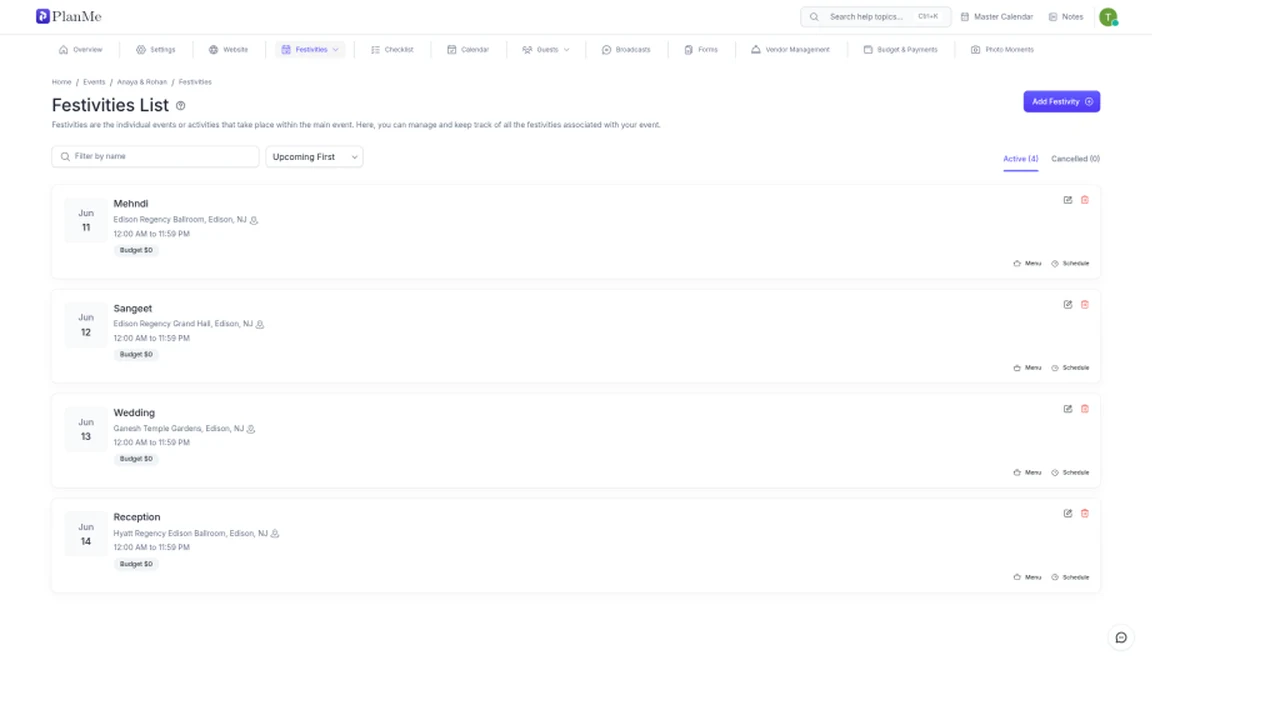
- Each household sees only its festivities. Guests get a private RSVP link by email or text, with no login and no app, that lists only the festivities they are invited to, each with its date and time, venue and dress code. Or they can look themselves up on the wedding website and see the same thing.
- The website schedule is the public version. The schedule on the wedding website lists the festivities you choose to show, and every visitor sees the same list. Leave a family-only haldi off it.
- The hour-by-hour itinerary stays with you. The schedule under each festivity is where the run of show for your family, planner and vendors lives.
- Texts go by tag or RSVP status. Email and SMS broadcasts go to everyone or to guests picked by tag or RSVP status, not by festivity. To text only the sangeet guests, tag them "sangeet" and send to that tag.
PlanMe sends by email and SMS. If your family lives in a group chat, paste the private link or the website link there yourself. Hotels, forms for arrival dates, the checklist and the budget sit in the same event; the month-by-month order is on the Indian wedding checklist. PlanMe is free during beta. Read who built it, see pricing, or get in touch.
Sources
Checked October 18, 2026. PlanMe capabilities checked against the product.
- Mandap Chat: Wedding Itinerary Template for Indian Wedding Guests
- Mandap Chat: Wedding Weekend Itinerary Template for Indian Destination Weddings
- ShaadiPath: Indian Wedding Itinerary Template, a Practical 3-Day Schedule
- Weddingkart: Indian Wedding Timeline, Day-by-Day Guide
- Zivaara Studio: Indian Wedding Timeline in the USA
Common questions
What should a wedding itinerary for guests include?
For each event: the day and the time guests should arrive, the venue with its address and parking or entrance notes, the dress code, whether a meal is served, and how guests get there and back. Add a short header with the RSVP link, the hotel block and one contact person for the weekend.
What is a typical 3-day Indian wedding itinerary?
A common shape is a welcome lunch or dinner and the mehndi on day one, a morning haldi and the evening sangeet on day two, and the baraat, the ceremony and the reception on day three. Many families swap the order, combine mehndi and sangeet, or move haldi to the wedding morning.
Should every guest get the same itinerary?
No. A reception-only guest should see the reception, not the haldi time and address. Send each household the events they are invited to, and keep the public website schedule to the events every guest may see.
When should you send the wedding weekend itinerary?
Share the shape of the weekend (which days, which city, roughly which events) with the save-the-date so people can book travel, and the full itinerary with times, venues and dress codes once the times are final. Weddingkart suggests four to six weeks out for overseas guests. Send a short reminder the week of the wedding.
Can PlanMe send each guest only their part of the itinerary?
Yes, through the RSVP. Each household gets a private RSVP link by email or text, with no login, that shows only the festivities they are invited to, each with its date, time, venue and dress code. Text broadcasts go to guests picked by tag or RSVP status rather than by festivity, so tag your sangeet guests if you want to text only them.