On this page
- The short answer
- What Aisle Planner bundles, and what it costs
- Why planners look for an Aisle Planner alternative
- The multi-event test: 7 checks for any trial
- Aisle Planner alternatives compared
- The alternatives, by use case
- When to stay on Aisle Planner
- Switching without losing a season
- Sources
- Common questions
PlanMe.Club is our product. It isn't a CRM, and we say so wherever it matters below. Every price and feature claim about another product links to that product's own pricing page or help center, and we give every tool a "best for" line, including the cases where staying on Aisle Planner is the right call. Prices and features checked October 26, 2026.
If you want the head-to-head instead, read PlanMe vs Aisle Planner. This page is the wider view: what to do when you're not sure Aisle Planner, or any single tool, is the answer.
The short answer
Start with what you'd be replacing. Aisle Planner does two jobs: it runs your business (leads, proposals, contracts, invoices) and it runs each wedding (checklists, timelines, guests, seating, website and RSVP). Most alternatives are strong at one of those jobs, not both.
- You want the same all-in-one idea for less: try Harpsen (flat $19 or $39 a month, floor plans on the higher plan) or Nuptial ($39 to $149 a month, newer, in beta since April 2026).
- You run venues or high event volume too: book a demo with Planning Pod.
- You mainly want a better CRM: HoneyBook or Dubsado, plus a separate place for guests and events.
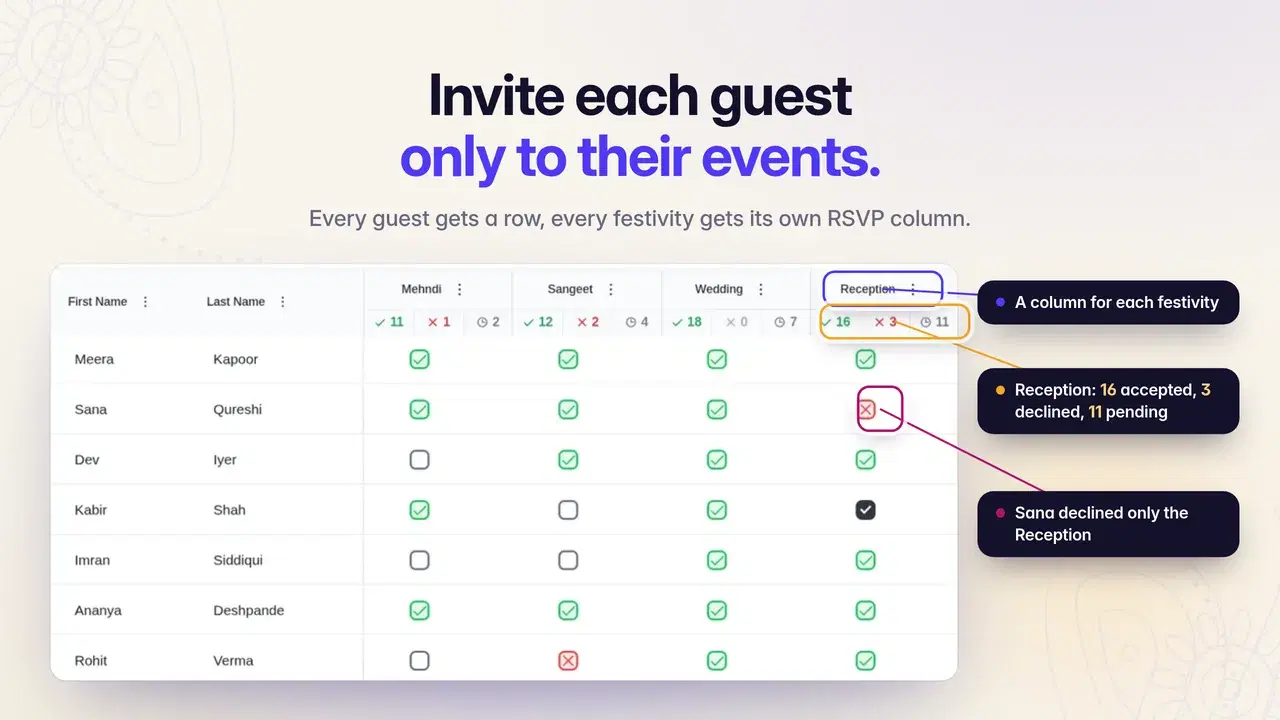
- Your real pain is guest logistics across the mehndi, sangeet, wedding and reception: pair any CRM with PlanMe.Club, a shared workspace for the couple and both families. It's free during beta.
- Aisle Planner already handles your multi-event guest lists and your couples use it: stay. Switching mid-season costs more than it saves.
Not sure which camp you're in? Run the multi-event test below on your current setup first. It takes an afternoon and tells you whether you have a software problem or a process problem.
What Aisle Planner bundles, and what it costs
It's worth being precise here, because some comparison pages aren't. Aisle Planner's own pricing page lists five plans, priced by how many projects you have active at once:
| Plan | Monthly price | What's included |
|---|---|---|
| Sales Essentials | $49.99 | Sales and business tools only. No project management tools. |
| Up to 15 projects | $69.99 | Sales tools plus all project tools |
| 16 to 25 projects | $109.99 | Same features, more active projects |
| 26 to 50 projects | $164.99 | Same features, more active projects |
| 51 to 100 projects | $229.99 | Same features; over 100, contact support |
The sales side covers lead management, a scheduling assistant, questionnaires, proposals and interactive quotes, contracts and e-signatures, invoicing and online payments. The project side, which starts at $69.99, covers the client portal, checklists, timelines, budgets, style guides, vendor and file management, guest management and messaging, layouts and seating, and an event website with online RSVP. Every plan includes unlimited users, custom branding and a Zapier integration. The 30-day trial needs a credit card.
Two details matter for multi-event weddings. Aisle Planner's guest manager help article says you can create separate guest lists for secondary events (it gives a rehearsal, shower and brunch as examples), and its guest messaging guide lets you pick events and then filter to all guests, confirmed guests, guests who haven't responded, or out-of-town guests. The messaging guide describes email. So the multi-event basics are there. Whether they hold up across four events and 350 guests from two families is what the test below checks.
A worked example. Say you book about 20 weddings a year and, because most clients book you around a year out, about 18 of them are active at any one time. That puts you on the 16 to 25 project plan: $109.99 a month, or $1,319.88 a year at list price (roughly $1,188 with the yearly discount). Add three more bookings in a busy spring and you're still on that tier; cross 25 active projects and you're on $164.99. That step is the "it got expensive as I grew" complaint you'll hear from planners.
One correction worth knowing: a Wedding Planner Central comparison describes Aisle Planner as "monthly + per-wedding fees". Aisle Planner's pricing page, checked today, shows tiers by active project count and doesn't list a per-wedding fee. Check the source before you build a budget on a third-party summary, including this one.
Why planners look for an Aisle Planner alternative
Autocomplete tells you what people are weighing: "Aisle Planner alternative", "Aisle Planner vs HoneyBook", "Aisle Planner vs Dubsado", "Aisle Planner pricing" and "does Aisle Planner have an app". Forum threads fill in the reasons. These are opinions, not benchmarks, but they keep coming up.
Cost that rises with your calendar. In a first-person post on Olive Branch Events Co., a planner explains leaving Aisle Planner for Dubsado mainly over price, while saying she still liked its wedding tools. Her post dates from 2021 and quotes older plan prices, so read it for the reasoning, not the numbers.
Clients who won't log in. The same post says many of her couples preferred Google Drive to another login. On r/EventPlanners (January 2026), planners split the same way: some keep the client plan in Drive and Sheets because families already know them, while an Aisle Planner user says her clients prefer it to a spreadsheet once she walks them through it on the kickoff call. Both can be true. It depends on your clients, and on whether you onboard them.
No tool does everything. In an r/weddingplanning thread from August 2025, one planning company says there's no great all-in-one software on the planner side; they use Aisle Planner and still pay for other tools. In the same thread, a couple whose planner set them up on Aisle Planner says they like the checklist and having payments on a calendar. A newer planner on r/weddingplanning asked what else offers a client portal plus 3D event renderings, which Aisle Planner doesn't market.
Phones on the day. Aisle Planner's help center says there's no official app in the app stores yet and points you to its mobile-friendly site. Its mobile tips article adds that the layout tool and drag-and-drop in the checklist, budget and seating tools aren't available on mobile. If you rework a seating chart in a hallway at 6 pm on the sangeet night, that matters.
Multi-event weekends. This one rarely shows up in generic "alternatives" lists, but it's the reason this page exists. A South Asian wedding is often four or more events across three days, each with its own guest list: the mehndi might be 180 people, the sangeet 260, the ceremony 320 and the reception 380, with both families adding names until the week before. Any tool that treats the weekend as one wedding with a few side events will make you do the math by hand.
The multi-event test: 7 checks for any trial
Before you move a single client, set up one realistic weekend in the trial. We use a fictional couple, Anaya & Rohan, with four events: mehndi, sangeet, wedding and reception. Add about 30 households, then run these checks. They work on Aisle Planner too, so you can test the tool you already pay for.
- The reception-only household. Invite one household to the reception only. Open their RSVP link as a guest. Do they see only the reception, or the whole weekend? Families notice, and some will ask why they weren't invited to the sangeet.
- The partial yes. Have a household say yes to the sangeet and reception and no to the mehndi. Does each event's count update on its own, without you editing anything?
- Four numbers for the caterer. Can you pull a yes count per event in under a minute? If you also need counts by diet, our catering headcount calculator turns yes counts per event into veg, Jain, halal and kids plate counts.
- Both families editing. Give the groom's side access to add their 40 names. Can they edit the guest list without seeing the budget? Can you tell who added whom?
- The targeted reminder. Message only the guests who haven't replied. Check whether that works by email, by text, or both, and what texting costs. To pick the reminder date, work back from your caterer and hotel cut-offs with the RSVP deadline calculator.
- Seating from the right list. Build the reception seating chart. Does it start from reception yeses, or from everyone invited to anything?
- The next client. Save this weekend as a starting point and spin up a second wedding from it. If you rebuild four events by hand for every client, the tool is costing you hours, whatever its price.
Score each check pass, workaround or fail. Two or more fails on a tool you're paying for is a real case for switching. All passes on Aisle Planner means your problem is probably onboarding or price, and the alternatives below are about cost, not capability.
Aisle Planner alternatives compared
PlanMe.Club is our product. Each competitor row links to that product's own pages; where a feature isn't documented there, we say so rather than guess. "Replaces" means which of Aisle Planner's two jobs the tool can take over.
| Feature | PlanMe.Club (ours) | Harpsen | Nuptial | Planning Pod | HoneyBook | Dubsado | Aisle Planner (baseline) |
|---|---|---|---|---|---|---|---|
| Replaces | The wedding job only. No CRM or invoicing. | Both jobs | Both jobs | Both jobs, plus venue ops | The business job | The business job | Both jobs |
| Multi-event guests (documented) | Yes: invites and RSVPs per event, one master guest list | Guest lists documented; per-event invites not spelled out | Multi-day run of show documented; per-event invites not spelled out | Guest lists, RSVPs, websites, seating and floor plans listed | Not listed on its pricing page | Not listed on its pricing page | Separate guest lists for secondary events; email by event |
| Starting price (checked) | Free during beta; paid plans planned, pricing not final | $19/mo or $39/mo ($15.83 / $32.50 billed yearly); trial, no card | Solo $39/mo (3 active weddings); Planner $79/mo; Business $149/mo; 30-day trial, no card | Demo-led; no public price list on its site | Starter $29/mo, Essentials $49/mo, Premium $109/mo (billed yearly); 30-day trial | Starter $335/yr, Premier $525/yr; 21-day trial, no card | $49.99/mo sales only; project plans $69.99 to $229.99/mo |
| Best for | Multi-event weekends where both families share one live plan | Planners who want Aisle Planner's all-in-one idea at a flat price | Small studios that want day-of vendor links and a newer, planner-built tool | Firms that also run venues, corporate events or high volume | Polished proposals, contracts, invoices and payments | Deep workflow automation, plus a mobile app | Wedding-only studios whose couples use the portal |
The alternatives, by use case
1. PlanMe.Club: for multi-event guest logistics (pair it with a CRM)
Best for: planners whose Aisle Planner frustration is the weekend itself: four or five events, overlapping guest lists, two families editing, and a caterer who wants a separate headcount for every night.
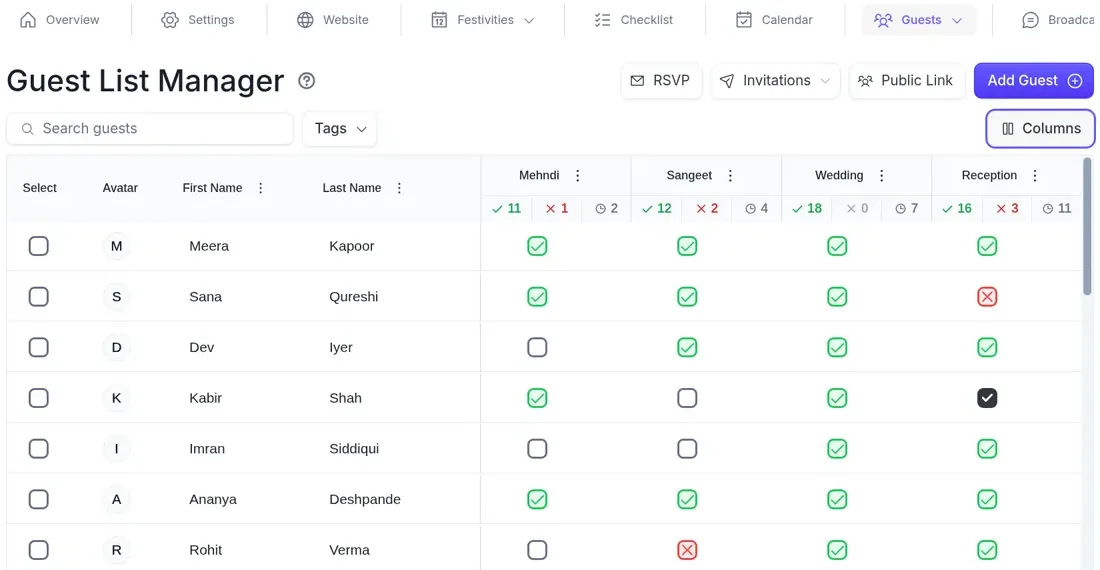
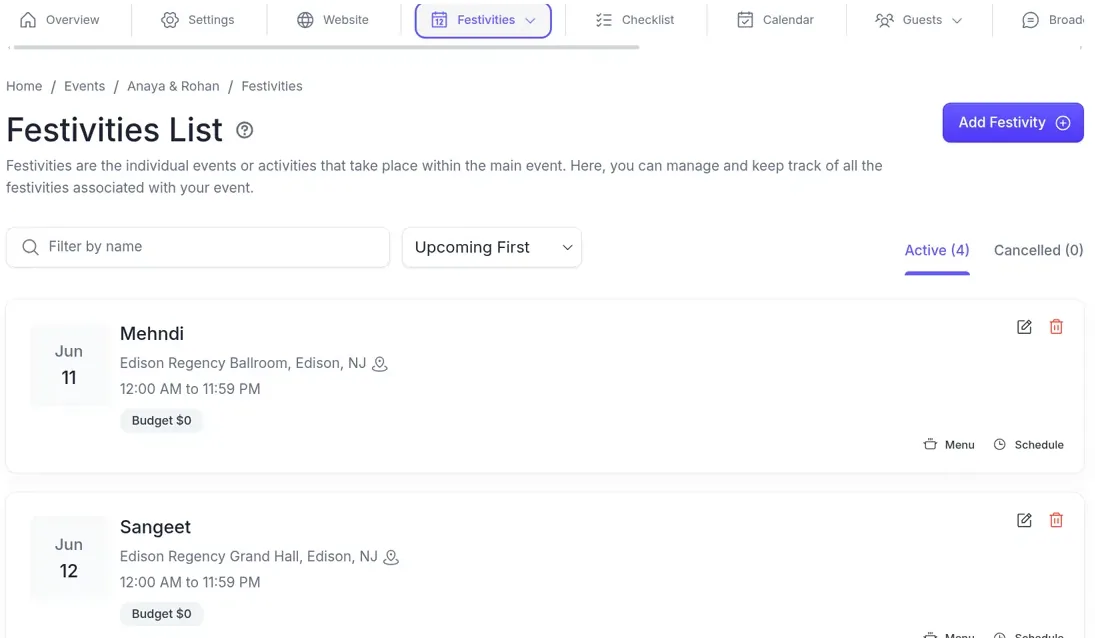
In PlanMe, each client wedding is one event, and each function inside it (mehndi, sangeet, wedding, reception) is called a festivity, with its own date, venue, menu, schedule and budget. You keep one master guest list, tag guests by family side or group, and invite each household only to the festivities they're on. Each household's RSVP link shows only those events, and every festivity keeps its own count. You can send email and SMS broadcasts by guest tag or RSVP status, build seating charts, add a registry to the wedding website, and save a client's weekend as a template to start the next one. The Master Calendar shows every client's dates in one place.
For the family, you invite the couple and each side by email and give them a role you define, so the groom's parents can edit their guests without opening the budget. Vendor management means quotes stored inside the wedding (amount, status, notes), not a vendor marketplace.
Price: free during beta. Paid plans are planned; pricing isn't final.
Where Aisle Planner beats PlanMe.Club: PlanMe has no leads, proposals, contracts, invoices or client payments, and no style guides or design boards. Aisle Planner also has years of use by professional planners. If you leave Aisle Planner for PlanMe, you still need a CRM: HoneyBook, Dubsado, Harpsen or Nuptial.
More on the planner setup on PlanMe for wedding planners. Set up one client weekend in PlanMe and run the seven checks against it.
2. Harpsen: the closest all-in-one, at a flat price
Best for: planners who like having sales and production in one login but want a flat monthly price instead of tiers by active projects.
Harpsen's pricing lists Essentials at $19 a month ($15.83 billed yearly) with tasks, budgets, workflows, proposals, contracts, invoices, menus, timelines and questionnaires, and Professional at $39 a month ($32.50 yearly), which adds a floor plan module, live timeline updates and team staffing per event. Both list unlimited team members and storage, and the trial needs no card. Its Aisle Planner alternative page also covers guest lists and moving active weddings over gradually.
Planners bring it up unprompted too: in a May 2026 r/EventPlanners thread from planners unhappy with changes to their seating tool, one reply suggested "Aisle Planner or Harpsen" for seating and floor plans.
Watch-outs: Harpsen writes much of the content ranking for "Aisle Planner alternatives" (see its own roundup), so read it as a vendor's view. Its pages don't spell out per-event invites for a multi-event weekend, so run checks 1 and 2 early.
3. Nuptial: newer, built with working planners, strong on the day
Best for: small studios that want inquiries-to-day-of in one place and live vendor timelines on the wedding day.
Nuptial covers inquiries, proposals, contracts, budgets, guests, a branded couple portal and a day-of schedule where each vendor gets their own link, no app or login. Its homepage calls out multi-day weddings in the run of show (a welcome dinner, mehendi and the wedding day). Pricing: Solo $39 a month for one planner and three active weddings, Planner $79 for five seats and 25 active weddings, Business $149 for unlimited; 15% off yearly and a 30-day trial with no card.
Watch-outs: it's young (in beta since April 2026, per its own FAQ), so expect gaps. Solo's three-wedding cap is tight for a busy season. Per-event guest invites aren't described in detail.
4. Planning Pod: event and venue operations
Best for: firms that plan weddings alongside corporate events, or that run a venue.
Planning Pod's wedding planning firms page lists budgets and payment tracking, timelines, checklists, guest lists and RSVPs, contracts and e-signatures, invoicing and online payments, vendor and venue management, lead management and proposals, wedding websites, and seating charts and floor plans. Its site is demo-led; we didn't find a public price list, so get a quote.
Watch-outs: it's broad. Planners on the r/EventPlanners portals thread mention a learning curve for both Planning Pod and Aisle Planner. If you only plan weddings, it may be more tool than you need.
5. HoneyBook: a better CRM, plus a separate wedding tool
Best for: planners whose Aisle Planner pain is the sales and payments side, and who are happy to run the wedding itself somewhere else.
HoneyBook's pricing page lists Starter at $29, Essentials at $49 and Premium at $109 a month billed yearly, with unlimited clients and projects on every plan, a 30-day trial with no card, and card fees from 2.7% + 10¢. It doesn't list guest lists, seating or RSVP websites. HoneyBook's own HoneyBook vs Aisle Planner post frames the split the same way: HoneyBook for business management, Aisle Planner for event production.
For a full rundown of CRM options, see HoneyBook alternatives for wedding planners.
6. Dubsado: automation-first CRM
Best for: planners who want their workflows to run themselves and are willing to spend setup time getting there.
Dubsado's pricing page lists Starter at $335 a year and Premier at $525 a year. Both include unlimited projects and clients, invoicing and payment plans, client portals and mobile app access; Premier adds scheduling, automated workflows, public proposals and Zapier. The trial is 21 days with no card. Like HoneyBook, it doesn't list guest lists or seating, so you'll need a wedding tool alongside it.
When to stay on Aisle Planner
Aisle Planner is still the right call for plenty of studios. Stay if:
- It passes most of the seven checks with your real clients.
- Your couples use the portal, because you onboard them on the kickoff call.
- You use the design side (style guides and color palettes, layouts) that the CRMs above don't offer.
- Your active project count sits comfortably inside one tier.
If price is the only problem, compare what you'd pay for a CRM plus a separate wedding tool. Sometimes one $109.99 subscription is cheaper than two cheaper ones and a second login for every family.
If only the multi-event guest side is failing, you don't have to switch the whole stack. Keep Aisle Planner for sales and design, and run the guest list, per-event RSVPs and family access in a shared workspace. The PlanMe vs Aisle Planner comparison covers that pairing feature by feature, and our guide to software for South Asian wedding planners has recommended stacks by studio size.
Switching without losing a season
- Decide which job you're moving. Business, wedding, or both. Write it down before you open a trial.
- Don't move weddings in progress. Let current clients finish where they are and start new bookings in the new setup. As projects close, you can move to a smaller Aisle Planner tier; its pricing page says you can downgrade anytime.
- Export guest lists early. Aisle Planner's guest manager article says you can download versions of a guest list. Keep a copy per client before your plan changes.
- Rebuild one template, not ten. Set up your standard four-event weekend once, test it with the seven checks, then reuse it for each new client.
- Agree family access on the kickoff call. Who sees the budget, who edits which side of the guest list. Our client portal guide has an access map you can walk through with both families.
- Tell clients once, plainly, which login is for contracts and invoices and which is for the weekend plan.
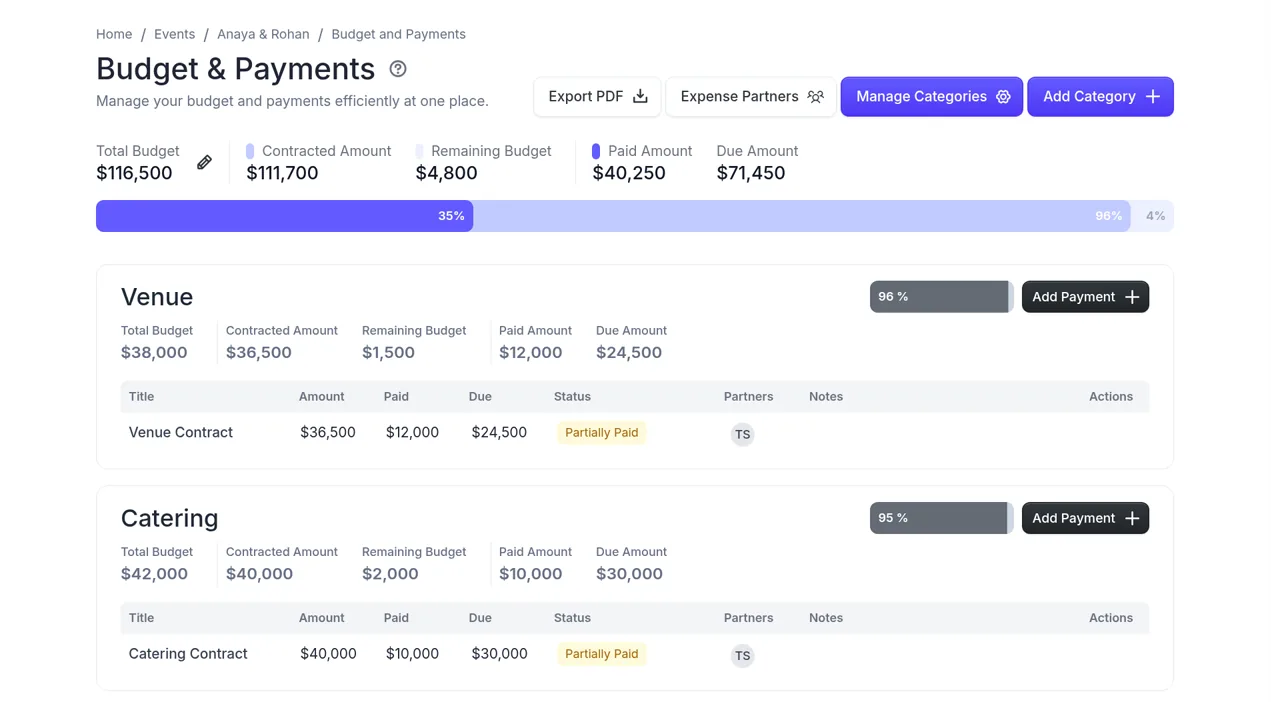
Planning several events for one client? Start with a single weekend: create a client wedding in PlanMe (free during beta), add the four events, and invite one family side to try it.
Sources
Checked October 26, 2026. Product facts link to each company's own pages. Reddit threads and blog posts are opinions, not benchmarks.
- Aisle Planner pricing · Aisle Planner: managing your guests · Aisle Planner: messaging your guests · Aisle Planner: mobile app · Aisle Planner: mobile tips
- Harpsen pricing · Harpsen: Aisle Planner alternative · Harpsen blog: best Aisle Planner alternatives (July 2026)
- Nuptial (features, pricing and FAQ)
- Planning Pod for wedding planning firms
- HoneyBook pricing · HoneyBook vs Aisle Planner
- Dubsado pricing
- Wedding Planner Central: Aisle Planner vs HoneyBook
- Olive Branch Events Co.: Dubsado for my wedding planning business
- r/EventPlanners: What portals do you use? (Jan 2026)
- r/EventPlanners: Any Prismm (AllSeated) users in mourning? (May 2026)
- r/weddingplanning: Wedding planning app for both brides and planners? (Aug 2025)
- r/weddingplanning: Software for professional wedding planners (Oct 2024)
Common questions
What is cheaper than Aisle Planner?
On list price, several tools. Harpsen is $19 or $39 a month ($15.83 or $32.50 billed yearly), Nuptial is $39 to $149 a month, Dubsado is $335 or $525 a year, and HoneyBook starts at $29 a month billed yearly. Aisle Planner's project plans run $69.99 to $229.99 a month by active projects. Cheaper tools don't all include guest lists, seating or RSVP websites, so compare the jobs, not only the price. Checked October 26, 2026.
Which Aisle Planner alternative handles multi-event weddings?
For guest logistics across several events (mehndi, sangeet, wedding, reception), test PlanMe.Club (our product), which gives every guest an invite and RSVP per event, and Nuptial, which documents multi-day run of shows. Planning Pod lists guest lists, RSVPs and seating for weddings. Aisle Planner itself supports separate guest lists for secondary events. Run the seven-check multi-event test in this guide on any trial before you move.
Is there free wedding planner software?
Not a free full replacement for Aisle Planner's CRM, contracts and invoicing. Google Drive and Sheets cost nothing and many planners still use them for the client plan. PlanMe.Club is free during beta for the wedding workspace (events, guests, RSVPs, seating, budget, vendor quotes), but it has no invoicing. Harpsen, Nuptial, HoneyBook, Dubsado and Aisle Planner offer free trials, not free plans.
Do I still need a CRM if I leave Aisle Planner?
Yes, if you used Aisle Planner for leads, proposals, contracts or invoices. Harpsen, Nuptial, HoneyBook, Dubsado and Planning Pod all cover that job. PlanMe.Club doesn't: it's the shared workspace for the wedding weekend, so pair it with a CRM.
Does Aisle Planner have a mobile app?
Aisle Planner's help center says there isn't an official app in the app stores yet and recommends its mobile-friendly website in Safari or Chrome. It also says the layout tool and drag-and-drop in the checklist, budget and seating tools aren't available on mobile. Dubsado's pricing page lists mobile app access on both plans.
Aisle Planner vs HoneyBook vs Dubsado: what's the difference?
Aisle Planner is wedding-specific and bundles sales tools with project tools such as guest management, layouts and seating, and an event website with RSVP. HoneyBook and Dubsado are CRMs for many kinds of service businesses: leads, proposals, contracts, invoices and automations. Their pricing pages don't list guest lists or seating, so planners who switch to them usually add a separate tool for the wedding itself.