On this page
“Who pays?” sounds like an etiquette question. In a Desi wedding it’s a planning question, because the answer decides who books which vendors, who adds which guests, and whose opinion settles the menu. Leave it vague and it comes back at the worst moment: when the first deposit is due, or when one side’s guest list doubles.
This guide gives you the traditional split so you know where everyone’s expectations come from, then the four models couples on r/DesiWeddings describe using, with the trade-offs of each. Survey and study figures are linked to their sources in the article and listed under Sources at the end. Where we show our own arithmetic, it’s labeled as an example, so you can swap in your own numbers.
The short answer
There’s no rule anymore, just a starting point. By tradition, the bride’s family paid for most of an Indian wedding (the ceremony and usually the mehndi), and the groom’s family paid for the baraat and the reception. Today most families pick one of four models: each family hosts its own events, costs are split by guest count, a three-way split with the couple, or fixed contributions into one pot with the couple covering the rest.
The few numbers that exist point the same way, toward shared costs:
- India: in WedMeGood’s 2023 survey of more than 2,400 couples, 59% said costs were shared equally between the two families, 32% said the bride’s side paid, and 9% said the groom’s side paid. 70% of couples contributed themselves. In a WeddingWire India survey of almost 500 couples married in 2022, parents handled 64% of wedding expenses, as reported by NDTV in June 2023.
- All US weddings: The Knot’s 2026 Real Weddings Study (10,474 couples married in 2025) found that parents and family covered 52% of the total cost and couples 48%. Zola found that 88% of couples put in their own money, 29% fully and 59% partly.
- South Asian weddings in the West: we couldn’t find a published survey. The best evidence is couples describing their own splits, which we quote below.
One more thing worth saying plainly: a family’s share of the wedding isn’t dowry. Maharani Designs, a Florida mandap decorator, notes in its guide to paying for an Indian wedding that dowry is officially illegal in India. Everything below is about hosting costs that both sides agree to.
The traditional split, function by function
Even families who plan to split everything 50/50 start from these expectations, so it helps to see them written down. This is the common North Indian Hindu and Punjabi pattern, with Pakistani and Sikh notes. Regions, communities and individual families differ, so treat it as the default your parents may have in mind, not a rule.
| Function or cost | Traditionally paid by | What often happens now |
|---|---|---|
| Roka or engagement | Whichever family hosts it | Host family, or split 50/50 |
| Haldi | Each family, at home | Each family, often small and at home |
| Mehndi | Bride’s family | Bride’s family, or each side funds its own |
| Sangeet | Bride’s family (often) | Shared if it is one joint party |
| Baraat | Groom’s family | Groom’s family |
| Wedding ceremony (pheras, Anand Karaj, nikah) | Bride’s family | Bride’s family, or split by guests |
| Reception | Groom’s family | Split by guest count or 50/50 |
| Walima (Muslim weddings) | Groom’s family | Groom’s family |
| Bride’s outfits and jewelry | Bride’s family | Bride’s family or the bride |
| Groom’s outfits | Groom’s family | Groom’s family or the groom |
| Travel and rooms for each side’s guests | That side | That side |
Hindu and Punjabi weddings. Maharani Designs describes the bride’s family as covering the main ceremony (venue, decor, food), pre-wedding events such as the mehndi and sangeet when they host them, and the bride’s outfits and jewelry. The groom’s family covers the baraat, the groom’s outfits and, traditionally, the reception. It adds that splitting costs more evenly, or the couple paying, is becoming more common, especially in diaspora communities.
Pakistani and Muslim weddings. The line runs between two events. The Pakistani wedding site Wedding Wala explains that the bride’s family hosts and pays for the barat, the main day around the nikah, while the groom’s family hosts and pays for the walima. The groom also pays mahr, an obligatory gift from the groom to the bride in Islamic marriage. Separate mehndis are usually funded by each family; a combined mehndi is often shared.
Baraat or barat? The two words name different things. In the table above, the baraat is the groom’s procession to the wedding, which his family pays for. In a Pakistani wedding, the barat (or shaadi) is the whole main wedding day hosted at the bride’s venue, which Wedding Wala says the bride’s family pays for. The groom’s party still arrives in procession, but the day itself is the bride’s family’s to host.
Sikh weddings. UK Wedding Websites says the bride’s family traditionally covered most costs, but that today there’s no fixed rule. Its common UK arrangements: the couple pays for everything, both families split venue, food and photography, one family funds the ceremony and the other the reception, or parents cover the gurdwara donation and the feast while the couple pays for the rest.
If one of you isn’t South Asian. Expect two sets of expectations. In the Western tradition that Joy’s who-pays guide describes, the bride’s family pays for the ceremony and the reception, and the groom’s family pays for the rehearsal dinner, the officiant and the marriage license. The Desi tradition gives the reception to the groom’s side instead, so say out loud which one each family has in mind.
If you want the full running order of these events first, see Indian wedding events in order.
Four ways families split it today
Read enough threads on r/DesiWeddings and the same four models keep coming up. None is the right one. Each fits a different mix of guest lists, incomes and opinions.
1. Each family hosts its own functions
This is the traditional split, updated. Each side takes whole functions, books those vendors and pays them directly. One commenter whose side was much smaller described her parents paying for just the mehndi, about 150 people, while his family paid for the sangeet, ceremony and reception at about 300 each:
“We wanted to avoid doing a per head cost just to avoid splitting hairs.”
Good for: families who want control over “their” event, and weddings where one side is much smaller. Watch for: events aren’t the same size, so the totals rarely match, and vendors who work the whole weekend (photo and video, decor, the planner) still need a shared arrangement.
2. Split by guest count
Shared events are divided by how many guests each side brings. One commenter gave the formula in two lines:
“Take your total budget, divide it by number of guests. Example budget: $10,000 divide by 100 guests equals $100 per person. You have 25 guests and he has 75 guests. You pay $2500 and he pays $7500.”
A commenter in Canada whose husband’s side had 175 of 250 guests described the usual refinement: guest-count costs by family, and everything else 50/50.
“We split accordingly to guest count by family + 50/50 on all other vendors including venue, photographer, decor, etc.”
Good for: lopsided guest lists, and families who want the split to feel fair on paper. Watch for: it only works if every guest is tagged to a side and you count each event separately, because the ratio at a 120-person mehndi isn’t the ratio at a 350-person reception.
3. A three-way split with the couple
Both sets of parents and the couple each take a share, equal or not. This came up again and again in “Who is paying/paid for your wedding?”, often with uneven percentages based on guest count and what each household can afford. One commenter listed theirs as bride’s parents 50%, groom’s parents 30%, couple 20%. Another, married in Canada:
“Three way split between my family, my partner’s family and us. Also anything going over the amount each of our families agreed to pay, my partner and I are covering.”
Good for: couples with their own income who want a real say. Watch for: a percentage applies to every bill, so someone has to collect three shares of each deposit, or agree that each party pays specific vendors that add up to its percentage.
4. Fixed contributions into one pot
Each family gives a set amount, or a cap, and the couple runs one budget and covers the rest, including overruns. Some couples skip the families entirely and fund it together: one commenter said she and her fiancé each put 50% into a joint account for the wedding. Another commenter described building the line-by-line budget before talking to anyone about shares:
“Tl,dr: budget first, proportion after”
Good for: parents who want to give a gift without managing vendors, and couples who want one set of books. Watch for: the couple carries all the risk if costs go up. That risk is real: 41% of couples in The Knot’s 2026 study went over their budget.
One wedding, four splits: a worked example
To see how much the model changes each family’s number, here’s one fictional weekend, Anaya & Rohan’s, split four ways. The costs are our own example inputs (all-in, including service charges), in line with the published US ranges in how much an Indian wedding costs in the US. Anaya’s side is a little larger at every event.
| Event | Cost (all-in) | Anaya’s side | Rohan’s side | Total guests |
|---|---|---|---|---|
| Mehndi | $12,000 | 80 | 40 | 120 |
| Sangeet | $30,000 | 120 | 100 | 220 |
| Wedding ceremony | $38,000 | 170 | 130 | 300 |
| Reception | $52,000 | 190 | 160 | 350 |
| Shared: photo and video, planner | $24,000 | blank | blank | blank |
| Total | $156,000 | blank | blank | blank |
Here’s what each family pays under each model:
| Model | Anaya’s parents | Rohan’s parents | Anaya & Rohan |
|---|---|---|---|
| 1. By function (Anaya’s side hosts mehndi, sangeet and ceremony; Rohan’s side hosts the reception; shared costs 50/50) | $92,000 | $64,000 | $0 |
| 2. By guest count per event (shared costs 50/50) | $86,126 | $69,874 | $0 |
| 3. Three-way, 40 / 30 / 30 | $62,400 | $46,800 | $46,800 |
| 4. Fixed contributions (parents give $60,000 and $50,000; couple covers the rest) | $60,000 | $50,000 | $46,000 |
Three things stand out.
- The traditional split is the most uneven. Hosting three events costs Anaya’s family $28,000 more than Rohan’s. Split by guest count, the gap is about $16,000. If the families expect to contribute equally, model 1 needs a balancing payment or a shared cost moved across.
- Guest count is the fairest to the guest lists, and the most work. Model 2 needs a side for every guest at every event. Change the reception from 190/160 to 160/190 and about $4,500 moves from one family to the other.
- Overruns land differently. If the weekend comes in 10% over, an extra $15,600, model 3 splits it $6,240 / $4,680 / $4,680. Under model 4, Anaya & Rohan pay all $15,600 unless the parents agree to top up.
Estimate what each event will cost before you divide it
Every split starts with a number per event. The Indian wedding budget calculator prices each event from its own guest count, per-plate catering, venue, decor and entertainment, then adds shared costs and a buffer. You see the total and the cost of each event on the page, with no sign-up, so the two families can talk about real figures.
Open the budget calculatorGuest lists, money and who gets a say
In almost every thread about who pays, the real argument is about guests and decisions. Couples are candid about it. One commenter who paid for their own wedding said it “came in handy when it was decision making time,” when a parent-in-law wanted specific entertainment at the reception (r/DesiWeddings). A groom paying for an international wedding wrote that his “parents wanted more control over the wedding if they contributed even a portion of it” (r/DesiWeddings).
The other classic: one side’s list grows after the budget is set. It’s common enough that r/weddingplanning has a thread asking how “my parents and I” can tactfully ask the groom’s family to cover the extra cost of their much larger invite list. A few habits keep this from turning into a fight:
- Agree on a guest cap per side, per event, at the same time as you agree on the money. “Your side has 160 at the reception” is easier to hold than “keep it reasonable.”
- Cost out extra guests with a per-head number. Use the caterer’s all-in per-plate rate, not the average cost per guest, because the venue and decor don’t change for 20 more people. In the example, if catering and bar run $110 a head, 30 more reception guests cost about $3,300, and the side adding them pays it.
- Count expected attendance, not invitations. Not everyone invited comes, and out-of-town relatives decline more often. The Indian wedding guest attendance calculator estimates how many invited guests will come to each event, local and out of town, so each side pays for a realistic number.
- Match a say to a share. If Rohan’s parents pay for the reception, it’s fair for them to pick the menu. If the couple is covering overruns, the couple decides whether to upgrade the decor.
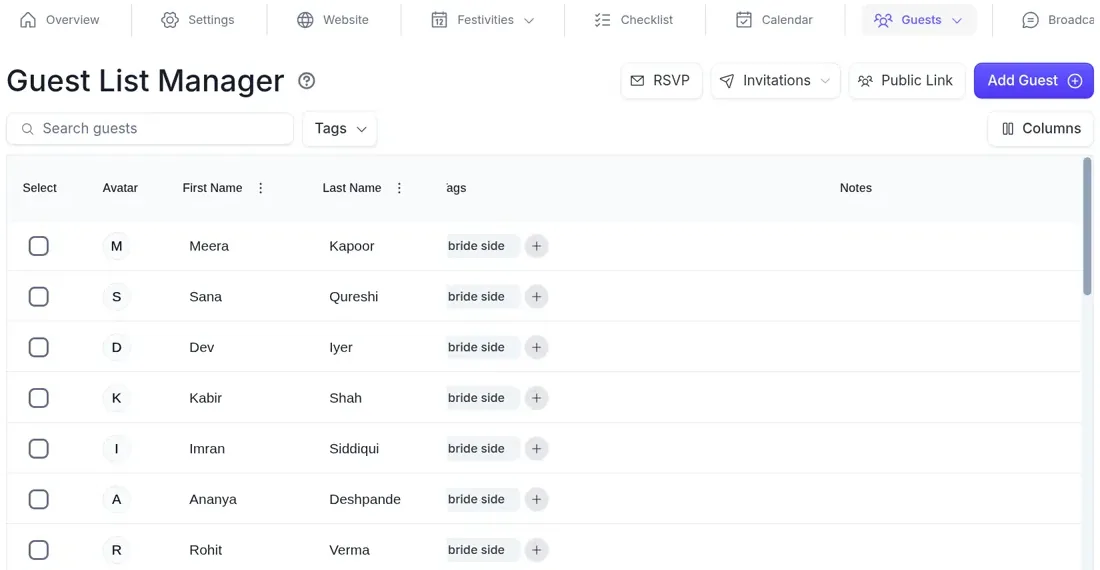
For building both families’ lists in the first place, with tiers and a column per event, see how to build an Indian wedding guest list by event.
US, Canada, UK, and parents paying from India
United States. The only large surveys cover all weddings, not Desi weddings, but they show how strongly family money shapes the size of the day. In The Knot’s 2026 study, couples spending over $41,000 had 62% of the bill covered by family. Zola found that heavily family-funded weddings cost nearly double those the couple pays for alone, and that for weddings costing more than $100,000, families covered 63% of the total cost. Published ranges for a 200- to 300-guest multi-day Indian wedding in the US start at about that level (see our cost guide), so parents are usually part of the conversation.
Canada. We found no Canadian survey. Commenters in Canada in the r/DesiWeddings threads we read described three-way splits and splits by guest count. One Canadian bride put the case for the three-way split simply: parents “are not obligated to pay for anything, so anything they choose to pay for or host is a gift” (r/DesiWeddings).
United Kingdom. For Sikh weddings, UK Wedding Websites lists the ceremony/reception split and the gurdwara-and-langar arrangement described above, and its one tip applies to every community: “Agree in writing who pays for each event before you book anything.”
Parents paying from India or another country. When one family lives abroad, agree on the contribution in the currency the vendors are paid in, and decide who absorbs a change in the exchange rate between the first deposit and the final balance. Transfer fees add up too. Our guide to budgeting several events covers cross-border payments and deposits in more detail.
How to have the money conversation
The order matters more than the words. This sequence is our suggestion, built on the one point every guide above agrees on: settle the budget and who pays before anything is booked.
- Couple first, privately. Agree which events you want, a rough guest count for each, a total range and what you can put in yourselves.
- Ask each family what they want to give, not what they will pay for. Each partner asks their own parents. “Would you like to host an event, or contribute an amount?” leaves room for either tradition.
- Pick a model and write it down. One page: the model, each party’s share or events, the guest cap per side, who signs which contracts, and who covers overruns.
- Agree on the awkward cases now. Vendors who cover the whole weekend, outfits and jewelry, rooms for each side’s out-of-town relatives (see the wedding hotel block guide), and what happens if an event is added or canceled.
- Review it at each big deposit. Not monthly. Just at the moments money moves, so nobody is surprised by a running total.
Some wording that keeps it friendly (our suggestions, adjust to your family):
- To your own parents: “We’re working out the budget for each event. Would you rather host the mehndi and sangeet like you’d planned, or put in an amount toward the whole weekend?”
- When one side’s list grows: “We’ve budgeted 160 from your side for the reception. Each extra guest is about $110. Happy to add them if you’d like to cover that.”
- When contributions are unequal: “Everyone is giving what works for them, and we’re grateful for all of it. We’re not comparing.”
If one event is driving the cost, look at it first. A sangeet with its own venue and dinner can cost nearly as much as the ceremony: in our example above it’s $30,000 against $38,000. The sangeet planning guide costs one out line by line.
Tracking who paid what
PlanMe.Club is our product. It’s an event planning tool built for multi-day weddings, with South Asian weddings as the specialty, so read this section with that in mind. Checked against the product on October 23, 2026.
Whatever model you pick, the hard part comes later: dozens of deposits, paid from three or four bank accounts, over a year. A shared spreadsheet works if one person keeps it up to date. It tends to break down when both families are paying vendors and nobody is sure whether the decorator’s second installment came from his dad or from the couple.
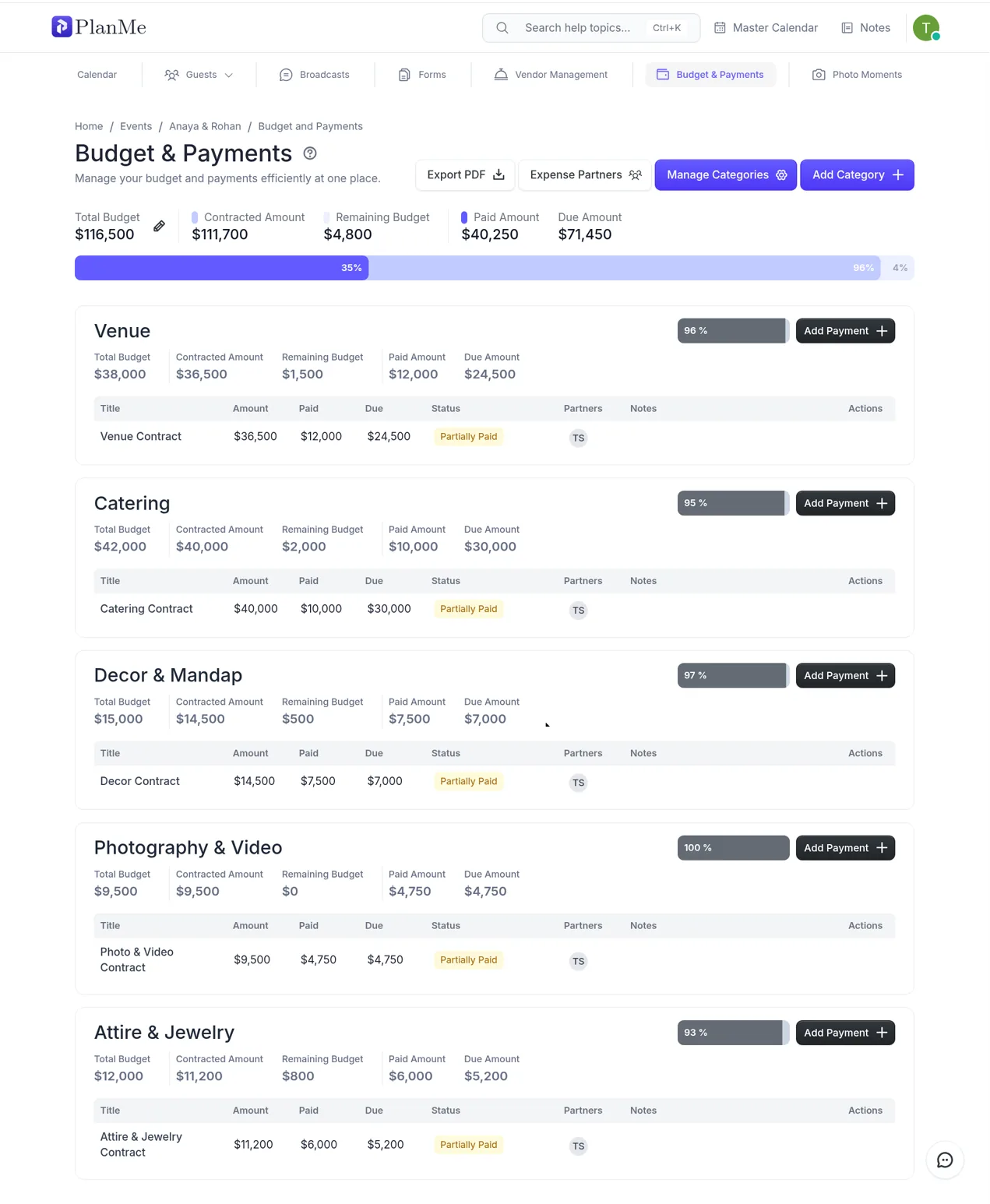
In PlanMe, each event (mehndi, sangeet, wedding, reception) is called a festivity, and Budget & Payments sits in the same wedding. You name the budget categories yourself, so you can make one per event or per vendor type, and each shows its budget, contracted, paid and due amounts. Expense Partners are the people paying, such as Anaya’s parents, Rohan’s parents and the couple. When you add a payment, you can record how much each partner paid toward it, and the partner list shows each one’s total paid.
Not everyone needs to see the money. In Members & Permissions you create roles such as Bride’s parents or Groom’s parents and tick the areas each role can open, so a family member can manage guests and RSVPs without seeing the budget, or see the budget if they’re paying. Roles are on or off per area, and there’s no separate read-only setting. More on that in the planner client portal guide.
The guest numbers behind a guest-count split live in the same wedding. Each event has its own invitations and its own RSVP count, and guests tagged by side can be filtered by tag, so a ratio like 190/160 at the reception can come from real replies rather than a guess.
Put the agreement where both families can see it
Set up your events in PlanMe.Club, make a budget category for each one, and add each family and the couple as Expense Partners. When you add a payment, you record how much each partner paid toward it, and the Expense Partners list shows each partner’s total paid. Free during beta.
Start your budget in PlanMeSources
Checked October 23, 2026. Reddit quotes are as posted by the commenters and are not verified. The worked example is our own arithmetic with assumed inputs.
- The Knot: Real Weddings Study data read-out (2026)
- Zola: Average Cost of Weddings in 2026 (Wedding Cost Index and 2026 Wedding Spend Survey)
- Joy: Who Pays for the Wedding? Follow Tradition or Make Your Own Rules
- The Knot: A Step-by-Step Guide to Indian Wedding Planning
- NDTV: WeddingWire India survey of couples married in 2022 (June 2023)
- Business Standard: WedMeGood annual survey, who pays for Indian weddings (January 2024)
- Maharani Designs: Paying for an Indian Wedding
- Wedding Wala: Who Pays for What in a Pakistani Wedding?
- UK Wedding Websites: Who pays for a Sikh wedding?
- r/DesiWeddings: Who is paying/paid for your wedding?
- r/DesiWeddings: How are people splitting the expenses of a desi wedding between the bride and groom?
- r/DesiWeddings: Who paid for most things? Girls or boys side?
- r/DesiWeddings: How did both families split up the wedding costs?
- r/DesiWeddings: Whose side paid for what in your wedding?
- r/weddingplanning: Groom’s family’s invite list is unexpectedly and drastically larger than the bride’s
Common questions
Who traditionally pays for an Indian wedding?
Traditionally the bride’s family paid for most of it: the wedding ceremony, its venue, food and decor, and usually the mehndi and the bride’s outfits and jewelry. The groom’s family traditionally paid for the baraat, the groom’s outfits and the reception. Customs vary by region and community, and many families in the US, Canada and the UK no longer follow the old split.
Who pays for the reception at an Indian wedding?
By tradition, the groom’s family hosts and pays for the reception, which is often held after the wedding in his family’s home city. Today many families split the reception by guest count or 50/50, because the reception is usually the biggest single event and both sides invite most of their guests to it.
Who pays for the mehndi and sangeet?
Whoever hosts them. Traditionally the bride’s family hosts the mehndi, and often the sangeet. When each family holds its own mehndi, each pays for its own. When the two families hold one combined sangeet, they usually share the cost, either 50/50 or by how many guests each side invites.
Who pays for a Pakistani or Muslim wedding?
By custom, the bride’s family pays for the barat (the main wedding day around the nikah, when the groom’s party arrives at the bride’s venue) and the groom’s family pays for the walima. The groom also pays mahr, an obligatory gift from the groom to the bride in Islamic marriage. Mehndis are often split, with each family funding its own. Apart from mahr, and the walima that Islam strongly recommends, who pays for what is custom rather than religious rule, so families work it out between them.
Who pays for a Sikh wedding?
Traditionally the bride’s family covered most of it. Today there’s no fixed rule. Common UK arrangements include one family funding the ceremony and the other the reception, both families splitting venue, food and photography, or the couple paying for most of it.
Is it normal for the groom’s family to pay less?
Under the traditional split, yes: the bride’s family hosted more events. In practice, it depends on the guest list. If his side brings more guests, many couples ask his family to pay for those guests at the events they attend. What matters is that both families agree before deposits are paid, not what tradition says.
How do you split Indian wedding costs by guest count?
Split each shared event by each side’s share of its guest list, and split costs that don’t depend on guests (photo and video, the planner, outfits for the couple) 50/50 or by agreement. If the bride’s side has 190 of 350 reception guests, her family pays about 54% of the reception. Do it per event, because the ratio changes from the mehndi to the reception.
Do Desi couples pay for their own weddings now?
Many contribute. In a 2023 WedMeGood survey of couples in India, 70% said they contributed to their own wedding. Across all US weddings, The Knot’s 2026 study found couples covered 48% of the cost and families 52%, and Zola found 88% of couples put in their own money. There’s no published survey for South Asian weddings in the US, Canada or the UK.