On this page
- The short answer
- Four decisions before you book anything
- Who to invite to the sangeet
- How many performances, and how long
- A timed run of show
- Dinner before or after the performances?
- The 12-week sangeet countdown
- What a sangeet costs in the US
- Venue, stage and sound: what to ask
- What guests need to know
- Mistakes that sink the night
- Keeping the sangeet in one place
- Sources
- Common questions
Most sangeet guides are about outfits, songs and decor ideas. Those matter, but they are not why sangeets go wrong. They go wrong because nobody capped the performances, the dinner time was never agreed, and the guest count for the night was a guess borrowed from the reception.
So this guide treats the sangeet the way your vendors will: as its own festivity with its own guest list, its own schedule and its own budget. Figures come from named sources, linked in place and listed at the end. Where we do our own arithmetic, it is labeled as an example with its inputs so you can swap in your own.
The short answer
A sangeet (Sanskrit for “sung together”) is the music-and-dance night before the wedding. The Knot’s sangeet guide describes it as a Punjabi and North Indian custom that began as a women-only gathering of songs and dhol, and is now usually a joint party for both families with choreographed Bollywood performances. Most modern sangeets last four to five hours. The Knot’s Indian wedding traditions guide notes it is often the Friday night before a Saturday wedding, and that Punjabi families call a similar event a dholki. Many Gujarati families hold a garba night instead or as well; the planning is much the same.
To plan one, in order:
- Decide the shape: who hosts, its own night or combined with the mehndi, home or venue, and roughly how many guests.
- Book the venue, DJ and sound (and a choreographer, if you want one) three to six months out.
- Cap the program. Six to eight acts of three to five minutes, with the performance block under about 90 minutes.
- Agree the dinner time with the caterer and DJ, and write it into a timed run of show.
- Collect every music file and the running order two weeks out, and give one cue sheet to the DJ and MC.
- Budget it as its own festivity with its own headcount, not as a slice of the reception.
Four decisions before you book anything
1. Who is hosting?
Some families hold one sangeet for each side; many now hold a single joint night, and The Knot notes couples increasingly host it together with both families performing. The answer changes the guest list, who pays, and whose aunties get the opening slot, so settle it before anyone books a hall.
2. Its own night, or combined?
Combining the mehndi and sangeet into one evening saves a venue fee and a travel night, at the cost of a long evening for the bride, who may be sitting for henna while others dance. Our Indian wedding events in order guide covers the common weekend shapes and what families combine. Some families skip a separate sangeet and fold a few performances into the reception; a r/DesiWeddings thread on the difference between a reception and a sangeet is a good read if you are weighing that.
3. Home, banquet hall or hotel ballroom?
A home or backyard sangeet works for a small list with family performances. Once you have more than a few groups performing, you need a stage, a proper sound system and lighting, which pushes most US, Canadian and UK sangeets into a banquet hall or hotel ballroom. If guests are staying at a hotel block, holding the sangeet in the same hotel removes the late-night drive; see the wedding hotel block guide.
4. Roughly how many guests?
You don’t need a final number yet, but you need a range, because it sets the venue, the stage size and most of the budget. The next section is about getting that number right.
Who to invite to the sangeet
The Knot’s answer is “it’s up to you”: the sangeet was once only for the women of both families, and many couples now treat it like a welcome party with a broader list. In practice it usually sits in the middle of the weekend: bigger than the haldi or a home mehndi, smaller than the ceremony and reception. The Curated Knot calls it a “mixed gathering” and often the largest pre-wedding event.
The common mistake, as Invyt’s sangeet guide puts it, is assuming everyone invited to the wedding is coming to every event and then catering for the full number. Your sangeet headcount should come from the sangeet invitations, not the reception’s.
Can you invite someone to the sangeet only?
Yes, and it is a real question people ask: “Is it okay to invite someone to the Sangeet only?” on r/DesiWeddings. It comes up most when the ceremony is small, religious or far away, and the sangeet is the big local party. What matters is that each household knows exactly which festivities they are invited to, and doesn’t find out from someone else’s invitation.
Questions to ask on the sangeet RSVP
- Attending, and how many from the household.
- Meal needs for that night (vegetarian, Jain, Halal, allergies), because the sangeet menu often differs from the reception’s.
- Whether they want to perform, and with which group.
- Kids attending, if the night runs late.
- Shuttle needed back to the hotel, if you are running one.
Even the big platforms treat this as its own problem: Joy has a guide to managing several Indian wedding events with different guest lists. If you are juggling different lists for each festivity, the guest list template by festivity shows how to lay it out, and per-guest RSVPs for multiple events covers invitations and reminders by festivity.
How many performances, and how long
This is the decision that makes or breaks the night, and the guides broadly agree on the shape even if the exact numbers differ:
| Source | Number of acts | Length per act | Total performance time |
|---|---|---|---|
| ShareUrWedding | 4 to 6 group acts, plus the couple and an opener | Shorter if more groups | 60 to 90 min |
| EventAtlas | 6 to 8, including the couple | 3 to 5 min | Attention drops after ~45 min straight |
| Invyt | No set number | 3 to 4 min | Under 90 min |
| The Wedding Trunk | 8 to 12 slots at most | 2:00 to 3:30 | Cap set 4 to 6 weeks out |
| Wedly Events | 6 to 10 | 3 to 5 min | 60 to 90 min |
A person who has coordinated sangeet dances for three years put it bluntly on r/DesiWeddings:
The shorter the performance, the better … Guests want to eat and dance, too!
Do the math before you say yes to everyone
The easiest way to hold the line is to show families the arithmetic. Here are two programs side by side. This is our own worked example, with the inputs shown:
| Program | Acts × length | Transitions | Block length |
|---|---|---|---|
| Tight | 7 × 4 min = 28 min | 7 × 1.5 min = 10.5 min | ≈ 52 min with a 10-min welcome and 4-min montage |
| Everyone gets a slot | 14 × 5 min = 70 min | 14 × 2 min = 28 min | ≈ 112 min with the same welcome and montage |
The second program isn’t twice as long, it is the difference between dinner at 8:45 and dinner after 10. If more groups want in, ShareUrWedding’s advice is to cut the length, not the number: eight groups of five minutes keeps more energy than eight groups of ten. Or merge small groups into one medley (all the cousins, all the college friends) so everyone performs but the program stays short.
A running order that works
- MC welcome and a short family welcome (two speakers at most).
- A high-energy opener, usually siblings or cousins.
- Alternate the two families’ groups, and fast and slow numbers.
- Parents or aunts and uncles in the middle, when attention peaks.
- A short video montage of the couple to break up the dances, if you have one.
- Closest friends just before the end.
- The couple’s performance last, straight into the open dance floor.
Rehearsals when the family is spread out
Diaspora sangeets almost always have performers in three cities and a time zone or two. What helps, from the same coordinator’s post and other threads: group performers by household or city, keep only the opener and finale open to everyone, record each routine in normal and mirrored versions, rehearse over video calls, and plan one or two in-person run-throughs in the final weeks. Label every music file the way the DJ asks; the coordinator names each file with “Sangeet,” the performance number and the performance name, in that order, and checks with the DJ before the night.
Choose a performance coordinator who is not the couple. Their job on the night is to have the next group waiting at the side of the stage before the current song ends.
A timed run of show
Here is a sample for a 7 p.m. start with seven acts. Adjust the times, but keep every line: the DJ, MC, caterer and venue each need the same document.
| Time | What happens | Who owns it |
|---|---|---|
| 6:00 p.m. | Sound check and stage walk-through; performers’ final files with the DJ | DJ, performance coordinator |
| 7:00 p.m. | Doors. Drinks and passed appetizers or chaat from the start | Caterer |
| 7:40 p.m. | Guests seated; MC welcome; family welcome (two speakers) | MC |
| 7:50 p.m. | Couple’s entrance | DJ, photo and video |
| 8:00 p.m. | Performances back to back (about 50 to 60 minutes) | Performance coordinator, MC |
| 8:55 p.m. | Couple’s performance | DJ, lighting |
| 9:05 p.m. | Dinner opens and the dance floor opens together | Caterer, DJ |
| 11:15 p.m. | Last song announced; last shuttle called | MC, transport |
| 11:30 p.m. | Music off; venue load-out | Venue, decor |
Patel Events’ run of show adds a short game or icebreaker between performance blocks and a dhol set to bridge into open dancing; both are easy to slot in. Leave a 15-minute buffer somewhere, as Invyt advises: a group will be missing a member or a track won’t play.
If the sangeet sits on the same weekend as a morning ceremony, the end time matters more than the start. The wedding day timeline shows how early hair and makeup start on the wedding day.
Dinner before or after the performances?
This is the question families argue about most, and the published advice genuinely disagrees:
- Invyt: serve dinner before the performances, because once the dance floor opens nobody wants to stop for a meal.
- Wedly Events: never place dinner before the performances, because energy drops once guests eat.
- EventAtlas: split the performances into two blocks and open a buffet in between, with the parents’ and couple’s dances after dinner.
The answers on a r/DesiWeddings thread asking for the best sangeet flow mostly land on a fourth option: appetizers from the start, all performances first, then dinner and the DJ together.
Have appetizers and non alcoholic drinks flowing from the start, many guests likely skipped a meal or had a poor meal that day … So front load all performances.
That is the plan in our sample run of show. Whatever you choose, the failure mode is the same: a late start and an unlimited program push dinner toward 10 p.m. or later. It is common enough that there is a thread titled “Why does every Punjabi wedding serve dinner at 10:45 PM?”. Write the dinner time down and give it to the caterer as a fixed time, not “after the performances.”
A buffet or food stations work better than a plated dinner at a sangeet, because people eat at their own pace while the floor fills (EventAtlas). With 200 or more guests, one commenter in the same thread warns, there is “no hope” of keeping everyone seated and quiet for performances during dinner.
The 12-week sangeet countdown
Combined from choreographer Sumit Khetan’s checklist, EventAtlas and Invyt. Venues, DJs and choreographers book up first in peak season, so those come before the twelve weeks.
| When | What to lock in |
|---|---|
| 3 to 6 months out | Venue and date; DJ and sound; choreographer if you want one (Sumit Khetan suggests about 6 months for November to March); photo and video hours |
| 12 weeks | Theme or story, rough list of who wants to perform, performance coordinator named |
| 10 weeks | Open performance sign-ups; put the sangeet question on the RSVP |
| 8 weeks | Final list of acts, song shortlist, draft running order with times |
| 6 weeks | Songs locked and music cuts done; remote rehearsals start for family abroad |
| 4 weeks | Stage, LED and lighting plan with the venue and decor; menu and dinner time agreed with the caterer |
| 2 weeks | All music files and the final running order in; sangeet headcount and meals to the caterer |
| Final week | Cue sheet to DJ, MC and AV; group leads get call times; guest itinerary out |
| Day of | Technical rehearsal on the actual stage; sound check before doors |
For where the sangeet fits in the whole year of planning, see the Indian wedding checklist.
What a sangeet costs in the US
Marigold’s 2026 cost guide says most couples spend the most on the reception, then the sangeet, because the sangeet carries catering for a big list, most of the weekend’s entertainment and real decor. Published totals for the night itself vary a lot, mostly with guest count and menu:
| Source | Guests | Total | What’s behind it |
|---|---|---|---|
| EventAtlas | 150 to 250 | $8,000 to $25,000+ | Catering $3,000 to $10,000; DIY decor and choreography at the low end |
| Anvaya | 150 to 400+ | $12,000 to $40,000 | Catering $50 to $100 a plate; DJ and dhol $2,000 to $5,000 |
| ShaadiHive | 250 | $30,000 to $70,000 | Plated dinner and bar $12,000 to $25,000; venue $5,000 to $15,000 |
The spread is mostly food. EventAtlas’s catering line works out to well under $50 a guest, while ShaadiHive prices a plated dinner with a bar. So start from your own per-plate quote and headcount. The line items, as the sources list them:
- Venue: $2,000 to $8,000 (EventAtlas), $3,000 to $12,000 (Anvaya), $5,000 to $15,000 for a 250-guest ballroom (ShaadiHive).
- DJ and sound: $800 to $2,500 (EventAtlas); $1,500 to $3,500 for the DJ (ShaadiHive); a live band $3,000 to $8,000 (Anvaya).
- Stage, lighting and backdrop: stage rental $500 to $2,000, LED uplighting $800 to $2,000, backdrops from $200 for draping to $8,000+ for LED walls (EventAtlas); stage, sound and lighting together $3,500 to $8,000 (ShaadiHive).
- Choreographer: $500 to $2,000+ (EventAtlas); $80 to $200 an hour or $800 to $2,500 per group for four to six sessions (ShaadiHive).
- MC: $0 for a family member to about $500 for a professional (EventAtlas).
- Extra photo and video hours: $2,000 to $4,000 beyond the wedding package (ShaadiHive).
- Overtime: sangeets run late; Marigold lists venue overtime at $500 to $1,500 an hour.
A worked example: 220 guests in a New Jersey hotel ballroom
Our own arithmetic, with each input picked from inside the ranges above. Swap in your quotes.
| Line | Assumption | Amount |
|---|---|---|
| Catering | 220 guests × $90 a head | $19,800 |
| Venue | Ballroom rental | $8,000 |
| DJ | DJ with dance-floor sound | $2,500 |
| Stage, sound and lighting | Stage, PA for performances, uplighting | $5,000 |
| Decor | Stage backdrop and table decor | $5,000 |
| Choreographer | Two group numbers plus the couple | $1,500 |
| Photo and video | Extra hours for the night | $2,000 |
| MC | Professional | $500 |
| Service charge and gratuity | 20% on catering and venue (Zola puts these at 18 to 22% of vendor costs) | $5,560 |
| Total | blank | ≈ $49,860 |
That lands inside ShaadiHive’s range and above EventAtlas’s, and the difference is almost all the per-plate number. The biggest levers: fewer guests, a lighter menu (chaat, kebabs, one rice and a couple of curries, as EventAtlas suggests), a family MC, and a venue you are already paying for elsewhere in the weekend. For how this fits the whole weekend, see how much an Indian wedding costs in the US and how to budget a multi-event wedding.
Price your sangeet next to the rest of the weekend
The Indian wedding budget calculator prices each festivity from its own guest count, per-plate catering, venue, decor and entertainment, so the sangeet gets its own line instead of a guess inside “pre-wedding events.” You see the total, the cost per festivity and the cost per guest on the page. No sign-up.
Open the budget calculatorVenue, stage and sound: what to ask
A sangeet asks more of a venue than a dinner does. Before you sign, ask:
- Is there room for a stage and a dance floor at the same time? EventAtlas suggests a 16 by 12 foot stage as a minimum for group numbers. For the floor, one rental company’s rule of thumb is about a third of guests dancing at once at roughly 4.5 square feet each (Mel’s Events), so 220 guests is roughly a 330 square foot floor, about 18 by 18 feet.
- What is the hard stop, and what does overtime cost per hour? Get it in the contract.
- Can the DJ use the house sound, or bring their own? Who supplies wireless mics for the MC and speeches?
- Are there sound limits, or rules on dhol, haze or cold sparklers? Hotels often have rules; ask rather than assume.
- Is there a room for performers to change and wait? Thirty cousins in costume need somewhere that isn’t the hallway.
- Can you get in early for the stage build and a technical rehearsal on the real stage?
Collect these answers and every DJ, decor and choreographer quote in one place, with the amount and a status, so both families can see what has actually been agreed.
What guests need to know
Guests need three times for the sangeet, not one: doors, the first performance and dinner. Tell performers their call time and rehearsal time separately. Add the dress code (festive and dance-friendly; The Knot suggests outfits you can move in), parking or shuttle details and the last shuttle back. The guest itinerary for a 3-day Indian wedding has a sample sangeet entry.
If some guests have never been to a sangeet, a line on the wedding website or a quick explanation from the MC goes a long way, and plenty of crossover songs once the floor opens helps everyone join in (EventAtlas makes the same point).
Mistakes that sink the night
- No cap on performances. Set the number and the time limit when sign-ups open, not two weeks before.
- No fixed dinner time. “After the dances” is not a time a caterer can work to.
- Music files arriving on the day. Collect them two weeks out, named in order, and keep a backup on a second device.
- The couple running the show. Name a performance coordinator and an MC, and give them the run of show.
- Catering for the reception’s headcount. Count sangeet RSVPs separately.
- Speeches without a time limit. Two speakers, a few minutes each, agreed in advance.
- Forgetting to feed the couple. Assign someone to bring them a plate.
Run the sangeet as its own festivity
In PlanMe.Club the sangeet gets its own date, venue, guest list, RSVP count, schedule and budget line, next to the mehndi, ceremony and reception. Guests see only the festivities they are invited to, and the run of show lives in the sangeet’s schedule where your planner and family can find it.
Start planning in PlanMeKeeping the sangeet in one place
PlanMe.Club is our product. It is the event planning tool made for multi-day weddings, with South Asian weddings as the specialty, so read this section with that in mind. Checked against the product on October 21, 2026.
In PlanMe the wedding is one event made of festivities. The sangeet is one of them, with its own date, venue and time, next to the mehndi, ceremony and reception. Each festivity has its own menu and its own schedule, so the run of show above can live in the sangeet’s schedule instead of a group chat.
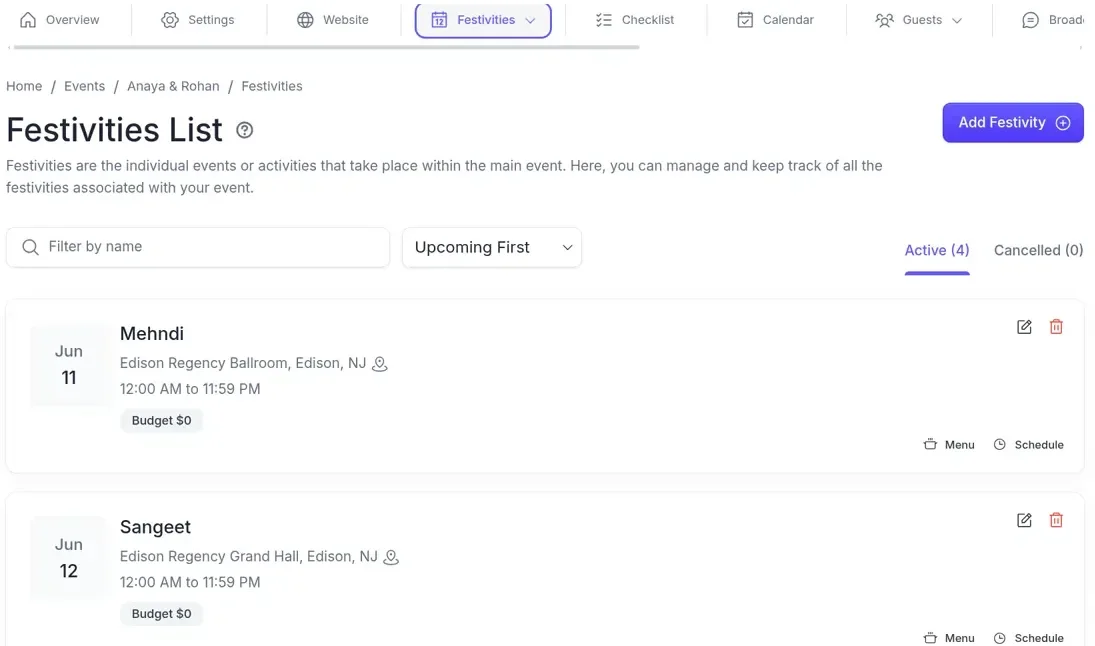
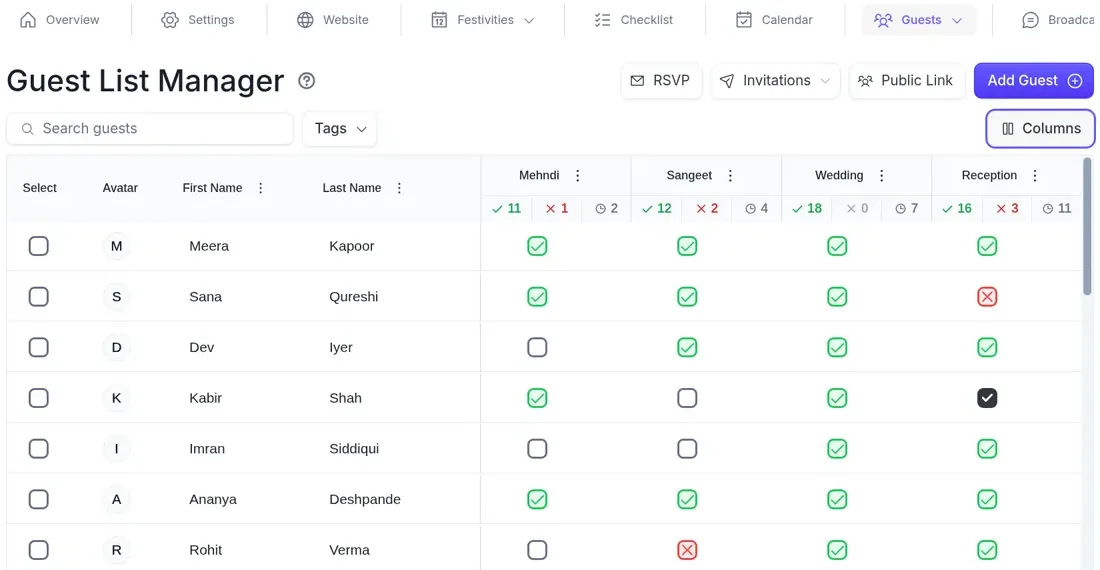
Guests are invited festivity by festivity, and the guest list shows the RSVP count for each one. Each household replies through a private link by email or SMS that shows only the festivities they are invited to, so your sangeet-only guests never see the ceremony details. Email and SMS reminders go to guests picked by tag or RSVP status (not by festivity), so tag your sangeet guests or performers if you want to message only them. Forms can collect extras, such as who wants to perform.
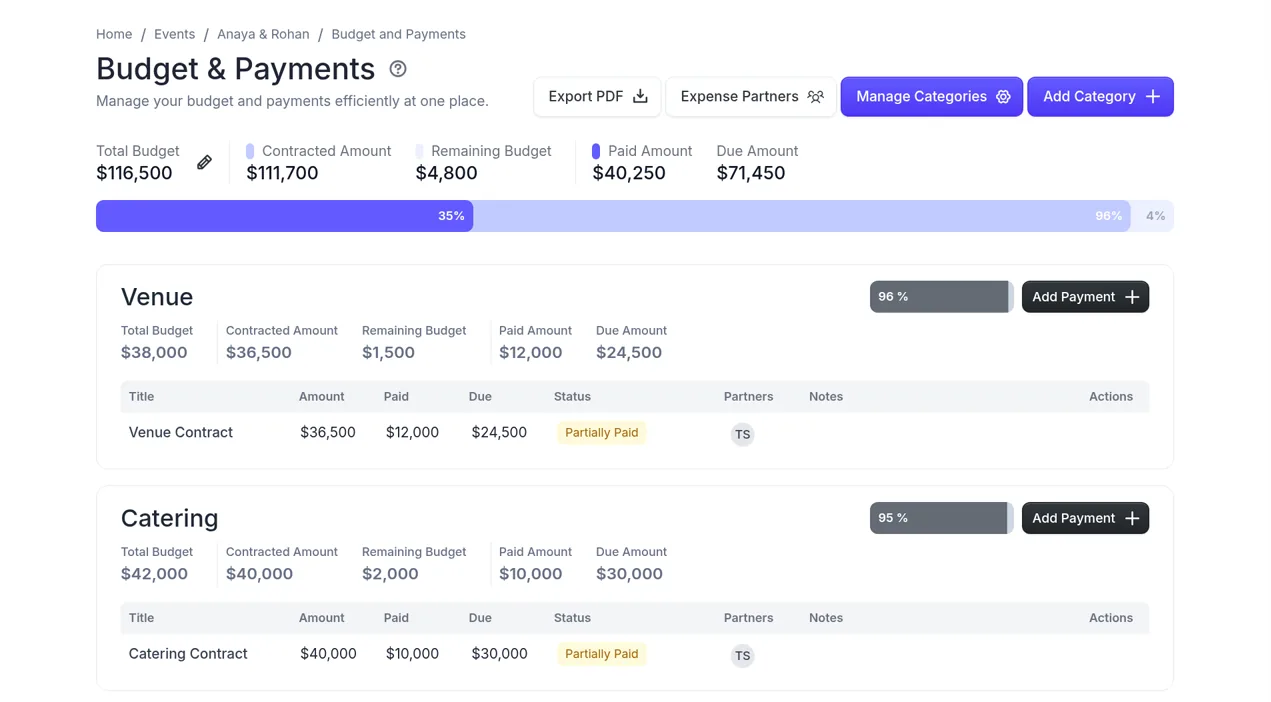
For money, Budget and Payments lets you name your own categories, so the sangeet can be its own category with its budget, contracted, paid and due amounts, and Expense Partners record which family paid what. Vendor Management keeps the DJ, decor and choreographer quotes side by side with a status. It tracks quotes you collect; it isn’t a vendor marketplace.
The same event holds the wedding website, hotels, seating charts, checklist and calendar. See RSVP for multiple events for how invitations by festivity work, or software for South Asian wedding planners if a planner is running the weekend.
Sources
Checked October 21, 2026. Reddit comments are quoted as posted and are opinions, not data. Cost figures are vendor and planner estimates, not surveys. The worked examples are our own arithmetic with assumed inputs.
- The Knot: A Sangeet Ceremony: Definition, Attire, Decor and More
- The Knot: Indian Wedding Traditions and Customs to Know
- Joy: How to Manage Multiple Wedding Events with Different Guest Lists for Indian Weddings
- Zola: Average Cost of Weddings in 2026
- The Curated Knot: Add Mehendi, Sangeet and Baraat to Your Wedding Website
- Invyt: How to Plan a Sangeet
- EventAtlas: How to Plan a Sangeet Night That Your Guests Actually Enjoy
- ShaadiHive: Sangeet Planning Guide
- Anvaya: How Much Does a South Asian Wedding Really Cost in 2026?
- Marigold: How Much Does an Indian Wedding Cost in the US? (2026)
- Sumit Khetan: Sangeet Planning Checklist
- The Wedding Trunk: How to Plan Sangeet Performances
- Wedly Events: Sangeet Ceremony Guide
- Patel Events: How to Plan a Sangeet Night
- ShareUrWedding: Sangeet Night Planning Guide 2026
- Mel’s Events: Dance Floor Rental Cost (2026)
- r/DesiWeddings: What is your favorite flow for Sangeet?
- r/DesiWeddings: Lessons from 3+ Years of Coordinating Sangeet Dances
- r/DesiWeddings: Is it okay to invite someone to the Sangeet only?
- r/DesiWeddings: How do I plan a Sangeet Dance?
- r/DesiWeddings: Why does every Punjabi wedding serve dinner at 10:45 PM?
- r/DesiWeddings: Difference between reception and sangeet
Common questions
How do you plan a sangeet?
Decide four things first: who hosts, whether it is its own night or combined with the mehndi, the venue and the guest list. Then book the venue, DJ and any choreographer about three to six months out, open performance sign-ups around ten weeks out, lock the songs and the running order six to eight weeks out, and share one cue sheet with the DJ and MC in the final week. Budget it as its own festivity with its own guest count.
How long is a sangeet?
Most modern sangeets run four to five hours from arrival to the end of the open dance floor, according to The Knot. The performance block itself is best kept to about 60 to 90 minutes; several planners say guests lose attention after roughly 45 minutes of back-to-back acts.
How many performances should a sangeet have?
Published guides range from four to six group acts plus the couple (ShareUrWedding) to six to eight including the couple's dance (EventAtlas), with each act around three to five minutes. A simple check: number of acts times length, plus one to two minutes of transition each. If that passes 90 minutes, shorten the acts or merge groups into medleys rather than cutting people out.
Should dinner be served before or after sangeet performances?
Guides disagree. Invyt says serve dinner first, Wedly Events says never put dinner before the performances, and EventAtlas opens a buffet between two performance blocks. The advice that comes up most on r/DesiWeddings is to keep appetizers and drinks flowing from the start, run the performances back to back early, then open dinner and the dance floor together. Pick one plan and tell the caterer and DJ the exact times.
Who should be invited to the sangeet?
It's up to the families. The Knot notes the sangeet was traditionally a women-only gathering but most couples now invite a broader group, much like a welcome party. In practice it is usually smaller than the reception and larger than the haldi or mehndi. Inviting some people to the sangeet only is common when the ceremony is small or far away, as long as you are clear about which festivities each household is invited to.
How much does a sangeet cost in the US?
Published 2026 ranges vary with guest count and menu: EventAtlas puts a 150 to 250 guest sangeet at about $8,000 to $25,000 or more, Anvaya at about $12,000 to $40,000, and ShaadiHive at about $30,000 to $70,000 for 250 guests with a plated dinner and bar. Catering and venue are the biggest lines, then stage, sound and decor. Price your own with the guest count you actually expect.
When should we start planning the sangeet dances?
Book a choreographer early if you want one: Sumit Khetan, a sangeet choreographer, suggests about six months out for peak season, with detailed planning from about twelve weeks out and most rehearsals in the final three weeks. EventAtlas suggests starting rehearsals two to three months out, with six to ten sessions per group for non-dancers.