On this page
- The short answer
- Which events need a seating chart (and which don’t)
- Assign tables, not seats
- The table math for 300+ guests
- Group your guests before you touch the floor plan
- Who to seat first
- Family politics: both sides, reserved tables and parents
- How seating changes from the mehndi to the reception
- Buffet vs plated dinner: what changes
- Late RSVPs and last-minute changes
- Helping 300+ guests find their table
- Making the seating chart in PlanMe
- Sources
- Common questions
Most seating chart advice is written for one reception of 120 guests. A Desi wedding has a mehndi, a sangeet, a ceremony and a reception, each with a different guest list and a different room, plus two families who both expect the best tables. The method is the same as any wedding (group guests, seat the important people first, leave room for changes), but the order and the details matter more.
Below you’ll find which events need a chart at all, the table math for 300+ guests, a priority order for seating elders, both families, kids and colleagues, how sangeet and reception seating differ, what changes with a buffet versus a plated dinner, and how to get 300 people to the right table quickly. The examples use our fictional couple, Anaya and Rohan.
The short answer
Make a seating chart for the reception and for any seated dinner. For the mehndi, haldi and most ceremonies, reserve rows or tables for immediate family and elders and leave the rest open.
Assign tables, not seats. Start from the guests who said yes to that event, not from your whole list. Group them by side and family branch, then seat in this order: the couple, both immediate families (at equally good tables), elders, guests with access needs, kids, your parents’ VIPs, extended family, friends, colleagues, and late additions last. Plan about 10% more seats than confirmed guests, and use two alphabetical boards (or escort-card tables) so 300 people don’t queue at one sign.
Which events need a seating chart (and which don’t)
You don’t need a chart for every event. The Indian wedding planning site Pyaar & Prema puts it plainly in its seating chart guide: “most Indian wedding events do not need assigned seats.” Mandap Chat’s seating template makes the same split by event. Here’s how that looks across a typical weekend (see Indian wedding events in order if you’re still deciding which events to host):
| Event | Seating style | What to reserve | Chart needed? |
|---|---|---|---|
| Mehndi / haldi | Open lounge clusters, low seating, a few tables | Chairs with backs for elders; the couple’s spot | No |
| Sangeet (dinner during performances) | Assigned tables or zones facing the stage | Front tables for both families and performers’ parents | Usually |
| Sangeet (party, standing or lounge) | Open, with cocktail and lounge tables | A few tables for elders and immediate family | No |
| Ceremony (mandap) | Rows facing the mandap | Front rows on each side for immediate family and elders | No, but reserve rows |
| Anand Karaj in a gurdwara | Guests sit on the floor in the darbar hall | Seating for anyone who can’t sit on the floor (ask the gurdwara) | No |
| Reception, buffet | Assigned tables | Family tables near the stage, kids’ tables | Yes |
| Reception, plated | Assigned tables, seats for meal service | Same, plus meal choices per seat | Yes |
In this article, the reception gets most of the attention because that’s where 300+ guests sit down at once. The section on how seating changes by event covers the others.
Assign tables, not seats
For a Desi reception, give every guest a table number and let them pick the chair. Many Indian receptions in the US already work this way. In a r/DesiWeddings thread on reception seating assignments, one commenter wrote:
“Every Indian wedding I’ve been to in the US has had table assignments, not exact seat assignments. You want to make sure the priority families get the tables in prime viewing, receiving areas.”
Western wedding advice agrees. In Martha Stewart Weddings’ seating chart etiquette, planner Leah Weinberg says guests “don’t want to be told what seat to sit in,” and that if a guest doesn’t like their seat, they’ll just rearrange the place cards. Weddingkart’s seating planner FAQ is firmer for Indian weddings: assign tables only, because family plans shift on the day.
Assign exact seats only in three places:
- The sweetheart or head table, where the photographer and the speeches depend on who sits where.
- A plated dinner, where servers need to know which seat ordered the vegetarian, Jain or non-veg plate.
- Ceremony front rows, where each side’s parents and grandparents need to be in place before the couple walks in.
Rows and rounds work differently, too. Ceremony rows are filled from the front, by side, and nobody minds who they sit next to for an hour. Banquet rounds are where people spend three or four hours eating and talking, so who shares a table matters more than where exactly each person sits.
The table math for 300+ guests
The formula is simple:
Tables = confirmed guests for that event ÷ seats per table, rounded up, plus about 10% spare.
Ask the venue which tables they have before you start. Joy’s seating chart guide notes that most venues use 60-inch rounds, which seat 8, and that a 72-inch round seats 10 to 12. Weddingkart’s FAQ calls eight the sweet spot at Indian weddings and ten the choice when floor space is tight, so ask what the room can actually hold with the stage, dance floor and buffet in place. The spare 10% matters: a planner quoted by Martha Stewart suggests seating 8 at tables that could take 10, so a surprise plus-one or a late “we’re coming after all” has somewhere to go.
Worked example: Anaya and Rohan’s reception
312 guests said yes to the reception, including 18 children. Six of the children are toddlers who will sit with their parents; the twelve older kids get their own tables. Tables are 72-inch rounds seating 10.
| Group | Guests | Table type | Tables |
|---|---|---|---|
| Anaya and Rohan | 2 | Sweetheart table | 1 |
| Bride’s immediate family (parents, siblings, grandparents) | 12 | Long family table, 12 seats | 1 |
| Groom’s immediate family | 12 | Long family table, 12 seats | 1 |
| Older kids (about 6 to 12) | 12 | Kids’ rounds, 6 seats | 2 |
| Everyone else, including 6 toddlers with their parents | 274 | 72-inch rounds, 10 seats | 28 |
| Spare for late changes (about 10%) | 0 | 72-inch rounds, 10 seats | 3 |
| Total | 312 | 348 seats | 36 |
For the sangeet the same weekend, the numbers change: fewer colleagues, more cousins, and performers who need a seat when they’re not on stage. Do the math again for each event with that event’s yes count. If replies are still coming in, the guest attendance calculator estimates how many invited guests will come to each event, so you can reserve tables before the final count.
Not sure how many people will actually come to each event?
Before you count tables, estimate the yes count for each event. The guest attendance calculator works it out from how many guests you invited to each event and how many are traveling from out of town, right on the page. No sign-up.
Open the attendance calculatorGroup your guests before you touch the floor plan
The most useful line in Mandap Chat’s Indian seating template is this one: “Seating is not a separate creative exercise. It is a filtered view of the guest list.” If your guest list already says which side, which branch of the family and which events each household is coming to, most tables almost build themselves.
Before you place a single name, make sure every guest has:
- A side: bride, groom, or both (shared family friends).
- A group: “Mom’s side, Delhi cousins”, “Dad’s colleagues”, “Rohan’s college friends”, “temple committee”. Be specific; “family” is too big to seat.
- A household: who arrives together and should sit together. Seating households, not individuals, cuts 312 people down to maybe 120 decisions.
- Their RSVP for this event: seat the people coming to the reception, not everyone you invited to the weekend.
- Notes that affect placement: walker or wheelchair, hearing, high chair, Jain or other meal needs, and “not near X” (kept private, never on a public sign).
The Knot’s seating etiquette guide quotes planner Leah Weinberg, who started grouping guests into rough tables “as soon as I sent out my invites” and then adjusted as RSVPs came in. That’s the right rhythm for a big Desi wedding too: build the groups early, fill tables late. Our Indian wedding guest list guide shows how to set up sides, households and per-event columns so the list is ready for seating.
Who to seat first
Seat the hardest guests first, while every table is still empty. Friends and colleagues can fill in around them later, and they’re the easiest to move when something changes.
- The couple. Sweetheart table or a head table with the wedding party. Zola’s seating guide suggests placing yourselves first, then working outward.
- Both immediate families, at equal tables. Parents, siblings and grandparents, one family table per side, the same distance from the stage. More on this in the family politics section.
- Elders. Close enough to see the stage, away from the speakers and dance floor, near the restrooms and an exit. Joy, Zola’s seating chart page and the Indian wedding planner Event Crafter’s 400-guest guide all say to keep older guests away from the speakers.
- Guests with access needs. A clear route for wheelchairs and walkers, a seat on the aisle, a companion next to them. Do this before the decorator fills the room.
- Kids. Toddlers with their parents; older kids at a kids’ table close to their parents’ tables, not across the hall. Zola suggests an adult or older teen keeps an eye on it.
- Your parents’ VIPs. The family friends, elders from the community and “important uncles” your parents care about. Ask each set of parents for their list and seat it near their family table.
- Extended family, by branch. Keep each branch together and behind its side’s family table.
- Friends. By friend group, near the dance floor.
- Colleagues and plus-ones. Together, or with the one person they know. No “singles table”; Zola and Event Crafter both advise against it.
- Late additions, into the spare tables.
Family politics: both sides, reserved tables and parents
At a Desi wedding, the seating chart is where family politics shows up on paper. The Knot quotes planner Natalie Good on the same point: the seating chart is often “where the drama comes out within families,” so start early and hear your parents’ requests before there’s a deadline.
Give both sides equal standing
Nobody should be able to say their side got the worse tables. Mirror the room: bride’s family table on one side of the stage, groom’s on the other, extended family behind each, and shared friends in the middle. The India-based guide WedPlan’s seating arrangements guide says the same for relatives who don’t get along: equal standing, and no sightline. Put them at tables of equal rank on opposite sides of the room, not one at the front and one at the back.
Let your parents seat their own guests (within limits)
Parents often want to run the seating, and it’s a common complaint. There’s a whole r/IndianWeddings thread asking “Do your parents and extended family try to take charge of reception seating?” and a r/ABCDesis thread on where to seat your parents at a big wedding. The cleanest split: you and your partner seat your friends; each set of parents seats their own relatives and friends, inside the tables you give them. Joy’s guide recommends asking parents about their extended family because “they know the dynamics.”
Stop people taking the reserved tables
Reserved signs alone don’t always work. A UK poster from a Pakistani family asked r/DesiWeddings how to stop relatives taking over reserved tables:
“I have seen this in many of our family weddings where the front tables that clearly say ‘reserved’ are taken over by those that it’s not reserved for.”
The replies point to people, not signs: have someone greet guests and point them to the chart, ask the venue to rope off the reserved tables, and give one firm relative the job of moving people politely. One commenter suggested assigning someone to walk elders to their seats, “as though you’re doing that to be respectful to them because they’re elders.” That’s a nice job for a cousin.
Divorced parents and family feuds
Joy suggests seating divorced parents at separate tables near the front, each with their own people, and Zola’s seating chart page says they’re usually seated at separate tables with their own families. The same goes for estranged siblings or in-laws. Write these rules down privately before you start, so you don’t discover them after the chart is printed.
How seating changes from the mehndi to the reception
One mistake to avoid: copying the reception chart to every event. The guest list is different, the room is different, and so is what people are doing.
Mehndi and haldi
Guests come and go, sit on the floor or on low seating, and crowd around the bride. Plan clusters, not tables: lounge seating, a few tables for eating, and proper chairs with backs for elders. WedPlan suggests chairs for about 50 to 60% of the crowd at informal events, arranged in clusters. Keep the mehndi artists’ area separate so guests waiting for henna aren’t blocking the walkway.
Sangeet
A sangeet is a show. Seating faces the stage, and the families whose kids are performing want to see them. The r/DesiWeddings thread “Seating arrangements for sangeet” asks exactly this question. If dinner is served during the performances, assign tables or at least zones, reserve the front tables for both families, and seat performers near the stage door so they can slip out and back. If it’s a dance party with a buffet, reserve a few tables for elders and leave the rest open. Our sangeet planning guide has the run of show that decides when people are seated.
Ceremony
Rows facing the mandap, with the front rows on each side reserved for immediate family and grandparents. Put elders on the aisle so they can get up during a long ceremony. At an Anand Karaj in a gurdwara, guests sit on the floor in the darbar hall, so there’s no chart; just plan seating for anyone who can’t sit on the floor; ask the gurdwara what it provides. For a nikah, follow your family’s and venue’s practice on seating. Our wedding day timeline covers when ceremony guests and elders need to be in their seats.
Reception
This is the big one: the most guests, the longest sit-down, and the most colleagues and parents’ friends who only come to this event. Assigned tables, family tables near the stage, two boards or escort-card tables at the entrance, and spare tables for late changes. Many guests here weren’t at the earlier events, so seat reception-only guests with at least one person they know.
Buffet vs plated dinner: what changes
| Item | Buffet | Plated |
|---|---|---|
| What you assign | Tables | Tables, and seats if meals differ by guest |
| What the caterer needs | Total count, with veg, Jain, halal and kids counts | Count per table and the meal for each seat |
| Where the elders eat | At their table, served by staff or family | At their table, served first |
| Flow problem to plan for | Long buffet lines; release tables in order | Servers finding the right plate for each seat |
| How guests learn their meal | They don’t need to | A mark on the escort card or place card |
Most Desi receptions are buffets, which is one more reason to assign tables rather than seats. Plan the line instead: put the buffet where the queue won’t block the dance floor, have the DJ or MC release tables a few at a time, and ask the caterer to bring plates to the elders’ tables. WedPlan’s guide is firm on this point: food for elders should be brought to them, “never queued for.”
For a plated dinner, the caterer needs to know which seat gets which meal. One commenter on r/weddingplanning suggested color-coded escort cards, one color per meal, so servers can spot them from a distance. Either way, check your veg, Jain, halal and kids counts per event with the catering headcount calculator before you send the numbers.
Late RSVPs and last-minute changes
At a 300-guest Desi wedding, the chart will change after you finish it. Someone’s cousin flies in, someone else’s father isn’t well, a family of five becomes a family of six. The Knot’s list of seating chart mistakes includes a guest with no assigned seat. The fix it gives: one central list of everyone who said yes, then “check, check and recheck.” Plan for changes:
- Chase the missing RSVPs first. A chart built on guesses breaks twice. Our RSVP reminder wording has messages for aunties, cousins and overseas family, and per-guest RSVPs for multiple events explains how to collect a separate answer for each event.
- Work in stages. Joy suggests starting the chart after RSVPs close, about 3 to 4 weeks out, and printing escort cards 1 to 2 weeks before. Mandap Chat suggests a working chart about two weeks out, a family review, and a freeze about 48 hours before setup.
- Keep the spare tables empty until the day. That’s where late additions go, so you never have to move an elder or a VIP to make room.
- Name one person who approves changes. If five relatives can edit the chart, nobody knows which version is right.
- Check who dropped out. A guest who changed their reply to “no” still has a seat on your chart until you remove them. Recheck the yes list against the chart before you print anything.
Helping 300+ guests find their table
Whatever you put at the door, list guests alphabetically, not by table. Couples on Reddit are close to unanimous on this. In a r/weddingplanning thread about displaying a seating chart for 300+ guests, the most upvoted reply was “PLEASE for the love of gaga do alphabetical order.” On r/DesiWeddings, a seating chart name order thread made the same point: alphabetical lets guests find their name and table number in one look, instead of scanning every table.
- Use two boards, or more. Event Crafter recommends two seating boards for weddings of 400+ guests to avoid bottlenecks. For 300, two boards (A to K and L to Z) at either side of the entrance work well.
- Or escort cards, spread out. In a r/weddingplanning thread about a 300-guest wedding, one commenter with about 500 guests laid every card out alphabetically on one table, with two attendants to help; another suggested separate stations by last name.
- List families under one name. “Shah, Kabir and Meera (+2 kids): Table 14” is easier to find than four lines.
- Number tables in a pattern. The Knot’s planner suggests odd numbers on one side, even on the other, or clockwise from the entrance.
- Put a person at the door. A cousin with the full list on their phone fixes every “my name isn’t there” in seconds.
Never put private notes on the public board. Side, “not near X”, meal codes beyond a simple color, and anything medical belong on the planner’s copy only.
Making the seating chart in PlanMe
PlanMe.Club is our product, so here’s how seating works in it, checked against the app on October 27, 2026. In PlanMe, each event (mehndi, sangeet, wedding, reception) is called a festivity, and every festivity has its own seating chart. The reception layout never moves when you change the sangeet.
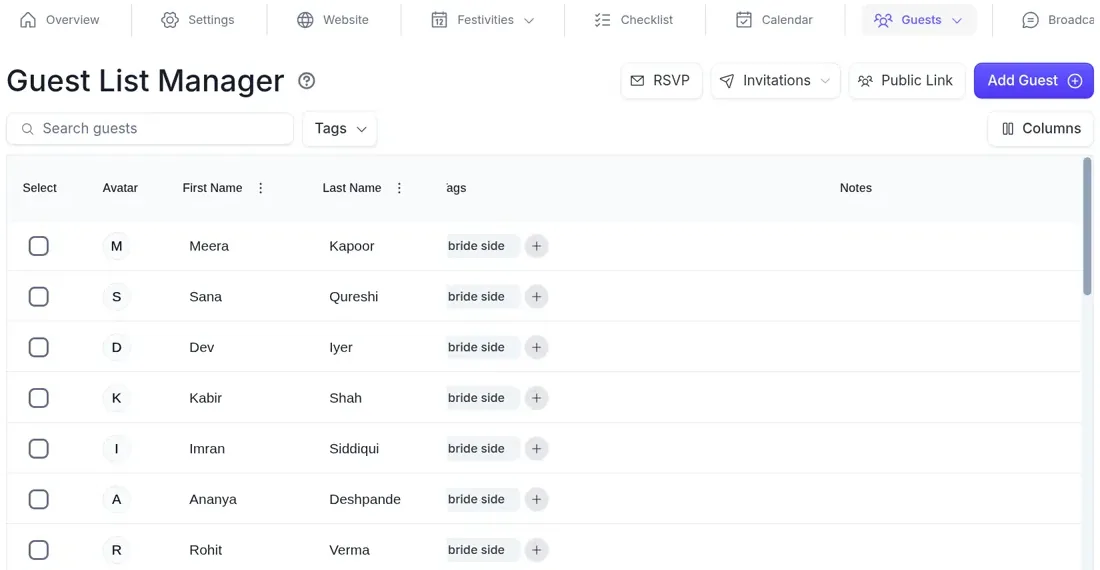
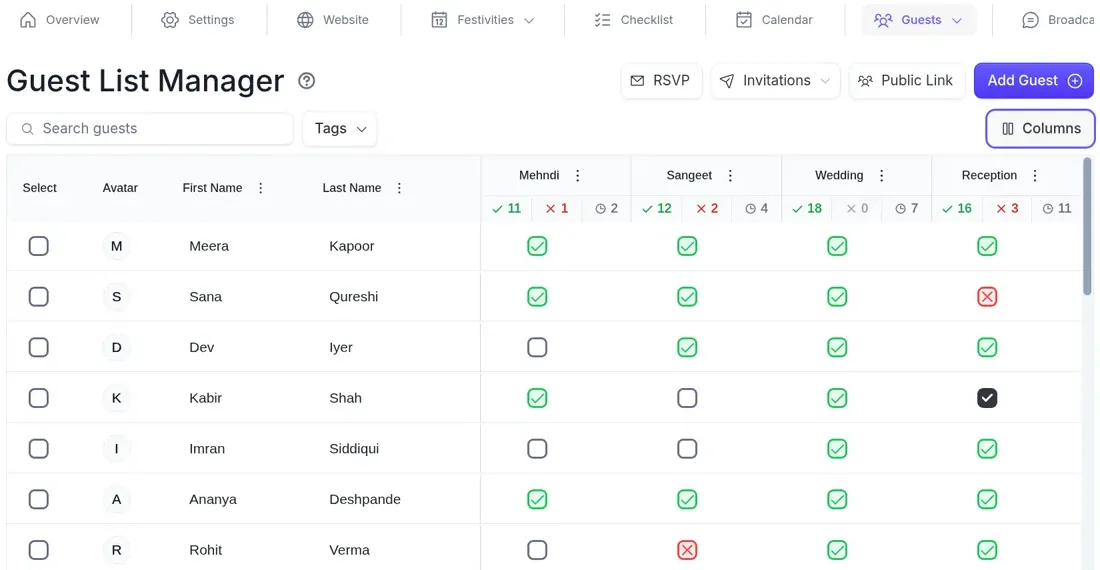
It starts with the guest list. You invite households festivity by festivity, tag them (for example “bride side”, “groom side”, “Mom’s cousins”), and collect an RSVP from each guest for each festivity they’re invited to.
Then, in the Seating Chart for one festivity:
- Lay out the room. Start from a floor plan template (reception and dining, banquet hall, or ceremony and lawn) or from scratch. Add tables such as 60-inch and 72-inch rounds, kids’ rounds, long banquet tables, a king’s table and a sweetheart table, plus the stage, dance floor, bar, buffet, entrance and areas like a mandap or a lawn.
- Seat guests by hand. Drag a guest, or a whole household, onto a table. By default the guest panel shows the people who accepted that festivity, and you can filter by RSVP status or tag to find, say, every groom-side guest who still needs a table.
- Catch changes. If a seated guest changes their reply to no, PlanMe flags that their seat is held by someone who is no longer attending, and you can clear it.
- Try options. Save more than one draft of a layout and switch between them, which helps when both sets of parents want to see a version.
- Share it with the venue. Export the floor plan as a PDF or image and the seating list as a PDF or CSV.
What it doesn’t do: PlanMe doesn’t seat guests automatically. You place every table and every guest yourself. If you want a computer to do the first pass, Joy’s Seating Chart can place your guest list with AI and is a one-time purchase per event, and Zola’s seating chart is free for up to 15 guests, with a premium version for more (both checked October 27, 2026). Where PlanMe helps a Desi wedding is that the seating chart, the per-event RSVPs and the side tags all live in the same guest list, so a late “no” to the reception shows up on the reception chart and nowhere else. See the seating chart feature for more, or the Indian wedding cost guide if table count is driving your budget.
Build each event’s seating chart from your real guest list
Put your events and guests in PlanMe.Club, tag each household by side, collect RSVPs for each event, then lay out the room and drag in the guests who said yes. Export the floor plan and seating list for the venue. Free during beta.
Start your seating chart in PlanMeSources
Checked October 27, 2026. Reddit quotes are as posted by the commenters and are not verified. The table math, worked example and seating-by-event recommendations are our own.
- The Knot: Your Etiquette Guide to a Seating Arrangement at a Wedding
- The Knot: Frequent Wedding Seating Chart Mistakes, Backed by a Planner
- Zola: How to Create a Wedding Seating Chart
- Zola Help Center: How do I use the Zola seating chart?
- Zola: Wedding Seating Chart Maker & Floor Plan Tool
- Joy: How to Create a Wedding Seating Chart
- Joy Help Center: Seating Chart
- Martha Stewart: Essential Wedding Seating Chart Etiquette
- Mandap Chat: Wedding Seating Chart Template for Indian Weddings
- Pyaar & Prema: How to Make a Seating Chart for an Indian Wedding
- Weddings by Event Crafter: How to Plan a 400+ Person Indian Wedding Reception
- Weddingkart: Wedding Seating Planner FAQ
- WedPlan: Wedding Seating Arrangements Without Family Drama
- r/DesiWeddings: Reception seating assignments
- r/DesiWeddings: How to prevent desi families taking over reserved seating
- r/DesiWeddings: Seating chart name order
- r/DesiWeddings: Seating arrangements for sangeet
- r/IndianWeddings: Do your parents and extended family try to take charge of reception seating?
- r/ABCDesis: Where do you seat your parents at your big wedding?
- r/weddingplanning: People with large weddings, how are you handling the seating arrangements?
- r/weddingplanning: Best way to display a seating chart for a large wedding
Common questions
Do Indian weddings need a seating chart?
Not for every event. The mehndi, haldi and most ceremonies work with open seating plus a few reserved rows or tables for immediate family and elders. The reception, and any sit-down sangeet or dinner, is where a chart pays off: elders get good seats, both families get equal standing, and the caterer can serve tables in order.
Should we assign tables or individual seats at an Indian wedding?
Assign tables, not seats, for almost everyone. Guests at Desi receptions move around, families arrive together, and seat-by-seat plans break the moment one aunty swaps places. Assign exact seats only for a sweetheart or head table, or for a plated dinner where the servers need to know who ordered which meal.
How many tables do I need for 300 wedding guests?
Divide your confirmed guests by the seats per table, then add about 10% for late changes. With 72-inch rounds seating 10, 300 guests need 30 tables, plus about 3 spare tables. With 60-inch rounds seating 8, it is 38 tables plus about 4 spare. Confirm the table sizes and how many fit in the room with your venue before you seat anyone.
Where should the bride’s and groom’s families sit at the reception?
Give each side an equally good spot near the stage: one family table for the bride’s parents and siblings and one for the groom’s, at the same distance from the stage and dance floor. Then seat each side’s extended family behind its family table, and mix friends and colleagues in the middle of the room.
Where do elders and grandparents sit at an Indian wedding?
Close to the stage with a clear view, but away from the speakers and the dance floor, with a short, step-free route to the restrooms and an exit. At a buffet, ask the caterer to serve the elders’ tables so nobody over 80 queues for food, and have a family member walk them to their table.
Do you need a seating chart for the sangeet?
It depends on the format. If dinner is served during performances, assign tables or at least zones, and reserve the front tables for both families and the performers’ parents. If it’s a standing or lounge-style party, reserve a few tables for elders and immediate family and leave the rest open.
When should we finish the wedding seating chart?
Start grouping guests when invitations go out, build the working chart once RSVPs close, and freeze it a few days before the event. Joy suggests starting after RSVPs close, about 3 to 4 weeks before the wedding. Keep a short late-change list until the day before, and give one person the job of approving changes.
Can PlanMe make the seating chart automatically?
No. Seating in PlanMe is manual: you lay out the room for each event and drag guests or whole households onto tables. By default the guest panel lists the people who accepted that event, you can filter by RSVP status or tag (such as bride side or groom side), and PlanMe warns you when a seated guest is no longer coming.