On this page
Generic wedding worksheets treat one Saturday reception as the whole party. A Desi weekend is a run of events (functions, as most families call them): mehndi, sangeet or garba, ceremony, reception, sometimes a farewell brunch. Guest counts change night to night. Menus change with Halal, Jain and vegetarian rules. Late sangeets push overtime. The sticker price on page one of a proposal is almost never the number you’ll pay.
This guide is for Western diaspora hosts comparing real bids in USD, with CAD and GBP callouts for tax and gratuity. It isn’t a price list for packages in India. Sources and method notes were checked November 7, 2026. Illustrative numbers in the Anaya & Rohan example are invented for teaching the method, not surveyed market averages.
Normalize scope first
Before you open a spreadsheet, write one brief and send it to every vendor in the category. All Wedding’s comparison worksheet puts it plainly: a proposal is only comparable when it covers the same event and work. Get every detail into one place, including hours, tax, service fees and tips, so each bid answers the same questions.
For a multi-event Desi weekend, the brief should lock:
- Which events each vendor is covering (mehndi only, sangeet plus reception, full weekend).
- Guest count per event, not one blended headcount. Use your Indian wedding events in order list so the vendor sees the same sequence your family uses.
- Service hours and end time, especially for a late sangeet or garba that runs past a hotel curfew.
- Diet rules: Halal sourcing, Jain exclusions (onion, garlic, root vegetables), vegetarian and vegan counts, and whether kitchens or oils stay separate.
- Deliverables: live stations, chaat, tandoor, stage and mandap pieces, second shooter, ceremony audio, baraat route support, glam seats and touch-ups.
- Who provides what: tables, linens, power, street permits, parking for the baraat, vendor meals.
Narrow the field early. Three solid finalists per category is usually enough to compare side by side. Once you’re talking to vendors in several categories at once, log every call in one shared sheet with a status and the next follow-up, or the details start to blur.
Price the weekend before you chase quotes
The Indian wedding budget calculator estimates each event from its own guest count, catering, venue, decor and entertainment, then adds shared costs and a buffer. Use it to set category caps before you compare catering or DJ bids. No sign-up.
Open the budget calculatorThe true-cost formula
Wedding proposals love “plus-plus” pricing: a per-guest or package number, then a mandatory service charge, then tax. Marry Math’s quote comparison guide and its 2026 service-fee walkthrough show why sticker prices mislead. A practical, fully loaded starting point for US quotes, where the service charge is taxable:
(base + travel + add-ons + expected overtime)
× (1 + service charge %)
× (1 + sales tax %)
+ fixed gratuity or processing fees required by the contract
Ask each vendor, in writing, what the service charge applies to and whether tax is calculated on the service charge. In many US jurisdictions a mandatory service charge is taxable revenue, not a tip, but the rules depend on the state and city. Where the service charge isn’t taxable, use base × (1 + service charge % + sales tax %) instead, which comes out lower. A service charge is also not automatically gratuity for staff; ask who receives it before you tip again.
Canada and UK notes
Canada: GST or HST sits on catering and venue services. Canada Wedding Guide’s 2026 service-charge explainer separates a contractual service fee, a mandatory gratuity, a voluntary tip and sales tax. The CRA’s special-cases guidance treats a freely given tip that is not on the bill as outside GST/HST, while a mandatory or suggested amount added to the bill is taxable. Ontario HST is 13%. Rates differ by province, so confirm the rate for the place of supply on the CRA rate table for your wedding city.
UK: wedding catering is ordinarily standard-rated VAT at 20% under HMRC Notice 709/1. HMRC guidance on tips and service charges says a compulsory service charge is part of the consideration for the meal (also standard-rated), while a tip freely given sits outside VAT. Put VAT into the same tax column you use for US sales tax so CAD and GBP bids stay comparable to USD ones.
For how those loaded numbers sit inside a whole weekend budget, see how to split a wedding budget by event and how much an Indian wedding costs in the US.
Columns for comparing Desi vendors in the West
Build one row per vendor and the same columns every time. Desi weekends need a few extra fields that generic Western sheets skip.
| Column | Why it matters on a Desi weekend |
|---|---|
| Events covered | Mehndi, sangeet/garba, ceremony, reception, brunch — list each |
| Guest count used | Force every bid onto the same headcount per event |
| Base / package | Sticker price before ++ fees |
| Service charge % | Mandatory admin or banquet fee; ask who receives it |
| Tax / VAT / GST-HST | US sales tax, Canada GST/HST, UK VAT |
| Overtime rate + start | Late sangeets and baraat delays blow past package hours |
| Diet / kitchen notes | Halal sourcing, Jain exclusions, separate oils |
| Extras | Travel, setup, street permits, power, vendor meals, corkage |
| Deposit + schedule | Amount, due dates, refundability |
| Status | Researching, contacted, negotiating, booked, rejected |
Category-specific extras that show up often for South Asian weekends in NJ, Houston, the Bay Area, Toronto/Brampton and London/Leicester:
- Catering: live chaat or tandoor stations, minimum guarantee, cake-cutting or outside-dessert plating fees, bartender cutoff vs your sangeet end time.
- DJ / dhol / live band: ceremony mics, second system for a separate mandap room, dhol arrival window for the baraat, noise ordinance cutoffs.
- Mehndi artists: per-hand vs package pricing, guest count caps, drying time before performances (useful when mehndi and sangeet share a night; see how to plan a sangeet).
- Glam: trial included or not, on-site touch-ups across events, overtime after the last look.
- Mandap / stage / decor: install and strike windows, flame rules for a havan, floral substitutions, storage between events at the same venue.
One caterer, several menus
Many diaspora caterers already plan for more than one night. Flavor of India’s Los Angeles wedding page (checked November 7, 2026) lists starting points from $70, $125 and $200 per person and separately describes mehndi, sangeet and reception menus; it also states halal across the menu and that vegetarian, vegan and Jain dishes can use separate equipment. WeddingCaterings.com’s Indian wedding page (checked November 7, 2026) gives an indicative market budget of roughly $70–$200+ per guest for one staffed meal, with tax and service identified separately, plus notes on Jain coordination and Halal sourcing. Treat those as published starting points from those companies’ own pages, not as your quote.
As a host process, ask one caterer for a menu and labor line for each event, then compare caterers on the sum of those lines after service charge and tax. That’s not the same as a software product storing a separate budget or quote ledger per event. In PlanMe, budgets and vendor quotes are organized by category for the whole wedding; you can still name a category “Catering” and keep mehndi / sangeet / reception notes on each quote row.
When families split who pays for which night, pair this with who pays for an Indian wedding so the quote comparison and the money conversation use the same event list.
Worked example: Anaya & Rohan (illustrative)
Illustrative only. Anaya & Rohan are PlanMe’s fictional showcase couple. The dollar figures below are invented to show the math. They aren’t survey averages or quotes from a real vendor.
Setup: a three-event New Jersey weekend. Mehndi 80 guests, sangeet 220, wedding/reception 280. Three caterers returned proposals for the same brief (Halal chicken, Jain thali option, live chaat at sangeet). The family expects the sangeet to end at 1:30am. Caterers A and B include service to midnight; C includes it to 1am. All three bill overtime at $450/hr after their included hours. The math applies New Jersey sales tax to the service charge, overtime and travel too, so check how your state treats each line.
| Line | Caterer A | Caterer B | Caterer C |
|---|---|---|---|
| Base food + labor (all events) | $48,000 | $44,500 | $52,200 |
| Service charge | 20% | 22% | 18% |
| Sales tax | 6.625% | 6.625% | 6.625% |
| Expected OT (sangeet to 1:30am) | $675 (1.5 hrs) | $675 (1.5 hrs) | $225 (0.5 hr) |
| Travel / setup extras | $800 | $0 | $1,200 |
| Approx. fully loaded | ~$63,300 | ~$58,800 | ~$67,500 |
| Deposit due to hold date | 30% | $10,000 flat | 25% |
Caterer B wins on loaded cost in this invented sheet, but only after the same guest counts, Halal/Jain rules and overtime assumption were forced onto every row. On base price alone, B was $3,500 below A and $7,700 below C. After service charge, overtime, extras and tax, those gaps grew to about $4,500 and $8,700. That’s the whole method: normalize, then decide.
Red flags in contracts
Marry Math flags undefined “full day” hours, plus-plus compounding, credit-card surcharges and vague backup plans. For Desi weekends, add these:
- Diet rules only in a chat thread. If Halal sourcing or Jain exclusions aren’t in the signed scope, you’ll be negotiating again the week of the wedding.
- One blended guest count for mehndi, sangeet and reception. You will over-plate the small night or under-staff the big one.
- Overtime that starts before your real end time. A sangeet that ends at 1am with package hours to 11pm is an overtime product, not a surprise.
- Baraat or street logistics left blank. City permits, police details and venue driveway rules are often the couple’s problem unless the quote says otherwise.
- “Market price” escalation on flowers or food with no cap and no notice window.
- Non-refundable deposit with cancellation language that only offers a date move inside a narrow window.
Deposits and payment schedule
Once a vendor is chosen, the comparison sheet should become a payment tracker. Add a payment-status column: different vendors use different schedules, and a deadline buried in an email is easy to miss. The Knot’s vendor manager guide likewise recommends calendar reminders for due dates and notes that many vendors want final payment about 30 days before the wedding (terms vary; read your contract).
Record for every booked vendor:
- Deposit amount, due date and refundability
- Second payment / progress payment
- Final balance due date and accepted payment methods
- Whether a card processing surcharge applies
- Which family or partner is paying that line (see who pays)
Book in the order your timeline needs. The wedding vendor booking timeline helps you see which categories usually lock first on a multi-event weekend.
How to track quotes in PlanMe
PlanMe.Club is our product. Read this section with that in mind. Product details checked November 7, 2026.
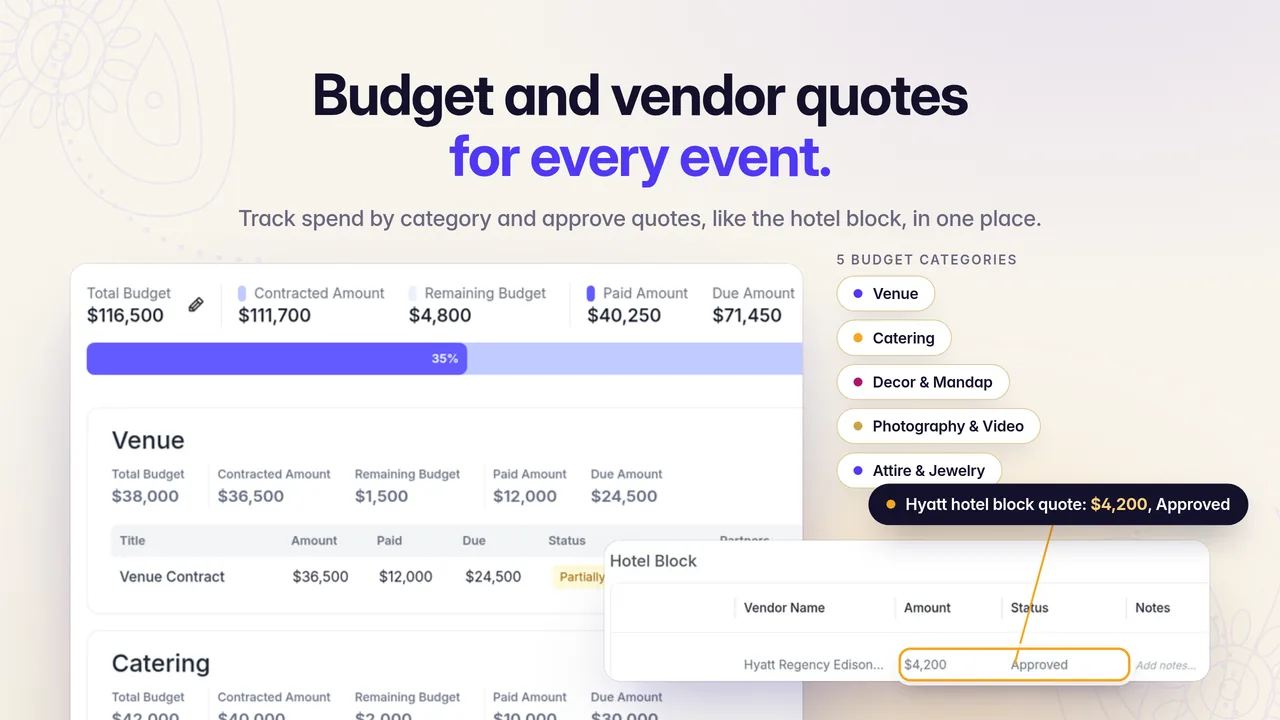
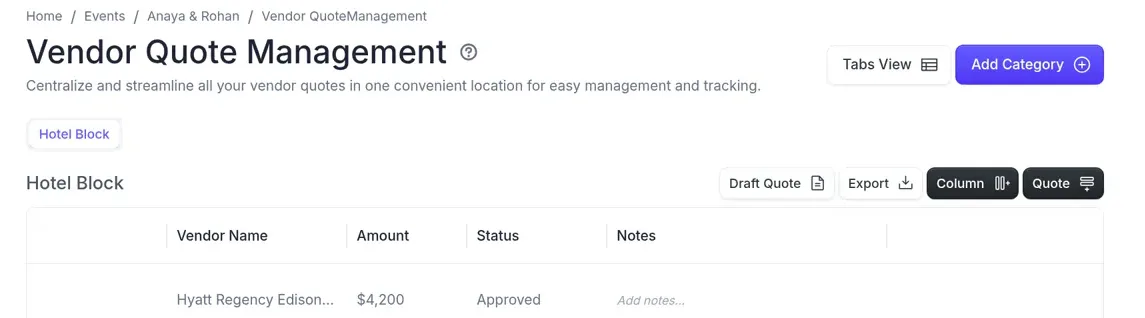
Spreadsheets work until two families are editing deposits from different phones. PlanMe’s vendor management keeps the quotes you collect in one table by category: catering, decor, photography, music and any categories you add. Each quote has a vendor name, amount, notes, optional custom columns and a status such as pending, negotiating, approved or rejected. It isn’t a vendor marketplace; you bring your own vendors.
Important truth for multi-event weekends: PlanMe budgets and vendor quotes are per wedding by category, not a separate ledger per event. In PlanMe each event (mehndi, sangeet, wedding, reception) is called a festivity, with its own date, menu and guest list, but quote amounts still live in wedding-level categories. Hosts can still compare multi-event catering bids as planning advice and put the notes on the quote row; the product does not claim per-festivity quote storage.
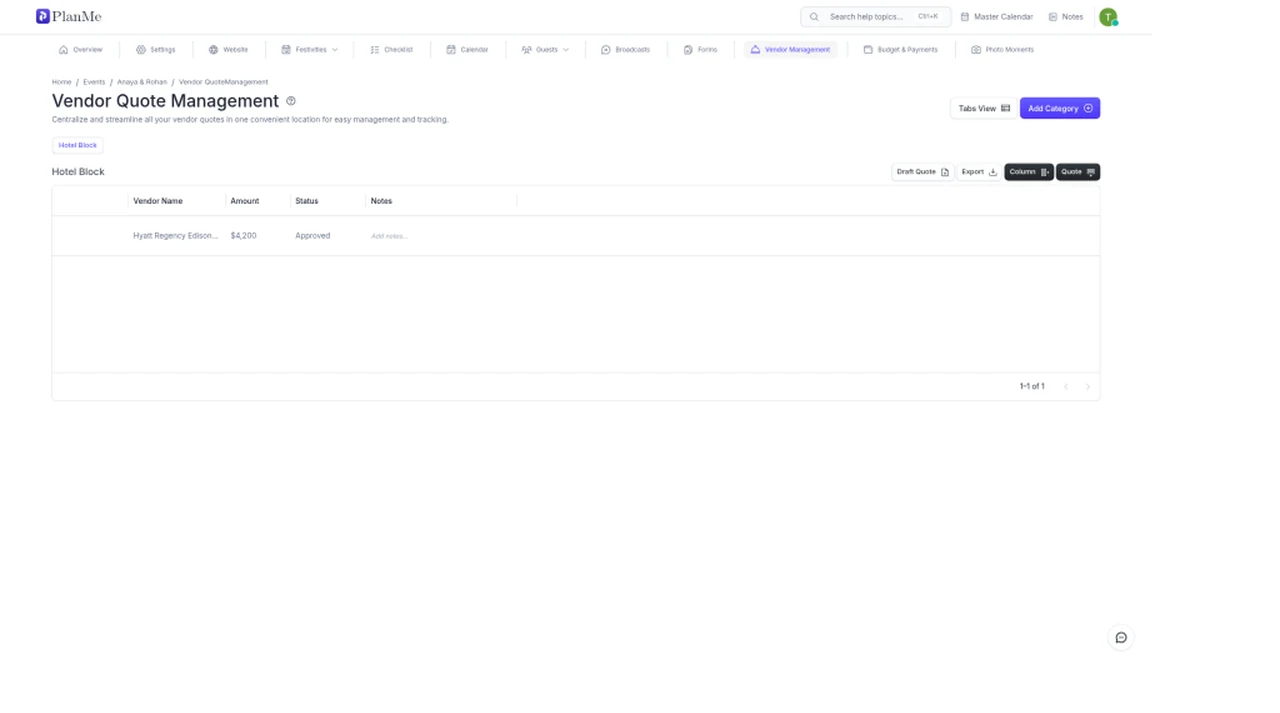
Approved quotes sit next to Budget and payments: one wedding budget split into categories you name, with contracted, paid and due amounts. For how PlanMe compares with other tools on multi-event weekends, see the best South Asian wedding planning tools roundup or the compare hub.
Keep every quote next to the budget
In PlanMe, add vendor quotes by category with an amount, status and notes, then track payments in one wedding budget. Both families and your planner can work from the same list. Free during beta.
Start tracking quotes in PlanMeSources
Checked November 7, 2026. Catering starting prices are taken from each company’s own page on the check date and are not PlanMe quotes. Illustrative Anaya & Rohan figures are invented for the method.
- All Wedding: vendor comparison worksheet
- Marry Math: vendor quote comparison spreadsheet
- Marry Math: service fee calculator guide (2026)
- The Knot: keep track of wedding vendors
- Canada Wedding Guide: venue service charges (2026)
- CRA: GST/HST special cases (tips and service charges)
- HMRC Notice 709/1: catering and VAT
- HMRC: tips, gratuities and service charges
- Flavor of India: Los Angeles Indian wedding catering
- WeddingCaterings.com: Indian wedding catering notes
Common questions
How do you compare Desi wedding vendor quotes fairly?
Write one shared brief first (events, guest counts, hours, diet rules, deliverables), send it to every candidate, then rebuild each proposal into the same columns: base, service charge, tax or VAT, overtime, extras and deposit. Then compare only those normalized totals, not the sticker prices.
What is the true-cost formula for a wedding vendor quote?
A practical US starting point, where the service charge is taxable, is (base + travel + add-ons + expected overtime) × (1 + service charge) × (1 + sales tax) + any fixed gratuity or processing fee the contract requires. Where the service charge isn’t taxable, use (1 + service charge + sales tax) instead. Ask in writing what the service charge applies to, and whether tax is calculated on it. Canada and the UK use GST/HST or VAT instead of US sales tax.
Is a service charge the same as gratuity?
Usually no. A service or admin fee is a mandatory business charge. A gratuity is a tip for staff, and it may be mandatory or optional. Ask whether any of the service charge goes to the team working your events, then decide whether you still want to tip. Don’t assume the labels mean the same thing on every quote.
Should one caterer quote separate menus for mehndi, sangeet and wedding?
Yes, as a host planning step. Ask for a line item or menu for each event with its own guest count, service hours and diet rules, then roll those into one caterer category when you compare bids. PlanMe stores vendor quotes by category for the whole wedding, not as a separate quote ledger per event.
How many vendor quotes should I collect per category?
Three solid proposals in each major category is usually enough. Once you’re talking to vendors in several categories at once, details blur, so narrow early, log every call in one sheet and compare the finalists side by side.
What should I watch for in a Desi wedding vendor contract?
Undefined coverage hours, overtime that starts earlier than your sangeet end time, diet rules that are not written down, baraat or street-permit logistics left to you, deposits that are non-refundable with vague cancellation wording, and “plus-plus” pricing that hides service charge and tax until the final invoice.
How do Canada and UK tax notes change the comparison?
In Canada, GST or HST applies to catering and venue services; a mandatory service charge or contractual gratuity is generally taxable, while a freely given tip is not. In the UK, wedding catering is usually standard-rated VAT at 20%, and a compulsory service charge is also standard-rated. Put those rates into the same true-cost columns you use for US sales tax.