On this page
- The short answer: two tracks
- Hindu Bengali events in order
- Bangladeshi Muslim events in order
- Who gets invited to which event: a worked example
- Venue and vendor notes for the diaspora
- Budget categories for each event
- One guest list, different invitations
- Running the weekend in PlanMe
- Sources
- Common questions
Most lists of Bengali wedding events are ritual glossaries: what saat paak is, why the turmeric paste travels from the groom’s house to the bride’s. That’s useful, and we link the good ones below. This one’s written for the people hosting, because the order of events is also the order of decisions: which nights are small, which night is the second reception, and what a Toronto, New Jersey or London venue has to allow.
Customs vary by family, religion and region. West Bengali Hindu, Bangladeshi Hindu, Sylheti, Dhaka and London Bengali Muslim families all do things a little differently, and the same event can go by two names. Treat the sequences below as the defaults most relatives and vendors expect, then check them with your families, priest or kazi. We say Bengali and Bangladeshi on purpose; folding everything into “Indian wedding” erases the second track.
The short answer: two tracks
There isn’t one Bengali wedding sequence. Hindu Bengali weekends (also followed by Bangladeshi Hindu families) and Bangladeshi Muslim weekends share gaye holud and a groom’s-side feast called bou bhaat, then diverge. Use the track that matches your families; some mixed weddings run pieces of both.
| Event | Usually when | Usually hosted by | Who usually comes |
|---|---|---|---|
| Aashirbaad / pati potro | Days or weeks before | Each family blesses the other’s child | Immediate family |
| Aiburo bhaat | A day or two before | Each family, at its own home | Close family and friends of that side |
| Dodhi mongol | Wedding morning, before sunrise | Each family | Close family |
| Gaye holud | Wedding morning, or the day before | Each family (groom’s first, then bride’s) | Close family and friends; often two lists |
| Bor jatri and wedding rituals | Wedding evening (often late) | Bride’s family, traditionally | Invited guests |
| Bashi biye and kanakanjali | Next morning | Bride’s family | Close family |
| Bou boron | Arrival at the groom’s home | Groom’s family | Groom’s family |
| Bou bhaat (reception) | Day after the wedding, often evening | Groom’s family | Usually the wider list, including colleagues |
| Event | Usually when | Usually hosted by | Who usually comes |
|---|---|---|---|
| Paan-chini / engagement | Weeks or months before | Both families | Close family, wider if it’s a party |
| Gaye holud (each side, or combined) | One or two days before | Each family at home, or one joint event | Family and friends; often two lists |
| Mehndi (optional) | With or just before holud | Bride’s family | Mostly the bride’s side, often women |
| Akd / nikkah | Wedding day (or earlier) | Bride’s family, traditionally | Often smaller and more intimate |
| Biye / wedding reception | Wedding day (after the nikkah) | Bride’s family | Wider list; rukhsati usually happens here |
| Walima / bou bhaat | Next day or within a few days | Groom’s family | Usually the biggest list |
The Hindu spine matches guides that cover it well, from Big Bang Events’ GTA Bengali wedding guide and Hello Biodata’s ritual order to Tov Studio’s photography guide, which notes how diaspora weekends compress the multi-day arc but keep saat paak and sindoor daan. The Muslim spine matches Biyah’s Bangladeshi customs explainer, amarjibon’s akd–holud–walima order and Hello Biodata’s Bengali Muslim guide.
For the pan-South-Asian Hindu version of this list (haldi, sangeet, baraat, pheras, vidaai), see Indian wedding events in order. For a Pakistani Muslim week (dholki, mayun, mehndi, nikah, baraat, walima), see Pakistani wedding events in order. This page stays on Bengali and Bangladeshi sequences.
Hindu Bengali events in order
Aashirbaad and aiburo bhaat
Aashirbaad is when elders of each family bless the other’s child, often with gifts of gold or a saree. Hello Biodata places it days before the wedding. Aiburo bhaat is the last unmarried meal: family and friends cook the bride’s or groom’s favorite dishes and serve them on a large thala. On r/DesiWeddings, commenters describe it as a bachelorette or bachelor meal for that side only, “none of the groom’s side,” with traditional food the bride loves.
Dodhi mongol and gaye holud
Dodhi mongol is the pre-dawn meal of curd and chira on the wedding morning; after it, the couple traditionally fast until the ceremony. Gaye holud is the turmeric ceremony. The groom’s comes first, and some of that turmeric, plus tattwa trays of gifts (often including a fish dressed as a bride), travels to the bride’s house for her holud. Big Bang Events puts music and yellow attire with it; a commenter on r/DesiWeddings called it “sort of like a Haldi and Sangeet combined.” Our haldi guide covers how it compares with turmeric ceremonies in other communities.
The wedding evening: bor jatri to sindoor daan
Traditional Bengali lagna timing puts the ceremony at night. Tov Studio notes many rituals fall between about 9pm and 1am, which matters for venues and photographers. The usual order, matching Hello Biodata and Big Bang Events:
- Bor jatri and bor boron: the groom arrives with his party, often in a white topor (shola pith crown), and is welcomed with a boron dala.
- Saat paak: the bride sits on a low wooden piri; her brothers (or uncles or cousins) carry her seven times around the groom while she holds betel leaves over her face.
- Shubho drishti: she lowers the leaves and the couple look at each other for the first time in the ceremony, usually to conch shells and ululation.
- Mala badal and sampradan: garlands exchanged (often three times), then an elder gives the bride’s hand.
- Yagna, saptapadi, anjali and sindoor daan: the fire rituals, seven steps, puffed rice offered to the fire, then the groom applies sindoor and a lajja bastra covers the bride’s head.
Saat paak isn’t the same as saptapadi: one is the seven circles around the groom on the piri, the other is the seven steps by the fire. For how this sits next to other Hindu ceremonies, see the wedding ceremony guide.
The next day: bashi biye, bou boron and bou bhaat
Bashi biye and kanakanjali (the bride’s farewell, or bidaai, as she leaves her parents’ home) close the bride’s-side rituals the next morning. Then the couple leaves for the groom’s home. Bou boron is the welcome there. Bou bhaat is the groom’s-side reception: the bride serves rice to the family, the groom presents bhaat kapor (food and clothing), and a larger feast follows. Hello Biodata places it traditionally on the third day (after kaal ratri, with phool sajja that night); diaspora weekends often compress so bou bhaat lands the day after the wedding. Big Bang Events spells out what that means for planning: there are typically two receptions, not one. Our reception guide covers run of show and guest count for that second night.
Planning notes for hosts: Decide early whether the wedding evening meal and the bou bhaat are both full receptions. That choice drives hall size, catering deposits and who gets which invitation. If you’re compressing into a US weekend, many families keep gaye holud small, run the ceremony earlier than a traditional lagna, and put the big list on bou bhaat.
Bangladeshi Muslim events in order
Biyah puts it in one sentence: a typical Bangladeshi Muslim wedding has three main events, gaye holud, the nikkah and bou bhat, and only the nikkah is religiously required. Everything else is culture, which is why diaspora families combine freely.
Gaye holud (and optional mehndi)
Each side usually holds its own holud, with turmeric paste, yellow and green outfits, songs and gift trays. On the Bangladeshi Muslim track, the groom’s family often goes to the bride’s holud without the groom, and the bride’s holud is often the day before the groom’s — the Hindu “groom’s first” order does not carry over here. Many families now run one combined holud to save a day, especially when relatives are flying in for a single weekend. Mehndi may be its own night or folded into holud; commenters on r/DesiWeddings describe both patterns, including an outfit change mid-event.
Akd / nikkah
The marriage itself: ijab and qabul (offer and acceptance), witnesses, an agreed mohor (mahr), and the kabin nama. amarjibon notes that “akd” and “nikkah” are used interchangeably in Bengali Muslim families. It can be intimate (close family only) or built into a larger wedding day. One commenter’s rundown of cousin weddings on r/DesiWeddings put four events in play, nikkah, holud, wedding and reception, with the nikkah sometimes months earlier so the couple could move in together.
Biye / wedding reception
After the nikkah, many Bangladeshi Muslim families hold a wedding reception hosted by the bride’s family (often called biye). That is usually where rukhsati happens, before the groom’s-side walima or bou bhaat. The Friday wedding dinner in the worked example below is this night.
Walima / bou bhaat
The feast the groom’s family hosts after the marriage. In Bengali-speaking Muslim families it’s often called bou bhaat; walima is the sunnah name for the same public announcement of the marriage. Hello Biodata places rukhsati (the bride’s farewell) before it, and a phirani (the bride’s first visit home) a few days later. Our walima guide covers timing and hosting norms; many Pakistani sequences on our Pakistani events page look similar at this step, even when the earlier nights differ.
“Generally you have four events: the nikkah, holud, wedding and reception. The holud, wedding and reception are held on back to back to back days. The nikkah can be played around with.”
Planning notes for hosts: If one side is Bangladeshi Muslim and the other is Hindu Bengali, agree in writing on which events you’re keeping, who hosts each, and which guest list each night uses. The shared vocabulary (gaye holud, bou bhaat) hides real differences in rituals and expectations.
Who gets invited to which event: a worked example
Here’s how the lists play out on paper. Take our fictional showcase couple, Anaya and Rohan. First, a Hindu Bengali weekend in central New Jersey with 400 people on the master list: 170 on the bride’s side, 160 on the groom’s side and 70 shared friends and colleagues. The numbers below are our own example to show the shape, not survey data.
| Event | Host | Bride’s side | Groom’s side | Friends / colleagues | Invited |
|---|---|---|---|---|---|
| Aiburo bhaat (bride’s home) | Bride’s family | 45 | 0 | 10 | 55 |
| Aiburo bhaat (groom’s home) | Groom’s family | 0 | 40 | 5 | 45 |
| Gaye holud (bride) | Bride’s family | 70 | 15 | 20 | 105 |
| Gaye holud (groom) | Groom’s family | 10 | 65 | 10 | 85 |
| Wedding ceremony (Friday evening) | Bride’s family | 140 | 130 | 30 | 300 |
| Bou bhaat (Saturday evening) | Groom’s family | 130 | 150 | 70 | 350 |
Now the same couple as a Bangladeshi Muslim weekend, still 400 on the master list. Holud stays smaller; the walima carries almost everyone.
| Event | Host | Bride’s side | Groom’s side | Friends / colleagues | Invited |
|---|---|---|---|---|---|
| Gaye holud (bride, Thursday) | Bride’s family | 80 | 20 | 25 | 125 |
| Gaye holud (groom, Thursday) | Groom’s family | 15 | 75 | 15 | 105 |
| Akd / nikkah (Friday afternoon) | Bride’s family | 60 | 55 | 10 | 125 |
| Biye / wedding dinner (Friday evening) | Bride’s family | 140 | 120 | 40 | 300 |
| Walima / bou bhaat (Saturday) | Groom’s family | 140 | 150 | 70 | 360 |
Three things jump out on both tracks:
- Gaye holud isn’t the big list. In these examples it sits around 85 to 125 people while the bou bhaat or walima climbs past 350. Size the holud room and the turmeric mess for the small list.
- Two receptions are real. On the Hindu track the wedding meal and the bou bhaat can both feel like receptions. On the Muslim track the Friday wedding dinner and Saturday walima do the same. Budget and invitations have to treat them as separate nights.
- Colleagues only at the last feast. The people invited only to bou bhaat or walima shouldn’t see aiburo bhaat or a private nikkah time on the wedding website.
Run each event’s invite count through the guest attendance calculator, then turn the yes count into plates with the catering headcount calculator. Set each RSVP deadline from that caterer’s final-count date with the RSVP deadline calculator.
Turn each invite list into a realistic headcount
Gaye holud, the wedding and the bou bhaat almost never share the same turnout. Enter how many local and out-of-town guests you’re inviting to each event, and the guest attendance calculator estimates how many will turn up, right on the page. No sign-up.
Open the attendance calculatorVenue and vendor notes for the diaspora
Big Bang Events’ GTA guide is written for Toronto banquet halls, and the same checklist travels to New Jersey, London and Leicester: a priest who knows Bengali rituals, a caterer who knows Bengali food, a decorator for holud and the mandap, and a photographer who has shot saat paak, shubho drishti and sindoor daan before. Tov Studio adds the diaspora compression note: the multi-day arc shortens, but those three moments stay, and low light at a late ceremony is the norm.
- Fire ritual: confirm the venue allows a ceremonial fire (yagna) indoors or has a workable outdoor alternative, plus an outside priest.
- Floor-level saat paak: the bride is carried on a piri around the groom. You need clear floor space, not only a raised mandap stage. Tell the decorator and the photographer before setup day.
- Late ceremonies: traditional lagna timing runs late. If your hall’s music cutoff is 11pm, either negotiate overtime or ask the priest for an earlier window and explain it to elders who expect a night ceremony.
- Two holuds, two homes: when each family hosts gaye holud at home, you need two small catering plans, two cleanup crews and a way to move tattwa trays between houses without losing the timeline.
- UK and London notes: London and Leicester Bengali and Bangladeshi weddings often lean on community halls and hotel ballrooms; the same fire, floor-space and overtime questions apply. Build the guest list with overseas fly-ins from Bangladesh or West Bengal marked early, because they drive hotel nights more than local cousins do.
Sarabala’s Bengali checklist is a useful function-by-function reminder (date, guest list, venue, food, decor, photography per event). Look N Feel’s Bangladesh planning guide is written for Dhaka timelines; use it for destination weddings back home, not as the default for a US or UK weekend. For a one-day compression, couples on r/DesiWeddings have put a Bengali ceremony earlier in the day and a reception after, which works when both families agree on what to shorten.
Budget categories for each event
The costs follow the lists. Aiburo bhaat and home gaye holuds are small food orders; the wedding carries the mandap or stage, priest or kazi, and dinner; bou bhaat or walima often carries the biggest hall and the widest catering count. Treat those as separate category lines inside one wedding budget, for example “Holud: decor and catering,” “Wedding: hall and priest,” “Bou bhaat: hall and catering,” not as separate budgets per event.
To set the overall number first, try the Indian wedding budget calculator, and see what an Indian wedding costs for published ranges with sources. For who traditionally pays for which night on Muslim weekends, who pays for a Desi wedding covers nikah and walima splits.
One guest list, different invitations
You don’t need six spreadsheets. You need one master list and a clear answer, for every household, to “which events are you invited to?” Our guide to separate guest lists for each wedding event goes deep on this. The short version for a Bengali or Bangladeshi weekend:
- One row per household, with headcount, children, dietary notes (fish-forward Bengali menus, halal for Muslim weekends) and whether they’re flying in.
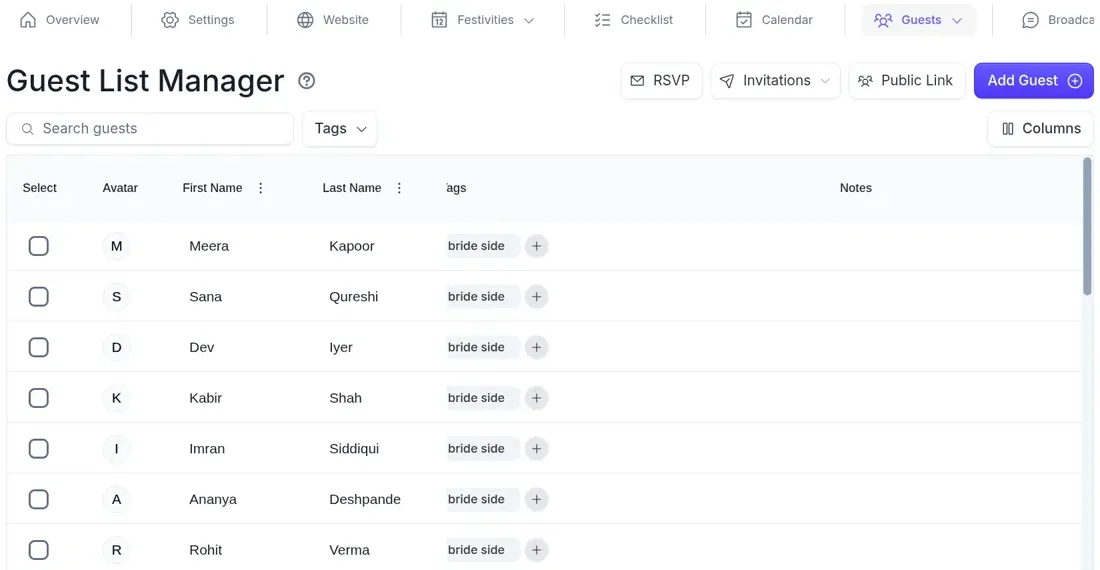
- Tag each household by side (bride’s side, groom’s side) so aiburo bhaat and each holud stay clean.
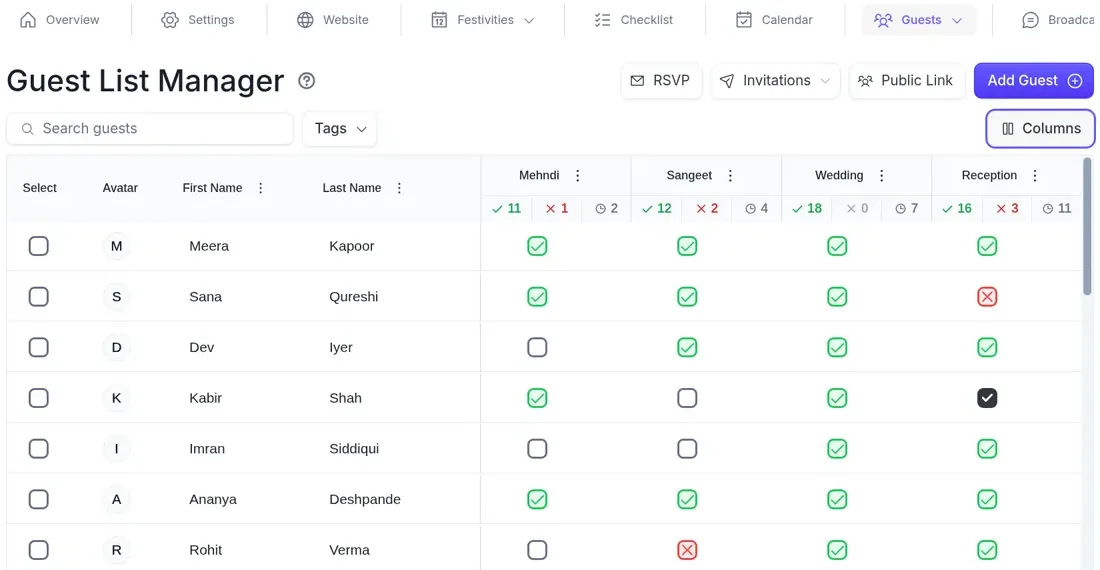
- Mark the events each household is invited to, and let the host of each event sign off on its list.
- Collect an RSVP for every event, not one for the weekend. Partial yeses are normal when someone can make bou bhaat but not a Thursday holud.
- Show each guest only their events. Joy’s help center describes tagging guests so each guest sees only the events they’re invited to; Zola also supports per-event RSVPs. Generic “Indian wedding” website templates often list every night for everyone, which is how colleagues learn about a private aiburo bhaat.
For the RSVP side, our guide to RSVPs for a multi-event wedding covers partial yeses and reminders, and RSVP for multiple events shows how it looks for guests. If you’re choosing a website or workspace, best South Asian wedding planning tools and our compare hub lay out the options. Every single-event guide lives in our wedding events hub.
Running the weekend in PlanMe
You can run all of this in a spreadsheet and a family group chat, and many families do. It usually breaks when two holuds, a late ceremony and a second reception all need different lists on the same weekend. If you’d rather keep it in one place, PlanMe.Club is our product, built for weddings with several events and two families. In PlanMe, each event (gaye holud, wedding, bou bhaat, walima and so on) is called a festivity.
- A festivity for every event. Add aiburo bhaat, each gaye holud, the wedding, bou bhaat or akd and walima (or just the ones you’re having), each with its own date, venue, menu and schedule. See festivities.
- One guest list for both families. Add every household once, tag it by side, and invite it to just its events. Each guest RSVPs to each event they’re invited to. See guest management.
- Messages by tag or RSVP status. Send email or SMS broadcasts to guests you pick by tag or by RSVP status, for example everyone on the groom’s side who hasn’t replied to bou bhaat. See guest email and SMS.
- A shared checklist. Put the priest or kazi booking, the lagna time, the tattwa trays and the hall overtime request on one checklist with owners and due dates.
- Seating for the bou bhaat or walima. Build a seating chart from the guests who accepted. You place tables and guests yourself; nothing is seated automatically.
- Budget categories and vendor quotes for the wedding. Track halls, caterers, decorators and the photographer as quotes by category inside the same wedding. See budget.
- Both families in the same plan. Invite parents, siblings or a planner as collaborators. If a sibling is next, save the whole weekend as a template.
What PlanMe doesn’t do, so you can plan around it: it doesn’t book halls, priests or hotel rooms, and it sends by email and SMS, not WhatsApp. If you’re choosing between tools, compare PlanMe with Zola, Joy and The Knot, or read our roundup of the best South Asian wedding planning tools, which says where other tools beat us. For a website built around several events, see best wedding websites for multiple events.
Put both tracks in one plan
Add aiburo bhaat, gaye holud, the wedding, bou bhaat (or akd and walima) with their own dates, venues, menus and schedules, tag every household by side, invite each one to just its events and collect an RSVP for each. Both families can work in the same plan, free during beta.
Start planning in PlanMeSources
Checked November 6, 2026. Reddit quotes are as posted by the commenters and are not verified. The 400-guest invitation examples and the budget category names are our own and use fictional data.
- Big Bang Events: How to Plan a Bengali Wedding in the GTA (2026)
- Sarabala: Complete Bengali Wedding Planning Checklist
- Look N Feel: How to Plan a Wedding in Bangladesh
- Tov Studio: Bengali Hindu Wedding Photography (2026 Guide)
- Hello Biodata: Bengali Wedding Rituals in Order
- Hello Biodata: Bengali Muslim Wedding Rituals
- Biyah: Bangladeshi Wedding Ceremony Explained
- amarjibon: Akd, Gaye Holud, Walima Order
- Joy Help Center: Managing RSVPs when not everyone is invited to every event
- Zola Help: Can I collect RSVPs for multiple events?
- r/DesiWeddings: Can someone explain some Bengali wedding traditions?
- r/DesiWeddings: Any help for a white girl trying to figure this stuff out?
- r/DesiWeddings: Desi/Bangladeshi pre-marriage and wedding traditions?
- r/DesiWeddings: Is it possible to do a Bengali-American wedding in one day?
Common questions
What is the order of events at a Bengali Hindu wedding?
A common order is aashirbaad and aiburo bhaat in the days before, dodhi mongol and gaye holud on or just before the wedding morning, then the wedding evening with bor jatri, saat paak, shubho drishti, mala badal, sampradan, the fire rituals and sindoor daan. The next day brings bashi biye and kanakanjali, then bou boron at the groom’s home and bou bhaat, the reception hosted by the groom’s side. Families reorder and combine these all the time.
What is the order of events at a Bangladeshi Muslim wedding?
A common order is gaye holud for each side (or one combined holud), then the akd or nikkah (the marriage contract), then a bride’s-family wedding reception (biye, where rukhsati often happens), then the walima or bou bhaat hosted by the groom’s family. Only the nikkah is religiously required; the holud and bou bhaat are cultural. Many diaspora families fold mehndi into the holud night.
Is bou bhaat the same as a walima?
In Bengali-speaking Muslim families they often refer to the same reception: the feast the groom’s family hosts after the marriage. Walima is the Islamic term for that feast; bou bhaat (the bride’s rice) is the Bengali name. Hindu Bengali families also hold a bou bhaat as the groom’s-side reception the day after the wedding, with different rituals.
Who is invited to gaye holud?
Usually close family and friends, and often one list for the bride’s holud and another for the groom’s. A commenter on r/DesiWeddings describes it as a lot of fun, with turmeric paste, music and food, closer to a combined haldi and sangeet than to a formal ceremony. Colleagues and distant relatives are usually saved for the wedding or the bou bhaat.
How many days is a Bengali wedding in the US, Canada or the UK?
Most diaspora weekends compress into two or three days: gaye holud one day, the wedding the next, and bou bhaat that evening or the day after. Some families fold gaye holud into the wedding morning. A one-day Bengali-American wedding is possible when the Hindu ceremony sits in the morning or afternoon and a reception follows; several couples on r/DesiWeddings have done that.
What should a diaspora venue allow for a Bengali Hindu ceremony?
Ask about a ceremonial fire (yagna), floor space for saat paak (the bride is carried on a low wooden piri around the groom), late evening start times, and an outside priest and caterer. Traditional Bengali ceremonies often run late; photographers who have shot a saat paak and shubho drishti before are worth seeking out.
Do Bengali and Bangladeshi weddings use the same guest list for every event?
No. Gaye holud is usually smaller; the wedding and especially the bou bhaat or walima carry the wider list, and some families effectively run two receptions. Keep one master list and mark which events each household is invited to, so colleagues invited only to the bou bhaat never see the aiburo bhaat time.