On this page
- The short answer: Gujarati wedding events in order
- Months before: chandlo matli and gol dhana
- The wedding week, event by event
- Does the pithi have to follow the mandvo mahurat?
- The wedding day: jaan to vidaai
- Reception and griha pravesh
- Sample weekends: how US families lay it out
- Who gets invited to which event: a worked example
- Budget categories for each event
- One guest list, different invitations
- Running the weekend in PlanMe
- Sources
- Common questions
Most lists of Gujarati wedding events are glossaries: what a mameru is, why the bride’s mother tries to catch the groom’s nose. That’s useful, and we link the good ones below. This one’s for the people hosting, because the order of events is also the order of decisions: which rituals happen at two homes at once, which night carries the biggest list, and what you can fold together when you only have three days.
Customs vary by family, community and region. Patel, Brahmin, Jain, Kutchi, Kathiawadi and Surti families all do things a little differently, and the same event can go by two or three names. Treat the sequence below as the default most relatives and vendors expect, then check it with your families and your maharaj.
The short answer: Gujarati wedding events in order
A typical Gujarati Hindu wedding runs in this order: the chandlo matli and gol dhana (engagement) weeks or months before, then in the wedding week the Ganesh sthapana and mandvo mahurat, the grah shanti, the pithi, the mehndi, the mameru and a garba or raas night, then the wedding day with the varghodo and jaan, the ponkhvu, the ceremony under the mandap and the vidaai, followed by the reception.
| Event | Usually when | Usually hosted by | Who usually comes |
|---|---|---|---|
| Chandlo matli | Weeks or months before, when the match is agreed | Bride’s family receives the groom’s side | Immediate family only |
| Gol dhana (engagement) | Weeks or months before | Both families | Close family, often wider if it’s an engagement party |
| Ganesh sthapana and mandvo (mandap) mahurat | A few days before, or the day before | Each family, at its own home | Close family |
| Grah shanti | Usually right after the mandvo mahurat | Each family, with its priest | Close family |
| Pithi | The day before the wedding, or that morning | Each family, at its own home | Close family and the couple’s closest friends |
| Mehndi | One or two days before | Bride’s family | Mostly the bride’s side, often women |
| Mameru | Often the day before | Bride’s maternal uncle (mama) and his family | Close family |
| Sanji, garba and raas | Usually the night before the wedding | Bride’s family, or both families jointly | Often the biggest list: family, friends and community |
| Varghodo, jaan and ponkhvu | The wedding day, before the ceremony | Groom’s family (jaan), bride’s family (welcome) | Both families and their guests |
| Wedding ceremony under the mandap | At the muhurat the priest sets | Bride’s family, traditionally | Invited guests |
| Vidaai | Right after the ceremony | Bride’s family | Family and whoever is still there |
| Reception | The wedding evening or the next day | Either family, or both jointly | By invitation; can include colleagues |
That spine matches the guides that cover it well, from WeddingWire India’s guide to Gujarati weddings and WeddingSutra’s Gujarati traditions piece to The Knot’s Indian wedding traditions guide, which notes the Gujarati names for the turmeric ceremony and the pheras. Where they differ is the middle of the week: whether the pithi is the day before or that morning, and whether the mehndi gets its own night.
For the pan-Indian version of this list (haldi, sangeet, baraat, pheras, vidaai), see Indian wedding events in order. This page stays on the Gujarati sequence.
Months before: chandlo matli and gol dhana
These first two events are small and family-led, and they often happen months before the wedding week.
- Chandlo matli: the formal acceptance of the match. WeddingWire India describes the groom and a few male relatives visiting the bride’s home, where her father puts a red chandlo on the groom’s forehead, gives him a token gift of money and blesses him. It’s often when the wedding date gets fixed. Weddingkart describes a version where the groom’s mother marks the bride instead, which is a good reminder that families do this differently.
- Gol dhana: the engagement, named for the jaggery (gol) and coriander seeds (dhana) handed out to guests. The couple exchange rings and are blessed by married women from each family, followed by a meal.
Planning notes for hosts: The chandlo matli doesn’t need an invitation; it’s phone calls between two families. The gol dhana is the first event with a real guest list, so it’s where the master list starts. If you’re planning a party-sized engagement, our engagement guide covers the guest list and running order.
The wedding week, event by event
Ganesh sthapana and mandvo mahurat
The wedding week opens with a puja to Ganesh, held separately at both homes, and the mandvo (or mandap) mahurat, when the ground for the mandap is blessed at an auspicious time. These are morning events for close family, and the timing comes from your maharaj, not your venue.
Grah shanti
WeddingWire India places the grah shanti, a puja to the planets for a peaceful married life, right after the mandvo mahurat, with each family’s priest. Going by the r/DesiWeddings threads below, many families run the Ganesh puja, mandvo mahurat, grah shanti and pithi as one long morning and call the whole thing the “vidhi.” That’s the word your non-Gujarati friends will see on the invitation, so put a one-line explanation next to it.
Pithi
The Gujarati turmeric ceremony. WeddingSutra describes it at the bride’s and groom’s homes separately, with a paste of turmeric, sandalwood, rose water and herbs that’s traditionally prepared by the kaki (the paternal uncle’s wife), followed by a ritual bath. WeddingWire India puts it a day before the wedding; Weddingkart puts it on the wedding morning and counts 20 to 50 close family. Our haldi guide covers how it compares with the haldi in other communities, so we won’t repeat it here.
Mehndi
Henna for the bride and the women of the family. In the diaspora it often splits in two. A Gujarati commenter in the r/DesiWeddings timing thread said it had been years since they’d seen a formal mehndi event; instead, the bride and immediate family have their henna done on the Wednesday “so that they can use their hands during the rest of the weekend.” Another bride in the standard sequence thread had mehndi for immediate family one day, then a mehndi party for extended family and guests. If you want it on the same night as the dancing, see combined mehndi and sangeet.
Mameru
The bride’s mama (maternal uncle) and his family arrive with gifts. WeddingWire India lists a panetar sari (the white and red sari many brides wear for the ceremony), jewelry, an ivory or white chuda, sweets and dry fruits, and places it at the bride’s home the day before the wedding. Some families hold it as an evening event of its own; others fold it into the pithi day.
Sanji, garba and raas
The night most guests remember. The sanji is traditionally an evening of wedding songs, and in most families it now leads into garba and dandiya raas. WeddingWire India calls it the first occasion where both families break the ice, and WeddingSutra says it’s generally the night before the wedding. When a couple on r/DesiWeddings listed a “sangeet” in their draft order, the top reply was:
“most gujratis do a garba night instead of a sangeet, which is more of a punjabi origin tradition”
Plenty of families do both on one night: family dance performances first, then the garba circles. Our garba night guide covers the band or DJ, a sample run of the evening, dandiya and guest count, and the sangeet planning guide has a run of show for the performance half. Here we’ll stick to where the garba sits in the week and who it’s for.
Planning notes for hosts: Each of these is a different list. The vidhi and pithi happen at two homes at once and are small; the mameru is family; the garba can be bigger than the wedding itself. Decide who is invited to each before anyone books a garba band, then send each household only the events that are theirs.
Does the pithi have to follow the mandvo mahurat?
It’s the sequencing question that comes up most when a family tries to fit everything into a weekend. A bride on r/DesiWeddings put it plainly:
“I’m finding that trying to condense a full Gujarati wedding into less than 3 days is proving difficult. I am trying to see if the pithi HAS to be after the mandap or can be done several days prior”
The replies in that thread show how much room families take:
- Same day, day before: one family always does the pithi the day before along with some of the marriage prayers, mehndi that night and the wedding the next day.
- Same day as the garba: one commenter had a friend who did the mandap on the morning of the garba and “was completely exhausted the entire weekend.”
- A week early: the same commenter has seen the mandap and pithi held the week before the wedding.
In another r/DesiWeddings thread, a commenter adds that more traditional families move the vidhi to the wedding morning, because the Ganesh puja is meant to happen on the day of the wedding. There’s no single right answer. Ask your maharaj what your family’s tradition needs, then build the weekend around it.
Planning notes for hosts: If the vidhi lands on the garba day, finish it by early afternoon. The pithi stains, the bride needs time to clean up, and the garba runs late. Block a rest window on the schedule so nobody books a photo shoot in it.
The wedding day: jaan to vidaai
The ceremony has a fixed core, but its length varies more than almost anything else in the week. A Gujarati commenter on r/DesiWeddings has been to traditional weddings that lasted six hours, two-hour ceremonies and one simple 15-minute ceremony. Their outline of the usual order, which matches WeddingWire India’s, runs:
- Varghodo and jaan: at the groom’s side, his sister circles a bundle of coins around his head (per WeddingWire India), then the groom and his family set off in a procession to the venue. Our baraat guide covers the procession logistics.
- Ponkhvu: the bride’s mother welcomes the groom with an aarti and playfully tries to catch his nose, a reminder that he’s come to ask for something.
- Madhuparka: the groom is led to the mandap, his feet are washed and he’s offered panchamrut.
- Antarpat and jaimala: the bride’s maternal uncles bring her to the mandap, and the couple exchange garlands.
- Kanyadaan and hasta melap: the bride’s parents give her hand, and the couple’s hands are joined and their garments tied together.
- Mangal pheras and saptapadi: The Knot notes Gujarati weddings take four circles around the fire rather than seven; the same Reddit commenter says the groom leads the first three and the bride the last. Then come seven steps with a vow at each.
- Sindoor and mangalsutra, kansar, and the blessings: the couple feed each other kansar, a sweet, and married women whisper blessings to the bride. Then the elders bless the couple.
- Vidaai: the bride’s farewell. Not every family keeps it: one r/DesiWeddings commenter said three of the last eight weddings they’d been to skipped it.
For how this compares with Punjabi, South Indian and Muslim ceremonies, see the wedding ceremony guide, and our wedding day timeline shows how to plan the clock backward from the muhurat.
Planning notes for hosts: Agree on the ceremony length with your maharaj weeks ahead, and ask him to explain each step in English if many guests aren’t Gujarati. Then tell your caterer whether guests will eat during the ceremony or after it, because that changes when the first plates go out.
Reception and griha pravesh
The reception is the dinner party that introduces the couple, and it’s often where colleagues and family friends who weren’t at the earlier events are invited. In the US it’s commonly the wedding evening or the next day. Weddingkart’s rituals guide lists the griha pravesh, the bride’s first entry into her new home, as the main post-wedding ritual. Our reception guide covers the run of show and guest count.
Sample weekends: how US families lay it out
When a couple on r/DesiWeddings asked for the “standard” Gujarati-American sequence, the answers were almost all three-day weekends. Days are as the commenters wrote them; we’ve only shortened the wording.
| Shape | What the weekend looked like | Source |
|---|---|---|
| Three days, classic | Thu mandap and pithi · Fri sangeet or garba · Sat wedding and reception | A Gujarati commenter, 2018 timing thread |
| Five events over a weekend | Thu night mehndi · Fri morning vidhi · Fri night sangeet or garba · Sat morning wedding · Sat night reception | A commenter in the 2023 standard sequence thread |
| More traditional | Thu night or Fri morning mehndi · Fri night garba · Sat morning vidhi · Sat night wedding · Sun reception, if there is one | The same commenter, describing more traditional families |
| Split mehndi | Ganesh puja and pithi one day · mehndi for immediate family the next, then a mehndi party for guests · sanji, garba and raas the next night · baraat, wedding, vidaai and reception | A bride in the 2023 thread |
Sources: “Timing of the ceremony” and “What is the Standard Gujarati-American Event Sequence?”.
A few patterns show up across these:
- The vidhi absorbs the small rituals. One commenter said almost every wedding they’d been to combined the Ganesh puja and haldi and called it the pithi, haldi or vidhi.
- Garba is the night before. Every shape puts the garba on the last night before the ceremony, which is why the bride’s henna moves earlier in the week.
- Fusion weddings bend it further. A Gujarati bride marrying into a Christian family planned three days with the Hindu ceremony and reception on the last day, and joked there weren’t enough Gujaratis on the guest list for a garba. A reply suggested adding some dandiya to the sangeet instead.
Who gets invited to which event: a worked example
Here’s how the lists play out on paper. Take our fictional showcase couple, Anaya and Rohan, and give them a Thursday-to-Saturday Gujarati weekend in central New Jersey with 420 people on the master list: 180 on the bride’s side, 170 on the groom’s side and 70 shared friends and colleagues. The numbers below are our own example to show the shape, not survey data.
| Event | Host | Bride’s side | Groom’s side | Friends and colleagues | Invited |
|---|---|---|---|---|---|
| Vidhi and pithi (Thursday morning, bride’s home) | Bride’s family | 40 | 0 | 5 | 45 |
| Vidhi and pithi (Thursday morning, groom’s home) | Groom’s family | 0 | 38 | 2 | 40 |
| Mehndi (Thursday evening) | Bride’s family | 60 | 10 | 15 | 85 |
| Mameru (Friday afternoon, bride’s home) | Bride’s mama | 35 | 0 | 0 | 35 |
| Garba and raas (Friday night, hall) | Both families | 170 | 160 | 60 | 390 |
| Wedding ceremony (Saturday morning) | Bride’s family | 150 | 140 | 30 | 320 |
| Reception (Saturday night) | Both families | 150 | 140 | 70 | 360 |
Three things jump out, and they’re the reason to build a table like this early:
- The garba is bigger than the wedding. In this example 390 are invited to the garba and 320 to the ceremony. That’s common when the community comes to dance; our garba guide notes it sometimes outgrows the reception. Size the hall and the caterer for the garba, not the wedding.
- Two vidhis at once. Each family runs its own pithi morning at home. That’s two hosts, two priests, two small food orders and two lists that mustn’t overlap by accident.
- Colleagues only at the reception. The 10 colleagues invited only to the reception shouldn’t see the mameru time on their invitation or the wedding website.
Run each event’s invite count through the guest attendance calculator, then turn the yes count into plates with the catering headcount calculator. If relatives are flying in for the whole weekend, the hotel room block calculator estimates how many rooms to hold.
Turn the garba list into a realistic headcount
The garba is usually your biggest invite list, and invited isn’t the same as coming. Enter how many local and out-of-town guests you’re inviting to the garba, the wedding or the reception, and the guest attendance calculator estimates how many will turn up, right on the page. No sign-up.
Open the attendance calculatorBudget categories for each event
The costs follow the lists. The pithi and mameru are home events with small food orders; the garba carries a hall, a band or DJ, dandiya and late-night snacks for the biggest crowd of the weekend; the wedding carries the mandap, the priest and lunch or dinner. Weddingkart’s Ahmedabad guide, for example, suggests light snacks and chaat at the garba rather than a full meal, which changes the per-head cost a lot.
The simplest way to keep it straight is one wedding budget with categories named for each event, for example “Garba: hall,” “Garba: band and dhol,” “Wedding: mandap and priest,” “Reception: catering.” That way you can see what each night costs without running a separate budget for each. To set the overall number first, try the Indian wedding budget calculator, and see what an Indian wedding costs for published ranges with sources.
One guest list, different invitations
You don’t need seven spreadsheets. You need one master list and a clear answer, for every household, to “which events are you invited to?” Our guide to separate guest lists for each wedding event goes deep on this. The short version for a Gujarati weekend:
- One row per household, with headcount, children and dietary notes. Many Gujarati families need vegetarian, Jain (no root vegetables) and no-onion-no-garlic options marked, so the caterer gets accurate counts by night.
- Tag each household by side and branch: bride’s side or groom’s side, and the mama’s family where it matters. That tag tells you who belongs at the mameru.
- Mark the events each household is invited to, and let the host of each event sign off on its list.
- Collect an RSVP for every event, not one for the weekend. Set each deadline from that caterer’s final-count date; the RSVP deadline calculator works it out.
- Show each guest only their events. Zola’s Indian wedding guest guide warns guests there may be other events “you might also be invited to,” which is the confusion you want to avoid. Most multi-event tools solve this with tags: Joy’s help center, for example, describes tagging guests so each guest sees only the events they’re invited to.
For the RSVP side, our guide to RSVPs for a multi-event wedding covers partial yeses and reminders, and RSVP for multiple events shows how it looks for guests. If your family is Punjabi on one side, the Punjabi wedding events in order guide covers that week. Every single-event guide lives in our wedding events hub.
Running the weekend in PlanMe
You can run all of this in a spreadsheet and a family group chat, and many families do. It usually breaks around Thursday, when two vidhi mornings, a 35-person mameru and a 390-person garba all need different lists and different numbers. If you’d rather keep it in one place, PlanMe.Club is our product, built for weddings with several events and two families. In PlanMe, each event (mehndi, garba, wedding, reception and so on) is called a festivity.
- A festivity for every event. Add the vidhi and pithi, mehndi, mameru, garba, wedding and reception (or just the ones you’re having), each with its own date, venue, menu and schedule. See festivities.
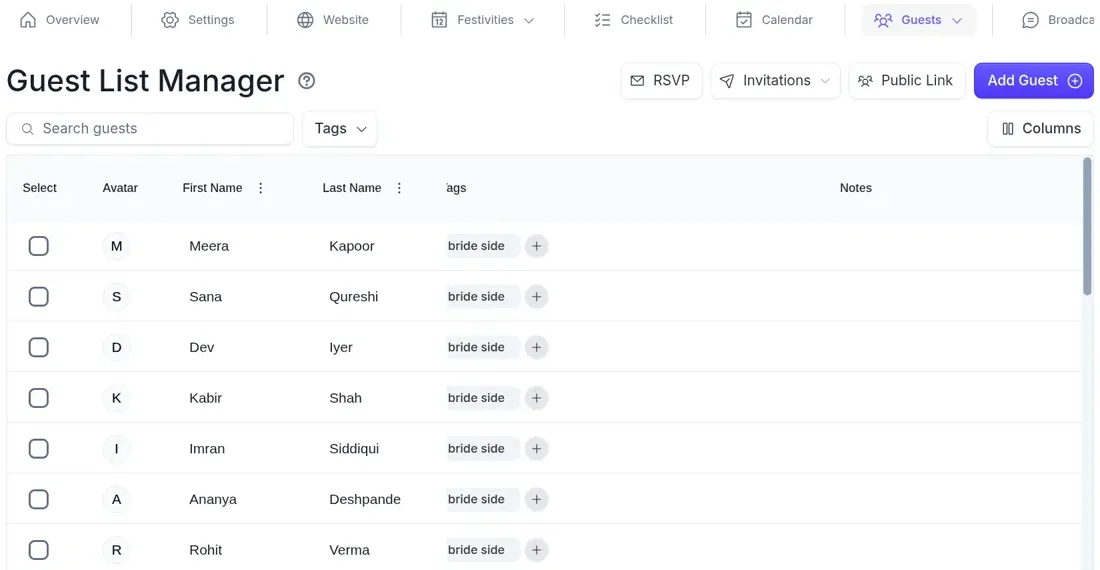
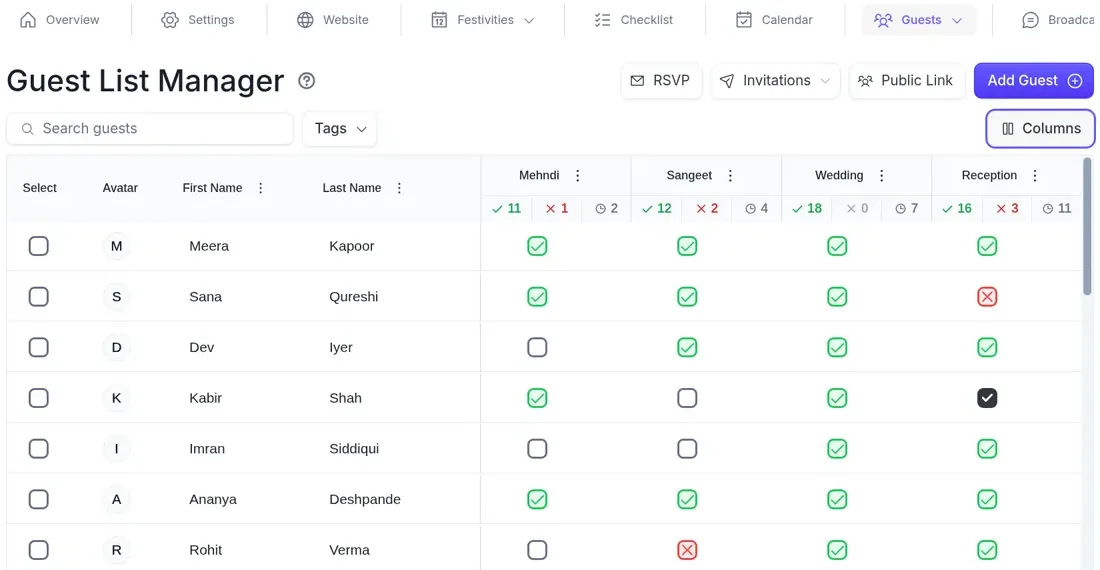
- One guest list for both families. Add every household once, tag it (bride’s side, groom’s side, mama’s family), and invite it to just its events. Each guest RSVPs to each event they’re invited to, so every event keeps its own yes, no and pending count. See guest management.
- Messages by tag or RSVP status. Send email or SMS broadcasts to guests you pick by tag or by RSVP status, for example everyone on the groom’s side who hasn’t replied yet. Tag your garba guests if you want to message only them. See guest email and SMS.
- A shared checklist. Put the maharaj booking, the muhurat time, the mameru gifts and the dandiya order on one checklist with owners and due dates.
- Seating for the reception. Build a seating chart from the guests who accepted. You place tables and guests yourself; nothing is seated automatically.
- Budget categories and vendor quotes for the wedding. Track the garba band, caterers, decorators and halls as quotes by category inside the same wedding, and see what’s paid and what’s due. See budget.
- Both families in the same plan. Invite parents, siblings or a planner as collaborators, so the groom’s family can manage its own vidhi list. If a sibling is next, save the whole weekend as a template.
What PlanMe doesn’t do, so you can plan around it: it doesn’t book halls, priests or hotel rooms, and it sends by email and SMS, not WhatsApp. If you’re choosing between tools, compare PlanMe with Zola, Joy and The Knot, or read our roundup of the best South Asian wedding planning tools, which says where other tools beat us.
Put the whole Gujarati weekend in one plan
Add the mandvo mahurat, pithi, mehndi, mameru, garba, wedding and reception with their own dates, venues, menus and schedules, tag every household by side, invite each one to just its events and collect an RSVP for each. Both families can work in the same plan. Free during beta.
Start planning in PlanMeSources
Checked November 4, 2026. Reddit quotes are as posted by the commenters and are not verified. The 420-guest invitation example and the budget category names are our own and use fictional data.
- The Knot: Indian Wedding Traditions You Should Know About
- WeddingWire India: Decoding Gujarati Weddings: Wedding Ceremony Rituals, Dresses and More
- WeddingSutra: Gujarati Weddings: Customs and Traditions
- Weddingkart: Gujarati Wedding Functions: Full Planning Guide
- Weddingkart: Gujarati Wedding Rituals, Step by Step
- Zola: What to Wear to an Indian Wedding
- Joy Help Center: Managing RSVPs and schedules when not everyone is invited to every event
- r/DesiWeddings: What is the Standard Gujarati-American Event Sequence?
- r/DesiWeddings: Timing of the ceremony
- r/DesiWeddings: How long is the actual Hindu marriage ceremony?
- r/DesiWeddings: Fusion Indian-American wedding schedule options?
Common questions
What is the order of events at a Gujarati wedding?
A common order is the chandlo matli and gol dhana (the engagement) weeks or months before, then in the wedding week the Ganesh sthapana and mandvo (mandap) mahurat, the grah shanti, the pithi at each family’s home, the mehndi, the mameru, and a garba or raas night. The wedding day runs from the varghodo and jaan (the groom’s procession) and ponkhvu through the ceremony under the mandap to the vidaai, with the reception that evening or the next day. Families and communities reorder and combine these all the time.
How many days is a Gujarati wedding in the US?
Usually three. A Gujarati commenter on r/DesiWeddings wrote in 2018 that it had been years since they’d attended a Gujarati wedding longer than three days, and described the usual shape as mandap and pithi on Thursday, sangeet or garba on Friday, and the wedding and reception on Saturday. For a wedding in Ahmedabad, Weddingkart describes six to eight functions over four to five days.
Does the pithi have to come after the mandvo mahurat?
In most families the mandvo (mandap) mahurat and Ganesh sthapana come first and the pithi follows, often on the same day. In practice there’s room to move it: one r/DesiWeddings commenter has seen the mandap and pithi held a week before the wedding, and another family does the pithi the day before along with some of the wedding prayers. Ask your maharaj what your family’s tradition requires before you fix the date.
Do Gujaratis have a sangeet or a garba?
Most hold a garba or raas night, sometimes called the sanji or sangeet sandhya. One r/DesiWeddings commenter put it simply: most Gujaratis do a garba night instead of a sangeet. Many families now mix the two, with family dance performances and then garba and dandiya raas on the same night.
How many pheras are there at a Gujarati wedding?
Four. The Knot notes that Gujarati weddings call this part the mangal phera, with the couple circling the sacred fire four times rather than seven. A Gujarati commenter on r/DesiWeddings adds that the groom leads the first three and the bride the last, and that the saptapadi, seven steps with a vow at each, follows.
What is the mameru?
The mameru is when the bride’s maternal uncle (mama) and his family bring her gifts before the wedding, traditionally including the panetar sari she wears for the ceremony, jewelry and a chuda. WeddingWire India places it the day before the wedding, at the bride’s home. It’s a family event, so the list is usually small.
Who is invited to each Gujarati wedding event?
It changes by event. The chandlo matli, grah shanti, pithi and mameru are usually close family at each home; the mehndi is often the bride’s side; the garba is usually the biggest list, open to extended family, friends and community; and the ceremony and reception are by invitation. Keep one master list and record which events each household is invited to, so nobody gets an invitation to an event that isn’t theirs.