On this page
- The short answer
- Matikor (dig dutty): the women’s night
- Cooking night and the lawa
- The wedding day
- Kangan, the days after and second Sunday
- Guyana, Trinidad and the diaspora
- Who gets invited to which event: a worked example
- Fitting it into a US or Canadian weekend
- Budget categories for each event
- One guest list, different invitations
- Running the wedding in PlanMe
- Sources
- Common questions
Most write-ups of Guyanese Hindu weddings explain what each ritual means. That matters, and we link the good ones below. This one’s for the people hosting it. The order of events is also the order of decisions: which events happen at home, who cooks, which nights are women only and when the big list comes.
Customs vary by family, village, pandit and tradition. Sanatan Dharma and Arya Samaj families do some things differently, and Trinidadian families use different names for a few steps. Treat the order below as the common default, then check it with your elders and your pandit.
The short answer
The traditional spine is a Friday matikor, a Saturday of cooking, a Sunday wedding and a Monday kangan, with each family running its own pre-wedding nights at its own home. Here’s the common order, with who usually hosts and who usually comes.
| Event | Traditionally when | Usually hosted by | Who usually comes |
|---|---|---|---|
| Engagement | Months before | The two families | Parents, close family, the pandit |
| Mehndi or sangeet (optional, newer) | Before the matikor, or the same night | Bride’s side (or both) | Women and friends of the bride |
| Matikor (dig dutty) and hardi | Friday, or one to two nights before | Each family, at its own home | Mostly women of that family and its neighbours |
| Cooking night | Saturday, the night before | Each family, at its own home | Family, neighbours and helpers, men and women |
| Baraat and wedding (vivah) | Sunday | Bride’s family receives the groom’s | The full guest list |
| Reception (newer, common abroad) | Wedding evening or the next day | Either or both families | Often the widest list, including colleagues |
| Kangan (meat day) | Monday, the day after | Both families, at their homes | Family and friends who move between both homes |
| Second Sunday | The Sunday after the wedding | Both families | Family and close friends |
That order matches the Indo-Caribbean accounts from World Hindu News (Indo-Caribbean World), the Guyanese guides from Fine Art Production and Zivaara Studio, Toronto planner Events by Whim, the Trinidadian sequence on Trinidadian Culture and in the Trinidad Express, and the day-by-day explanation in an r/Guyana thread. Where they disagree, we say so below.
For the North Indian version of this list (haldi, sangeet, baraat, pheras, vidaai), see Indian wedding events in order. This page stays with Indo-Caribbean Hindu weddings.
Matikor (dig dutty): the women’s night
The matikor (maticore, maticoor, matkor) is, as Fine Art Production puts it, “essentially prayers to Mother Earth,” and in Guyana it’s popularly called dig dutty. Mati means earth and kor means digging. The same rites happen separately at the bride’s home and the groom’s home, traditionally two days before the wedding.
- The procession: the bride’s mother leads the women, with tassa drums and traditional songs, to a clean spot some distance from the house. In Trinidadian accounts a young girl carries a tray of sweets on her head and the women look for running water.
- The digging and the prayer: offerings go into a small hole in the earth, married women apply sindoor, and a little earth comes home for the puja. World Hindu News describes it as a ritual led by the mother in front of an all-female audience, followed by sweets and a teasing tassa dance.
- The puja and the hardi: the bride, traditionally in yellow, sits with the pandit, a protective thread or kangan is tied on her wrist, and the hardi (turmeric mixed with oil) is blessed and rubbed on. Trinidadian sources describe the kangan as a cloth holding a pen knife, corn and coins.
- Staying in: after the hardi, the bride and groom traditionally stay home until the wedding.
It’s the event people outside the community know least, and the one families are most attached to. A Hamilton, Ontario bride quoted by World Hindu News said she would keep it without a doubt: “It’s the first part of the wedding. You’re planting the roots of the wedding in the earth so that it can grow and you want to give it a good foundation.” Our haldi guide covers the turmeric ceremonies of other communities. The matikor shares the turmeric but adds the earth, the procession and the songs.
Planning notes for hosts: Two homes means two matikors, two tassa bookings (or one group that plays both, at different times) and two guest lists that are mostly women. In a city, ask early where the procession can walk and where the earth can be dug. An apartment or a hall changes that. Tell a male photographer or videographer in advance which parts the family wants women only.
Cooking night and the lawa
The night before the wedding is cooking night, again at both homes. According to Trinidadian Culture and the Trinidad Express, men and women gather to cook dinner and prepare the vegetables for the wedding day, because no meat is served at the wedding. Roti is made in large quantities. The ritual center of the night is the lawa: the bride’s father’s youngest sister parches rice paddy over a fire while everyone dances and gives her money, and that parched lawa is thrown into the sacred fire at the wedding.
Guyanese accounts describe the Saturday more as preparation. The r/Guyana commenter lists putting up decorations, setting up the kitchen and fireside, gathering fresh leaves to eat from and setting up the bamboo arch. Taste Guyana describes family, neighbors and friends gathering the day before to peel vegetables, grind spices and cook the seven curry meal over open fires.
Planning notes for hosts: This is where a Guyanese budget differs most from an Indian one. Decide early whether family cooks or a caterer does. One poster in r/DesiWeddings planning in Connecticut and New York said they hadn’t found a vendor that could do traditional Guyanese catering, and a commenter replied that they had rarely if ever seen catering at Guyanese weddings because the whole family usually cooks, though they did name a few caterers. If family is cooking, cooking night needs a space that allows open-flame or large-batch cooking, plus a list of who is coming to help.
The wedding day
The wedding (vivah) is traditionally held at the bride’s home under a bamboo maro, the Indo-Caribbean word for the mandap; World Hindu News notes that bamboo stands for a family that grows strong and intertwined. Today it’s often a hall or a mandir. The order, as the Trinidadian sources and Guyanese guides describe it:
- Morning at each home: the nuptial bath to remove the hardi, then dressing. The groom’s family has its own small rites before the procession leaves.
- Baraat: the groom’s procession to the bride’s home or venue, led by tassa drums. Zivaara Studio notes that in the US the baraat usually moves through a parking lot or street outside the venue.
- Welcome at the door: the bride’s family receives the groom with a puja at the entrance (dwar puja) before he goes to the maro. Sources differ on who leads it: Trinidadian Culture describes the bride’s father meeting the groom’s party and doing the puja with the groom; Zivaara describes the bride’s mother greeting the groom with aarti.
- Kanyadaan: the bride’s parents give their daughter’s hand, with the pandit and the sacred fire as witness.
- Lawa and the rounds of the fire: the lawa from both families is offered in a havan. The bride’s youngest brother pours it onto a bamboo fan and the couple shake it onto the altar, then they take their seven steps around the fire. Trinidadian Culture describes the bride leading the first four steps, the groom leading the next two and the two walking side by side on the seventh.
- Sindoor daan: under a sheet, the groom puts sindoor in the parting of the bride’s hair, he places the mangal sutra, and the couple receive blessings. Some families exchange rings earlier in the ceremony.
- Leaving: the bride leaves for the groom’s home, often to a farewell song. World Hindu News mentions the bangle-catching game once she arrives.
The meal is vegetarian, often a seven curry spread, which Taste Guyana says has no single fixed list: “Ask ten Guyanese families what belongs in Seven Curry and you may receive ten different answers.” For how a baraat works in other communities, see our baraat guide, and the wedding ceremony guide for how this sits next to other Hindu ceremonies.
Planning notes for hosts: Book the pandit first, and ask for one who follows the Indo-Caribbean order your family expects. Zivaara Studio calls finding that pandit the most important and often the most challenging task. Then book the tassa group, which it says is in high demand in wedding season. If the ceremony is at a hall, ask about open flame, rice and lawa on the floor, a bamboo maro and an outside caterer.
Kangan, the days after and second Sunday
The kangan is the amulet tied during the matikor, and the day after the wedding takes its name. World Hindu News quotes Teerath Misir, satsang coordinator at a Scarborough, Ontario mandir: “after the removal of the kangan, the religious aspect of the wedding is finished.” In Guyana it’s also called meat day: after the vegetarian wedding food, meat is back on the menu.
“Monday is Kangan AKA meat day AKA sporting day at both bride’s house and groom’s house. The couple has lunch at the groom’s house and then in the afternoon they go back to the bride’s house to meet and greet and dance at dinner time.”
The same commenter describes the rest of the week as quieter: a close friends and family day, often a thank-you lunch for the people who built, cooked, served and drove, then the second Sunday, “the big closing off of the wedding.” Toronto planner Events by Whim describes the kangan as the concluding event, with the newlyweds welcomed into the bride’s family home.
In North America, families have added a reception. World Hindu News calls the next-day reception “a new tradition which has been magnified in North America,” with the kangan celebrations moved a day later to make room for it. Our reception guide covers run of show and guest count.
Guyana, Trinidad and the diaspora
- Names: Guyanese families often say dig dutty or maticore; Trinidadian families say maticoor night (or Friday night) and cooking night. World Hindu News notes the name used depends on whether the family’s roots are Guyanese or Trinidadian.
- Days: the Friday-to-Monday rhythm is the traditional one. The r/Guyana commenter notes that in Guyana a Saturday wedding with a Sunday kangan is becoming more common so guests can get back to work on Monday. Another commenter in Canada describes weddings on a Friday afternoon, a Saturday reception and a Sunday kangan.
- Mehndi and sangeet: not traditional, but Fine Art Production notes elaborate mehndi nights before the matikor are now popular, and the r/Guyana thread lists sangeet and mehndi nights at some weddings. Our guide to a combined mehndi and sangeet covers running both as one evening.
- Sanatan and Arya Samaj: rites and order differ between them, and plenty of families have one parent from each. One r/Guyana poster with that mix and a Catholic partner, was leaning toward a Hindu wedding and then a Catholic ceremony before the reception.
- Muslim and Christian Guyanese weddings follow their own traditions (a nikah, a church service), and Events by Whim notes some now borrow the dye-rubbing ceremony. For a Muslim sequence, see Pakistani wedding events in order and our walima guide.
Who gets invited to which event: a worked example
Here’s how the lists play out on paper. Take our fictional showcase couple, Anaya and Rohan, with a Guyanese Hindu wedding in New York and 380 people on the master list: 170 on the bride’s side, 160 on the groom’s side and 50 shared friends and colleagues. The numbers below are our own example to show the shape, not survey data.
| Event | Host | Bride’s side | Groom’s side | Friends / colleagues | Invited |
|---|---|---|---|---|---|
| Matikor (bride’s home, Friday) | Bride’s family | 60 | 5 | 10 | 75 |
| Matikor (groom’s home, Friday) | Groom’s family | 5 | 55 | 5 | 65 |
| Cooking night (bride’s home, Saturday) | Bride’s family | 80 | 0 | 10 | 90 |
| Cooking night (groom’s home, Saturday) | Groom’s family | 0 | 70 | 10 | 80 |
| Wedding and lunch (Sunday) | Bride’s family | 165 | 155 | 40 | 360 |
| Reception (Sunday evening) | Both families | 150 | 140 | 50 | 340 |
| Kangan (both homes, Monday) | Both families | 70 | 65 | 5 | 140 |
Three things jump out:
- Four of the seven events are split by side. The matikor and cooking night happen twice, once per home. A single “Friday” or “Saturday” invite for everyone sends people to the wrong house.
- The matikor list is mostly women. Track it as its own list, not as a share of the wedding list.
- Cooking night guests are often helpers. Note who is cooking, serving or driving, because the same people are often thanked later in the week.
Run each event’s invite count through the guest attendance calculator, then turn the yes count into plates with the catering headcount calculator. Set each RSVP deadline from the caterer’s or hall’s final-count date with the RSVP deadline calculator.
Turn each invite list into a realistic headcount
The matikor, the wedding and the kangan never draw the same crowd. Enter how many local and out-of-town guests you’re inviting to each event, and the guest attendance calculator estimates how many will come, right on the page. No sign-up.
Open the attendance calculatorFitting it into a US or Canadian weekend
The r/Guyana poster above, living 800 miles from family, put the problem plainly: “idk HOW to go about planning the full 5 day ceremony.” Most families abroad keep the matikor and the wedding, compress the rest, and add a reception. Here’s one common layout:
| Day | Daytime | Evening |
|---|---|---|
| Thursday (optional) | — | Mehndi or sangeet |
| Friday | Shopping, setup, out-of-town arrivals | Matikor at both homes |
| Saturday | Decorating; cooking or caterer tasting | Cooking night at both homes (or a smaller family dinner) |
| Sunday | Baraat, wedding and vegetarian lunch | Reception |
| Monday (or the next weekend) | Kangan at both homes | — |
If guests are flying in from Guyana, Trinidad, Florida or Canada, mark them on the list early; they affect hotel nights and whether they can be at the Friday matikor. Our guide to the welcome party covers whether to give them a dinner, and the wedding hotel block guide covers rooms.
Budget categories for each event
People search for a Guyanese wedding budget because the usual Indian wedding cost guides don’t match: the family cooks, the wedding meal is vegetarian, and there are two homes to run. The costs still follow the lists. Treat each event’s costs as category lines inside one wedding budget, for example “Matikor: tassa, pandit and sweets,” “Cooking night: groceries, tent and fireside,” “Wedding: hall, maro decor, pandit and vegetarian lunch,” “Reception: hall, DJ and dinner,” “Kangan: meat dinner at both homes,” rather than a separate budget for every event.
- Food: family cooking moves money from catering into groceries, equipment and helpers, but doesn’t make it free. If you hire, get a quote for the vegetarian wedding meal and the non-vegetarian reception or kangan separately.
- Music: tassa for the matikor and the baraat, then a DJ or chutney band for the reception.
- Two homes: tents, chairs, cleanup and parking at both houses for the matikor, cooking night and kangan.
To set the overall number first, try the Indian wedding budget calculator, and see what an Indian wedding costs for published per-plate and per-event ranges with sources. For how families split the bill, who pays for an Indian wedding covers the common arrangements.
One guest list, different invitations
You don’t need seven spreadsheets. You need one master list and a clear answer, for every household, to “which events are you invited to, and at whose house?” Our guide to separate guest lists for each wedding event covers this in more detail. The short version for a Guyanese wedding:
- One row per household, with headcount, children, dietary notes and whether they’re flying in.
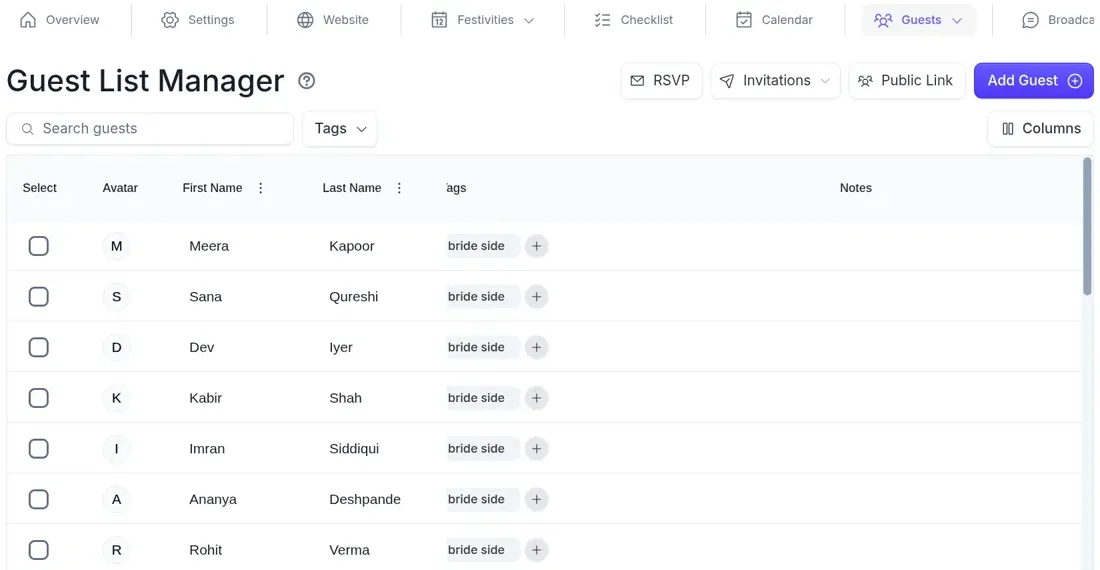
- Tag each household by side (bride’s side, groom’s side) so the two matikors, two cooking nights and the kangan go to the right house.
- Tag helpers (cooking, serving, driving, decorating) so you know who to call on Saturday and who to thank afterward.
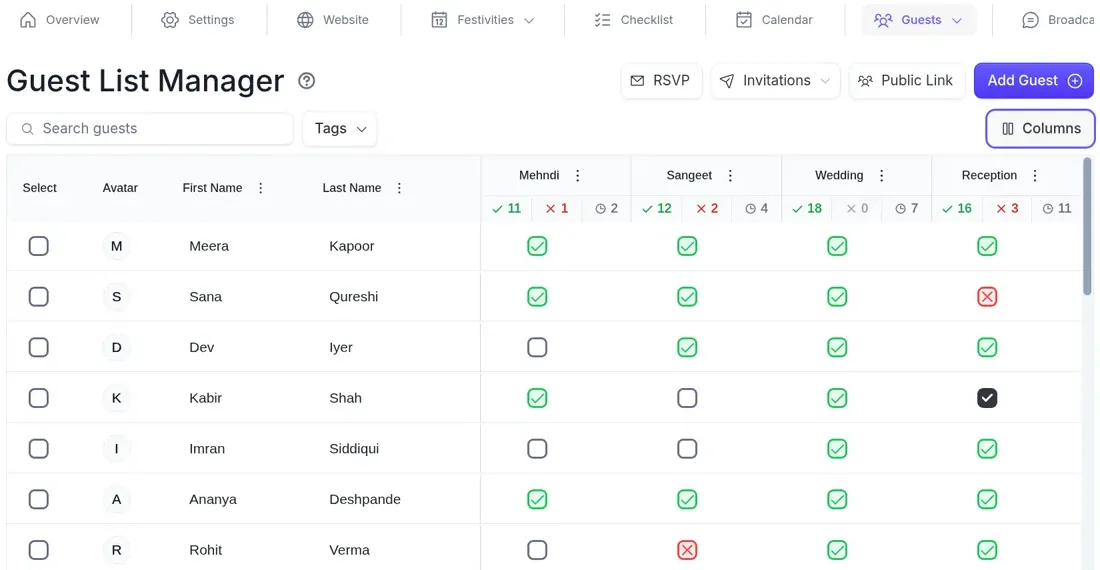
- Collect an RSVP for every event, not one for the weekend. Plenty of colleagues will come to the reception and nothing else.
- Show each guest only their events, so the women-only matikor and the family kangan don’t appear for reception-only guests.
For the RSVP side, our guide to RSVPs for a multi-event wedding covers partial yeses and reminders, and RSVP for multiple events shows how it looks for guests. Every single-event guide lives in our wedding events hub.
Running the wedding in PlanMe
You can run all of this in a spreadsheet and a family group chat, and many families do. It usually breaks when two homes, a women-only night and a reception all need different lists in the same week. If you’d rather keep it in one place, PlanMe.Club is our product. It’s built for weddings with several events and two families. In PlanMe, each event (the matikor, cooking night, the wedding and so on) is called a festivity.
- A festivity for every event. Add each matikor, cooking night, the wedding, the reception and the kangan, each with its own date, address, menu and schedule. See festivities.
- One guest list for both families. Add every household once, tag it by side or as a helper, and invite it to just its events. Each guest RSVPs to each event they’re invited to. See guest management.
- Messages by tag or RSVP status. Send email or SMS broadcasts to guests you pick by tag or by RSVP status, for example every helper, or everyone on the bride’s side who hasn’t replied. See guest email and SMS.
- A shared checklist. Put the pandit, the tassa bookings, the lawa, the maro and the cooking list on one checklist with owners and due dates.
- Seating for the reception. Build a seating chart from the guests who accepted. You place tables and guests yourself; nothing is seated automatically.
- Budget categories and vendor quotes for the wedding. Track the tassa group, pandit, caterer or groceries, tent and DJ as quotes and categories inside the same wedding. See budget.
- Both families in the same plan. Invite parents, siblings or a planner as collaborators. If a cousin is next, save the whole wedding as a template.
What PlanMe doesn’t do, so you can plan around it: it doesn’t book halls, pandits, tassa groups or hotel rooms, and it sends by email and SMS, not WhatsApp. If you’re choosing between tools, compare PlanMe with Zola, Joy and The Knot, or read our roundup of the best South Asian wedding planning tools, which says where other tools beat us.
Put every event of the wedding in one plan
Add the two matikors, cooking night, the wedding, the reception and the kangan with their own dates, venues, menus and schedules, tag every household by side, invite each one to just its events and collect an RSVP for each. Both families can work in the same plan, free during beta.
Start planning in PlanMeSources
Checked November 11, 2026. Reddit posts and quotes are as posted by their authors and are not verified. The 380-guest invitation example, the weekend layout and the budget category names are our own and use fictional data.
- World Hindu News: Indo-Caribbean Hindu Wedding
- Fine Art Production: Guyanese Wedding Traditions and Guyanese Wedding Photography
- Zivaara Studio: Guyanese Hindu Wedding Traditions and Ceremonies
- Events by Whim: Guyanese Wedding Traditions
- Trinidadian Culture: Trinidad pre-wedding rites
- Trinidadian Culture: Trinidad wedding rites
- Trinidad Express: The Hindu Bride
- Taste Guyana: Seven Curry
- r/Guyana: What are the different celebrations in an Indo-Guyanese “7 day wedding”?
- r/Guyana: How do I plan a traditional Guyanese Hindu wedding?
- r/DesiWeddings: Guyanese Hindu wedding budget NYC/CT
Common questions
What is the order of events at a Guyanese Hindu wedding?
The traditional order is the matikor (dig dutty) at each family's home, then a Saturday of cooking and preparation, then the wedding itself, usually on Sunday at the bride's home or a hall, then the kangan the day after. A 'second Sunday' a week later closes things off in many families. In North America a reception is often added the evening of the wedding or the next day, and many families add a mehndi or sangeet night before the matikor. Families, pandits and Sanatan or Arya Samaj practice all vary it, so check with your elders.
What is a matikor or dig dutty?
It's the women's ceremony a night or two before the wedding. The bride's mother and the women of the family go in procession, usually with tassa drums, to a clean spot, offer prayers to Mother Earth and bring a little earth back for the puja. The bride (and the groom, at his own home) is then rubbed with hardi, a turmeric and oil paste, and a protective kangan or thread is tied on the wrist. Trinidadians usually say maticoor; Guyanese often say dig dutty.
What happens on cooking night?
It's the night before the wedding, held at both homes. Family and neighbors peel, chop and cook for the next day, and the wedding food is vegetarian. In Trinidadian accounts the main ritual is parching the lawa (rice paddy) over a fire, traditionally by the bride's father's youngest sister, while everyone dances and gives her money; that lawa goes into the sacred fire at the wedding. Guyanese families often describe the Saturday simply as preparation: setting up the kitchen and fireside, decorating and getting leaves to eat from.
What is the kangan at a Guyanese wedding?
Kangan is the protective amulet tied during the matikor, and also the name of the day after the wedding when it is removed. World Hindu News quotes a Toronto mandir coordinator saying that once the kangan is removed, the religious part of the wedding is finished. In Guyana the kangan day is often called meat day, because the vegetarian fast ends, and guests move between the bride's and the groom's homes.
Is a Guyanese Hindu wedding really seven days?
Not seven days of events. One r/Guyana commenter explains that the 'seven day wedding' is a Sunday-to-Sunday stretch, from the wedding to the second Sunday, with smaller family and thank-you days in between. The matikor comes before that. Diaspora families usually fit the main events into a long weekend.
How is a Guyanese Hindu wedding different from an Indian Hindu wedding?
The Vedic core is shared: kanyadaan, the rounds of the sacred fire and sindoor daan. The differences are the matikor and cooking night, tassa drumming, Bhojpuri wedding songs, a vegetarian wedding meal such as seven curry and a meat-day kangan, and a pandit who follows the Indo-Caribbean order. Many families hold the ceremony under a bamboo maro rather than a mandap.
How should we budget for a Guyanese Hindu wedding?
Budget by category and note which event each cost belongs to: tassa, pandit and sweets for the matikor; groceries, cooks or a Guyanese caterer and a tent for cooking night; venue, maro decor, pandit and the vegetarian meal for the wedding; the hall, DJ and a non-vegetarian dinner for any reception or kangan. Decide early whether family will cook or you'll hire a caterer, because that swings the food line more than anything else.