On this page
- The short answer
- Before the wedding: engagement to pellikuthuru
- The wedding day, built around the muhurtham
- After the muhurtham: appagintalu to the reception
- How families and communities vary it
- Who gets invited to which event: a worked example
- Fitting it into a US or Canadian weekend
- Budget categories for each event
- One guest list, different invitations
- Running the weekend in PlanMe
- Sources
- Common questions
Most lists of Telugu wedding rituals are glossaries: what jeelakarra bellam means, why the bride is carried in a basket. That’s useful, and we link the good ones below. This one’s written for the people hosting. The order of events is also the order of decisions: which events are family only, when the big list comes, and what a temple or banquet hall has to allow.
Customs vary by family, community and region. Andhra and Telangana families, Brahmin, Reddy, Kamma, Kapu, Vysya and other communities all do things a little differently, and the same ritual can go by two names. Treat the sequence below as the default most elders and priests expect, then check it with your families and your purohit.
The short answer
A Telugu wedding has one fixed point: the muhurtham, the minute the priest sets for jeelakarra bellam. Everything else is scheduled backward and forward from it. Here’s the common order, with who usually hosts and who usually comes.
| Event | Usually when | Usually hosted by | Who usually comes |
|---|---|---|---|
| Pelli choopulu | Months before | Bride’s family receives the groom’s | Parents, grandparents, the couple |
| Nischitartham (engagement) | Weeks or months before | Both families | Close family; wider if it’s a party |
| Pasupu kottadam | Days before | Bride’s family, at home | Married women of the family |
| Pellikuthuru / pellikoduku | One or two days before (or that morning) | Each family, at its own home | Close family and friends of that side |
| Mehndi or sangeet (optional, newer) | Evening before | One or both families | Family and friends, both sides |
| Snathakam and kashi yatra | Wedding morning | Groom’s family | Groom’s side, then everyone at the venue |
| Kanyadanam to saptapadi (the muhurtham) | Wedding day, at the fixed time | Bride’s family, traditionally | The full guest list |
| Appagintalu | End of the wedding or next morning | Bride’s family | Both families |
| Grihapravesam and Satyanarayana vratham | Arrival at the groom’s home, then a day or so later | Groom’s family | Close family |
| Reception | Same evening or the next day | Either or both families | Often the widest list, including colleagues |
That spine matches the Telugu guides from Hello Biodata, Velvet Knot, Pellikart and Karishye, and the Wikipedia entry on Telugu Hindu weddings. Where those sources disagree on the order (they do, around the madhuparkam), we say so below.
For the North Indian Hindu version of this list (haldi, sangeet, baraat, pheras, vidaai), see Indian wedding events in order. For the other big South Indian sequence, see Tamil wedding planning. This page stays with Telugu weddings.
Before the wedding: engagement to pellikuthuru
Pelli choopulu and nischitartham
Pelli choopulu is the first formal meeting: the groom’s family visits the bride’s, and the couple see each other. Horoscopes have usually been matched before it. Nischitartham (or nischayam) is the engagement. Elders exchange thamboolam (betel leaves, nuts and fruit), the purohit writes the lagna patrika fixing the wedding date and muhurtham, and the bride is given clothes and jewelry by her future in-laws, per Hello Biodata and Wikipedia. Treat it as its own event with its own guest list, especially if it happens in a different city or country from the wedding.
Pasupu kottadam
Married women of the family pound turmeric roots in a stone mortar, usually at the bride’s home, while singing. It marks the start of the wedding work. It’s small and it’s family. If you’re short on days, ask the elders who lead it whether it can be folded into the pellikuthuru morning.
Pellikuthuru and pellikoduku
Pellikuthuru (“the bride”) is the ceremony that makes her one. Married women apply turmeric paste and oil, she has the mangala snanam (ritual bath), changes into a new saree and is given green glass bangles. Velvet Knot puts it a day or two before the wedding, sometimes the same morning, and the groom has his own pellikoduku at his family’s home. The Knot’s Indian wedding traditions guide calls pellikuthuru the Telugu version of a haldi, and our haldi guide covers the turmeric ceremonies in other communities. The difference, per Velvet Knot, is that pellikuthuru is a change of status, not only a blessing.
It’s also the event people outside the community know least about. An American marrying into a Telugu family wrote on r/DesiWeddings that their three-day wedding had two days of pellikuthuru and pellikoduku, both at the future in-laws’ home, and that it was hard to find much on what happens there, even though the wedding ceremony itself is well covered. A separate r/DesiWeddings thread asks whether pellikuthuru and haldi are the same thing.
Planning notes for hosts: Decide early whether pellikuthuru and pellikoduku happen at two homes or at one venue. Two homes means two small guest lists, two breakfasts and two cleanups. Velvet Knot notes that at a destination wedding both can be held at the resort the day before, one in the morning and one in the afternoon, so guests from both sides can attend both. Turmeric and water stain floors, so ask a hall about cleaning charges.
The wedding day, built around the muhurtham
The priest fixes the muhurtham from both horoscopes. It can fall at any hour: Hello Biodata notes it can be morning or late night because it follows the lagnam that suits both charts, and Wikipedia says many Telugu muhurthams are close to midnight, unlike most other South Indian weddings. Karishye puts the main wedding-day rituals at about three to five hours around it. The usual order:
- Mangala snanam: the purifying bath for the bride and the groom, separately, early on the wedding day.
- Snathakam and kashi yatra: the groom is given a sacred (often silver) thread, marking the end of student life, then sets off for Kashi with an umbrella and walking stick until the bride’s brother (or father) talks him into marrying instead. Hello Biodata notes snathakam is done in Brahmin and many other families.
- Edurukolu: the bride’s family welcomes the groom’s party at the venue, usually with some teasing from both sides.
- Ganesh puja and Gauri puja: the groom prays to Ganesha at the mandapam; the bride prays to Gauri, often separately, before she comes in.
- The bride’s entry: in many families her maternal uncles carry her in a decorated bamboo basket. A curtain (tera) is held between the couple.
- Kanyadanam: the bride’s parents wash the groom’s feet and give their daughter’s hand.
- Jeelakarra bellam, at the muhurtham: the couple place a paste of cumin and jaggery on each other’s heads, the curtain drops and they see each other. Velvet Knot calls it the moment the marriage is sealed.
- Mangalya dharanam: the groom ties the mangalsutram, two gold discs (pustelu), one from each family, with three knots.
- Talambralu: the couple pour rice mixed with turmeric (and sometimes pearls) over each other’s heads. It turns into a contest, with cousins cheering for their own side.
- Brahmamudi and saptapadi: the bride’s saree and the groom’s scarf or dhoti are knotted together, and they take seven steps around the sacred fire.
- Sthalipakam and Arundhati: the groom puts silver toe rings (mettelu) on the bride, and the couple are shown the Arundhati star (after dark, if the timing allows).
Where the sources differ: the madhuparkam, the couple’s change into a white or cream saree and dhoti with a red border, moves around. Karishye puts it before kanyadanam, Pellikart between kanyadanam and jeelakarra bellam, and Velvet Knot and Wikipedia right after jeelakarra bellam. Hello Biodata just says the couple wear it for the main rituals. Ask your priest which your family follows, because it decides when the outfit change happens and when the photographer needs to be in the room.
For the hours inside a ceremony day in general, see the Indian wedding day timeline, and the wedding ceremony guide for how this sits next to other Hindu ceremonies.
Planning notes for hosts: The muhurtham is fixed to the minute, so everything else in the schedule is a buffer. Put the muhurtham time on every invitation and on the website for the ceremony guests. Tell the photographer and the caterer which ritual comes right before and after it. Velvet Knot’s planner note makes the same point: the priest and photographers have to be perfectly in sync.
After the muhurtham: appagintalu to the reception
After the ceremony, guests usually eat: a banana-leaf meal is the classic Telugu wedding lunch. Then come the family events:
- Appagintalu: the bride’s parents formally hand her over to the groom’s family, at the end of the wedding or the next morning. It’s the emotional close of the bride’s side.
- Grihapravesam: the bride’s first entry into the groom’s home, often by gently pushing a vessel of rice at the door with her foot.
- Satyanarayana vratham: a puja at the groom’s home, the next morning per Wikipedia or a few days later per Hello Biodata, to give thanks for the wedding. Close family only.
- Reception: not a ritual, but in the diaspora it’s usually where colleagues and friends who skipped the early ceremony come. It can be the same evening or the next day. Our reception guide covers run of show and guest count.
“I personally don’t care much about events like sangeet, haldi, etc. since they’re not traditionally a thing in South India (but no shade to people who do want to do them - they’re lots of fun!)”
How families and communities vary it
- Community more than state: Hello Biodata notes the main rituals are the same in Andhra Pradesh and Telangana, and the differences come more from the community (Brahmin, Reddy, Kamma, Kapu, Velama and others). The Knot’s guide, for example, singles out the sthalipakam toe ring in Reddy weddings and the snathakam in Arya Vysya weddings.
- Telugu Brahmin weddings start with additional Vedic rites such as punyahavachanam and matruka puja, per Wikipedia. Your priest will tell you which ones your family keeps and how long they add.
- Mehndi and sangeet: not traditional, but Hello Biodata notes Telangana weddings around Hyderabad often add them, and many diaspora couples add a music night. Our guide to a combined mehndi and sangeet covers running both as one evening.
- Auspicious months: Telugu families usually avoid Ashadham (around June and July), and Wikipedia adds Bhadrapadam and Shunya masam. Check the year’s muhurtham dates with your purohit before you put deposits on venues.
- Fusion weddings: if one side is North Indian, Tamil, Kannada, Malayali or non-Desi, agree in writing on which events you’re keeping, who hosts each, and which guest list each one uses.
Who gets invited to which event: a worked example
Here’s how the lists play out on paper. Take our fictional showcase couple, Anaya and Rohan, with a Telugu wedding weekend in Dallas and 360 people on the master list: 160 on the bride’s side, 150 on the groom’s side and 50 shared friends and colleagues. The numbers below are our own example to show the shape, not survey data.
| Event | Host | Bride’s side | Groom’s side | Friends / colleagues | Invited |
|---|---|---|---|---|---|
| Pellikuthuru (bride’s home, Friday morning) | Bride’s family | 40 | 5 | 5 | 50 |
| Pellikoduku (groom’s home, Friday morning) | Groom’s family | 5 | 35 | 5 | 45 |
| Sangeet (optional, Friday evening) | Both families | 80 | 70 | 30 | 180 |
| Muhurtham and lunch (Saturday morning) | Bride’s family | 150 | 140 | 40 | 330 |
| Reception (Saturday evening) | Both families | 135 | 125 | 40 | 300 |
| Satyanarayana vratham (groom’s home, Sunday) | Groom’s family | 10 | 30 | 0 | 40 |
Three things jump out:
- The muhurtham is the big list. On many North Indian weekends the reception is the largest event. At a Telugu wedding the ceremony often is, because the muhurtham is the event elders expect everyone to see. The US couple quoted above is planning for about 150 at a welcome party, 350 at the ceremony and 300 at the reception.
- Pellikuthuru and pellikoduku are small and split by side. In this example they sit around 45 to 50 people each. Size the room, the breakfast and the turmeric cleanup for that, not for the wedding list.
- The vratham is family only. Guests invited only to the reception shouldn’t see a Sunday puja time on the wedding website.
Run each event’s invite count through the guest attendance calculator, then turn the yes count into banana-leaf plates with the catering headcount calculator. Set each RSVP deadline from that caterer’s final-count date with the RSVP deadline calculator.
Turn each invite list into a realistic headcount
Pellikuthuru, the muhurtham and the reception rarely draw the same turnout. Enter how many local and out-of-town guests you’re inviting to each event, and the guest attendance calculator estimates how many will come, right on the page. No sign-up.
Open the attendance calculatorFitting it into a US or Canadian weekend
The Telugu poster who started a r/weddingplanning thread about a US wedding put the problem plainly: the traditional ceremony, two to three hours of poojas, muhurtham and rituals, is non-negotiable, but they work full-time and can’t take a full week off. Here’s a common compressed layout:
| Day | Morning | Afternoon | Evening |
|---|---|---|---|
| Friday | Pellikuthuru and pellikoduku (two homes, or one venue) | Rest, out-of-town arrivals | Optional sangeet or welcome dinner |
| Saturday | Mangala snanam, snathakam, kashi yatra, muhurtham | Lunch, appagintalu, a gap to rest and change | Reception |
| Sunday (optional) | Grihapravesam and Satyanarayana vratham | Family only | — |
That same thread shows how a real couple is handling it. The commenter quoted above is holding the ceremony at a local temple, because it was too hard to find another venue in their Midwest city for 350 people with outside caterers and an open flame. The reception is at a downtown ballroom with a professional kitchen. Their muhurtham is 9:30 am on the Sunday of a long weekend, with a gap of about five hours before the reception so guests can go home or to their hotels to change. The commenter has also found it hard to find photographers willing to start that early.
Questions to ask every ceremony venue before you sign:
- Fire: is an open flame allowed for the homam, indoors or in a workable outdoor spot?
- Rice and turmeric: talambralu throws a lot of rice. Will the venue allow it, and what does cleanup cost?
- Timing: can you get in early enough for a morning muhurtham, or stay late enough for a night one?
- Outside priest and caterer: many halls require their own caterer; a Telugu lunch usually needs one who knows the menu.
- Floor space: room for the bride to be carried in, a curtain held between the couple, and both families close to the mandapam.
If guests are flying in from India or across the country, mark them on the list early; they affect hotel nights and the Friday plan. Our guide to the Indian wedding welcome party covers whether to give them a Friday dinner, and the wedding hotel block guide covers rooms.
Budget categories for each event
The costs follow the lists. Pellikuthuru and pellikoduku are small food and decor orders; the muhurtham carries the mandapam, priest, flowers, photographer and the biggest meal; the reception carries the hall, DJ and dinner. Treat those as category lines inside one wedding budget, for example “Pellikuthuru: decor and breakfast,” “Muhurtham: mandapam, priest and lunch,” “Reception: hall and catering,” rather than a separate budget per event.
To set the overall number first, try the Indian wedding budget calculator, and see what an Indian wedding costs for published ranges with sources. For how families split the bill, who pays for an Indian wedding covers the common arrangements.
One guest list, different invitations
You don’t need six spreadsheets. You need one master list and a clear answer, for every household, to “which events are you invited to?” Our guide to separate guest lists for each wedding event covers this in more detail. The short version for a Telugu weekend:
- One row per household, with headcount, children, dietary notes and whether they’re flying in.
- Tag each household by side (bride’s side, groom’s side) so pellikuthuru and pellikoduku stay clean.
- Mark the events each household is invited to, and let the host of each event sign off on its list.
- Collect an RSVP for every event, not one for the weekend. Partial yeses are normal when a colleague can make the reception but not a 7 am muhurtham.
- Show each guest only their events. Joy’s help center describes tagging guests so each guest sees only the events they’re invited to; Zola also supports per-event RSVPs. Websites that list every event for everyone are how colleagues end up at a family-only vratham.
For the RSVP side, our guide to RSVPs for a multi-event wedding covers partial yeses and reminders, and RSVP for multiple events shows how it looks for guests. Every single-event guide lives in our wedding events hub.
Running the weekend in PlanMe
You can run all of this in a spreadsheet and a family group chat, and many families do. It usually breaks when two homes, an early muhurtham and a reception all need different lists on the same weekend. If you’d rather keep it in one place, PlanMe.Club is our product. It’s built for weddings with several events and two families. In PlanMe, each event (pellikuthuru, the muhurtham, the reception and so on) is called a festivity.
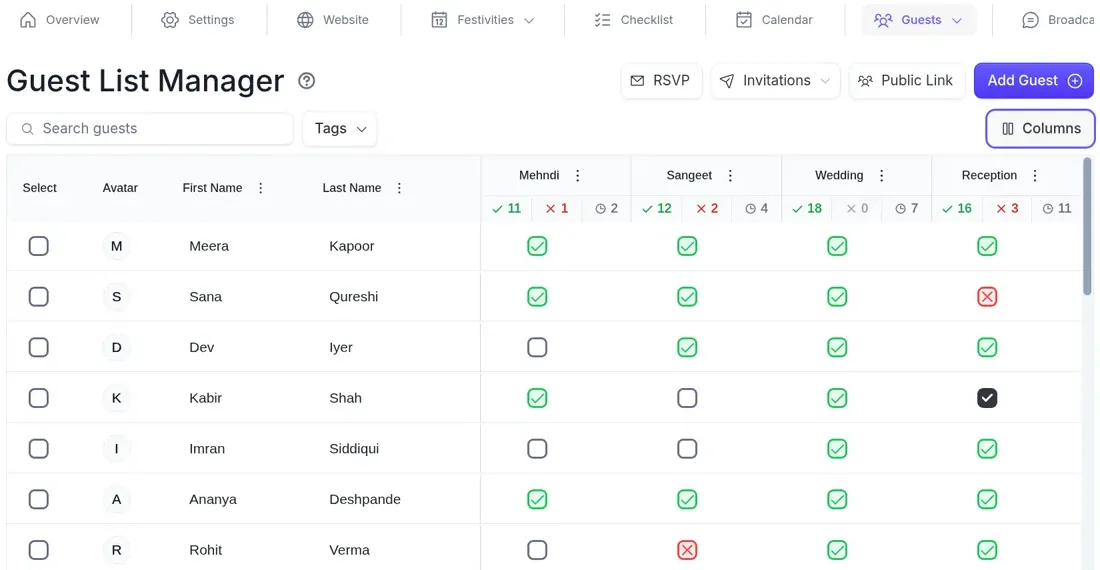
- A festivity for every event. Add pellikuthuru, pellikoduku, the muhurtham, the reception and the vratham (or just the ones you’re having), each with its own date, venue, menu and schedule. See festivities.
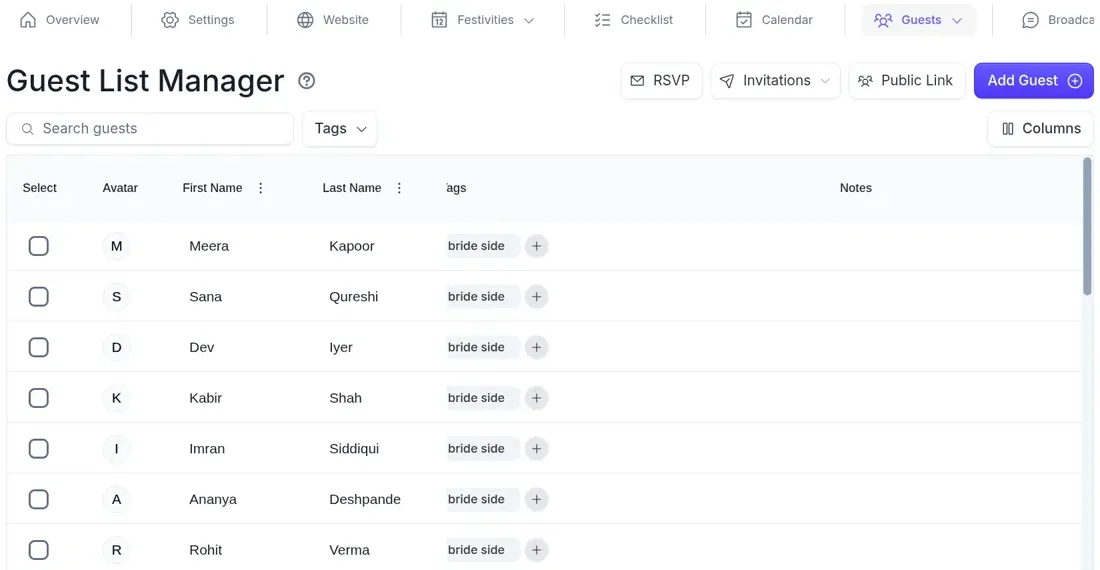
- One guest list for both families. Add every household once, tag it by side, and invite it to just its events. Each guest RSVPs to each event they’re invited to. See guest management.
- Messages by tag or RSVP status. Send email or SMS broadcasts to guests you pick by tag or by RSVP status, for example everyone on the groom’s side who hasn’t replied yet. See guest email and SMS.
- A shared checklist. Put the purohit booking, the muhurtham time, the talambralu rice and the venue’s fire rules on one checklist with owners and due dates.
- Seating for the reception. Build a seating chart from the guests who accepted. You place tables and guests yourself; nothing is seated automatically.
- Budget categories and vendor quotes for the wedding. Track the priest, caterers, decorators and the photographer as quotes by category inside the same wedding. See budget.
- Both families in the same plan. Invite parents, siblings or a planner as collaborators. If a sibling is next, save the whole weekend as a template.
What PlanMe doesn’t do, so you can plan around it: it doesn’t book temples, halls, priests or hotel rooms, and it sends by email and SMS, not WhatsApp. If you’re choosing between tools, compare PlanMe with Zola, Joy and The Knot, or read our roundup of the best South Asian wedding planning tools, which says where other tools beat us.
Put every Telugu wedding event in one plan
Add pellikuthuru, pellikoduku, the muhurtham, the reception and the vratham with their own dates, venues, menus and schedules, tag every household by side, invite each one to just its events and collect an RSVP for each. Both families can work in the same plan, free during beta.
Start planning in PlanMeSources
Checked November 10, 2026. Reddit posts and quotes are as posted by their authors and are not verified. The 360-guest invitation example, the weekend layout and the budget category names are our own and use fictional data.
- Hello Biodata: Telugu Wedding Rituals in Order
- Velvet Knot: Telugu Wedding Rituals and Traditions
- Velvet Knot: Pellikuthuru and Pellikoduku Ceremony
- Pellikart: Telugu Wedding Rituals in Order
- Karishye: Telugu Wedding Rituals, Step by Step
- Wikipedia: Telugu Hindu wedding
- The Knot: Indian Wedding Traditions You Should Know About
- Joy Help Center: Managing RSVPs when not everyone is invited to every event
- Zola Help: Can I collect RSVPs for multiple events?
- r/weddingplanning: Indian wedding in the US — what did you keep, skip, or combine?
- r/DesiWeddings: Telugu wedding rituals
- r/DesiWeddings: Pellikuthuru vs haldi
Common questions
What is the order of events at a Telugu wedding?
A common order is pelli choopulu (the families meet) and nischitartham (the engagement) weeks or months before, then pasupu kottadam and the pellikuthuru and pellikoduku ceremonies a day or two before. The wedding day runs mangala snanam, snathakam and kashi yatra for the groom, Gauri puja for the bride, kanyadanam, jeelakarra bellam at the muhurtham, mangalya dharanam, talambralu and saptapadi. Appagintalu, grihapravesam and the Satyanarayana vratham follow, with a reception the same evening or the next day. Families and communities reorder and skip steps, so check with your elders and priest.
What is the most important ritual in a Telugu wedding?
Jeelakarra bellam. At the exact muhurtham, the bride and groom place a paste of cumin seeds and jaggery on each other’s heads while a curtain separates them; the curtain is then lowered. Hello Biodata calls it the most important moment, more than the tying of the mangalsutram. Velvet Knot says the marriage is considered sealed at that instant, so the whole day is scheduled around it.
Is pellikuthuru the same as haldi?
Not quite. Both use turmeric, and The Knot calls pellikuthuru the Telugu version of a haldi. But pellikuthuru is a change of status: married women apply turmeric and oil, the bride has a ritual bath, puts on a new saree and green glass bangles, and is treated as a bride from then on. The groom has his own pellikoduku at his home. Velvet Knot explains the difference well.
What time is a Telugu wedding muhurtham?
Whatever time the priest fixes from both horoscopes. Hello Biodata notes it can fall at any hour, morning or late night, because it follows the lagnam that suits both charts, and Wikipedia’s entry says many Telugu muhurthams are close to midnight. Diaspora couples often ask the priest for a morning or daytime window so guests and the venue can manage it.
How many days is a Telugu wedding in the US?
Most diaspora families fit it into two or three days: pellikuthuru and pellikoduku (and sometimes a sangeet or welcome dinner) on day one, the muhurtham, lunch and appagintalu on day two with a reception that evening or the next, and an optional family-only Satyanarayana vratham after. One Kannada commenter marrying a Telugu groom on r/weddingplanning is planning a Saturday welcome party, a Sunday morning temple ceremony and a Sunday evening reception on a long weekend.
Do Telugu weddings have a mehndi or sangeet?
Traditionally no, but many now do. Hello Biodata notes that Telangana weddings in and around Hyderabad often add a sangeet and mehendi, and plenty of diaspora couples add one night of music. If you add one, give it its own guest list; it doesn’t replace pellikuthuru.
What should a US venue allow for a Telugu ceremony?
Ask about an open flame for the homam, rice thrown during talambralu, an outside priest and caterer, an early start time, and floor space for the bride to be carried in a basket if your family keeps that custom. Some couples choose a temple for the ceremony and a separate hall for the reception for these reasons.