On this page
- The short answer
- Tamil wedding events in order, from the host’s side
- First decision: whose traditions, and which version
- Tamil wedding planning checklist, month by month
- Planning around an early-morning muhurtham
- A muhurtham-morning itinerary for guests
- Nalangu: when it happens and who comes
- Sri Lankan Tamil and Christian Tamil weddings
- Guest lists for each event: a worked example
- Budget categories for a Tamil weekend
- Running the plan in PlanMe
- Sources
- Common questions
Most Tamil wedding guides online are ritual glossaries, and the good ones are linked below. This one’s for whoever’s holding the spreadsheet. The order of events is also the order of decisions: when to ask the priest, which venue lets the decorator in at 4 AM, who’s invited to the nalangu, and how many plates the breakfast caterer needs.
There’s no single Tamil wedding. Iyer and Iyengar families, other Tamil Nadu communities, Sri Lankan Tamil families from Jaffna or Colombo, and Tamil Christians all do things differently, and two cousins in the same family can disagree. Use the sequence below as a starting point, then check it with your elders and your priest.
The short answer
Plan a Tamil wedding backward from the muhurtham. Ask your priest for dates 12 to 18 months out, then book a venue that allows early-morning setup and a ceremonial fire, then the caterer, nadaswaram and thavil players, photographer and decorator. A common order of events is the nichayathartham (engagement), the pandhakal and vratham a day or two before, the janavasam the evening before, the wedding morning (kashi yatra, maalai maatral, oonjal, kanyadanam, thali tying at the muhurtham, saptapadi), then nalangu and an evening reception.
Each of those events has its own host and its own guest list, often from 30 people at the nalangu to several hundred at the reception, so plan the lists event by event from day one. For the North Indian sequence (haldi, sangeet, baraat, pheras), see Indian wedding events in order. For a Tamil and Telugu wedding, the Telugu side’s sequence is in Telugu wedding events in order. This page stays with Tamil weddings.
Tamil wedding events in order, from the host’s side
This is the Tamil Hindu sequence most relatives and diaspora vendors expect, drawn mainly from WeddingWire India’s guide to Tamil weddings, which covers Iyer, Vanniyar, Chettiar and Gounder customs separately. We’ve added who usually hosts and who usually comes, because that’s what you need to plan.
| Event | Usually when | Usually hosted by | Who usually comes |
|---|---|---|---|
| Nichayathartham (engagement) | Weeks or months before, or the evening before in some families | Bride’s family receives the groom’s side | Close family of both sides |
| Pandhakal or muhurtha kaal | A few days before | Each family, at home or the hall | Immediate family |
| Vratham and kaapu (kanganam) | The day before, or that morning | Each family, with the priest | Immediate family |
| Janavasam | The evening before | Bride’s family welcomes the groom’s side | Both families, often wider |
| Wedding morning: kashi yatra to saptapadi | At the muhurtham, often early morning | Bride’s family, traditionally | Invited guests |
| Meal after the ceremony | Straight after the muhurtham | Bride’s family, traditionally | Everyone at the ceremony |
| Nalangu | The night before, or after the wedding | Either family | Close family, often 30 to 50 |
| Reception | The wedding evening or another day | Either family, or both | Usually the biggest list, including colleagues |
Months before: nichayathartham
The formal engagement. WeddingWire India describes a puja to Ganesha followed by the reading of the lagna patrikai, the letter that fixes the day, date and muhurtham, which both families sign. Kalyan Shastra’s Iyengar guide adds that it used to be held at the bride’s home and is now often held at the kalyana mandapam, and that it’s mostly close family. That makes it the first real guest list, and a small one.
The days before: pandhakal, vratham and janavasam
In Iyer families, WeddingWire India says, smaller rites take place at each family’s home just before the two main days, including the panda kaal, a bamboo pole with banana leaves set up outside the house. Chettiar families call it the muhurtha kaal and hold it four or five days before. The vratham follows, when a protective thread (kaapu) is tied on the couple’s wrists, and then the janavasam, when the groom is brought to the hall in a procession with nadaswaram. These are family events, but the janavasam evening often turns into the first big gathering, so decide early whether it gets dinner.
The wedding morning
For Iyer weddings, WeddingWire India lists the kashi yatra (the groom pretends to leave for a life of study in Varanasi until the bride’s father talks him out of it), the maalai maatral and oonjal, the kanyadanam, the change into the koorai saree, the mangalya dharanam, when the groom ties the thali in three knots (the first by him, the other two by his sister) to the sound of the nadaswaram, and the saptapadi. Aana Avanna’s guide to Tamil Hindu weddings makes a point worth passing on to every relative with an opinion: the kashi yatra and oonjal are especially Tamil Brahmin customs, so leaving them out of another family’s wedding doesn’t mean anything was forgotten.
For how this compares with Punjabi, Gujarati and Muslim ceremonies, see the wedding ceremony guide.
After: nalangu, reception and the bride’s welcome
After the ceremony comes a meal, then, depending on the family, the nalangu games, the bride’s welcome into the groom’s home and the reception. WeddingWire India notes that for Iyer weddings a reception isn’t mandatory, though many families now hold one. In the diaspora, the reception is usually where colleagues and friends come, and our reception guide covers its run of show.
First decision: whose traditions, and which version
Before you book anything, sit both families down and agree on which version of the wedding you’re having. It sounds obvious. It’s also the step that saves the most arguments later, because it decides how many events there are, how long the ceremony runs and what the caterer serves.
- Community: Iyer, Iyengar, Chettiar, Gounder, Vanniyar, Mudaliar and other families each have their own steps and names. WeddingWire India says Iyer weddings used to run over four days and have now come down to two.
- Food: Aana Avanna notes that Tamil Brahmin wedding food is traditionally vegetarian, while other Tamil communities may serve meat or seafood at related events, and Sri Lankan Tamil menus differ from Tamil Nadu ones. That’s a caterer decision, so make it early.
- Faith and mixed families: Christian Tamil and interfaith couples often keep the thali, garlands and koorai saree but not the puja. More on that below.
- Who explains it: plenty of diaspora families don’t have an elder nearby who knows every step. One r/DesiWeddings poster planning a sister’s pre-wedding nalangu wrote that they had “no elders to consult.” Ask your priest for a written order of the ceremony, and put a relative in charge of the ritual items list.
Tamil wedding planning checklist, month by month
When an r/DesiWeddings user asked for a checklist of what to do first, they were asking the question every couple has. For a Tamil wedding abroad, the answer is the muhurtham, then the venue. This is the order we’d use for a wedding in the US, Canada, the UK or Australia. Our general wedding planning checklist covers the rest of the bookings; this one only adds what’s specific to a Tamil wedding.
| When | Tamil-specific tasks |
|---|---|
| 12 to 18 months before | Agree whose traditions you’re following · ask the priest or astrologer for muhurtham dates (with jathagam if your family matches horoscopes) · set an overall budget · draft a rough guest list for each event |
| 10 to 12 months | Book a venue that allows early access or overnight setup and a ceremonial fire · book the priest for the exact date and time · book the caterer for a post-ceremony meal and the reception |
| 8 to 10 months | Book nadaswaram and thavil players, a photographer who has shot Tamil ceremonies, and a decorator for the manavarai (the wedding platform) · send save-the-dates to out-of-town guests · hold hotel rooms near the venue |
| 6 months | Order the koorai saree (a nine-yard madisar for many Iyer and Iyengar brides) and the groom’s veshti · arrange the thali (and the ponnurukku date for Sri Lankan families) · agree on the seer list between families |
| 3 to 4 months | Send invitations event by event · open RSVPs for each event · write a one-page guide to the ceremony for guests who haven’t been to a Tamil wedding |
| 6 to 8 weeks | Chase RSVPs · book early-morning transport from the hotel · confirm the ceremony length and order with the priest · confirm the ritual items list (coconuts, betel leaves, akshathai, oonjal swing) |
| 2 weeks | Give each caterer its final count · finish the reception seating chart · send vendors and family the run of show, starting from the decorator’s load-in time |
| The week of | Pandhakal or muhurtha kaal · vratham · janavasam · nalangu if it’s before the wedding · a final reminder to guests with the morning start time |
For vendor lead times in general, the wedding vendor booking timeline gives a date for each booking from your wedding date, and the save-the-date timing calculator tells you when to send them. If you want the ten big decisions in order before the detail, start with how to plan an Indian wedding.
Why the muhurtham goes first
In the US, priests who do Tamil ceremonies are booked up, and they don’t always release dates far in advance. When a couple in Seattle asked how to find a muhurtham for 2025 because local priests were asking them to wait months, one reply described the same wait:
“Happened to us for our 2023 wedding. We had to wait until October 2022 for an August muhurtham.”
You can get an early idea of likely weekend dates. But as the same commenter put it, the final call is up to the priest performing your ceremony. If your preferred venue wants a deposit before the priest confirms, ask whether it’ll hold two or three dates for a few weeks.
Planning around an early-morning muhurtham
itsmy.wedding’s Tamil traditions guide says the most auspicious muhurtham times overwhelmingly fall between 5 and 9 AM, and that the bride’s family may arrive at the hall by 3 or 4 AM to finish the rituals that come first. Western venues aren’t built for that. A couple planning a Tamil wedding near Seattle spelled out the problem:
“Most venues are quoting from 12 hours from 11 am to 11 pm. Extra per hour if we want to extend. But if have to have a wedding in the morning, then the mandap and decoration has to go the previous day.”
The replies in that thread are a good checklist for the venue conversation:
- Get the room the day before if you can afford it. A wedding coordinator in the thread said it’s ideal for getting the pandal ready, and described a wedding where they could only get in at 4 AM on the day, which was “really hectic and stressful” for the family bringing in the puja items.
- Otherwise, simplify the decor. Another reply pointed out that a same-day setup and a flip from ceremony to reception means either a simple setup or extra crew, which costs more.
- Check the fire rules. The same coordinator’s advice: if you’re planning an open flame, make sure the venue allows it. Aana Avanna also notes that fire restrictions can affect the homam in diaspora weddings.
- Have a rain plan for outdoor ceremonies. A gazebo or semi-closed structure can double as the mandapam.
The long day for the couple
The morning ceremony usually means a lunch and then a reception in the evening. When a bride marrying into a South Indian family asked on r/DesiWeddings what that day looks like, one newlywed shared theirs: ceremony from 9 to 12, lunch until about 2, and the reception from 7 to midnight. “It was a long day but wasn’t as bad as I thought it would be,” they wrote. Another commenter said their ceremony ran close to three hours, food was served right after, and they skipped the reception altogether.
Planning notes for hosts: Block a real rest window between lunch and the reception on the schedule, and give hair and makeup a second slot before the evening. Book rooms at or near the venue so the couple and close family aren’t driving at 4 AM and again at midnight. The hotel room block calculator estimates how many rooms to hold, and our hotel block guide explains courtesy and contracted blocks. The wedding day timeline shows how to plan the rest of the clock backward from a muhurtham.
A muhurtham-morning itinerary for guests
Non-Tamil guests, and plenty of Tamil ones, need to know three things: when to arrive, which part not to miss, and when they can eat. Here’s an example morning for our fictional showcase couple, Anaya and Rohan, with a 7:40 AM muhurtham at a banquet hall outside Toronto. The times are our own example to show the shape; your priest sets the real ones.
| Time | What’s happening | What guests should know |
|---|---|---|
| 5:00 AM | Family and priest arrive; rituals begin on the manavarai | Family only |
| 6:00 AM | Shuttle leaves the guest hotel | Wear something you can sit in cross-legged; shoes may come off near the manavarai |
| 6:30 AM | Guests seated; light coffee and tea | Pick up akshathai (turmeric rice) at the door |
| 6:45 AM | Kashi yatra and maalai maatral | The fun part: the groom ‘leaves’ and is talked back |
| 7:05 AM | Oonjal and kanyadanam | Stay seated; the family will be crowded around the swing |
| 7:40 AM | Muhurtham: the thali is tied | The moment not to miss. Shower akshathai when the music rises |
| 8:00 AM | Saptapadi and blessings from elders | Photos with the couple follow |
| 9:00 AM | Breakfast or brunch | Served right after; vegetarian |
| 11:00 AM | Guests return to the hotel | Rest; the shuttle runs back every 30 minutes |
| 6:30 PM | Reception | Separate invitation; evening dress |
Put this on your wedding website’s schedule for the ceremony guests only, not for the reception-only list. Zola’s Indian wedding guest guide tells guests there may be other events “you might also be invited to,” which is the confusion to avoid. Our guest itinerary guide covers the full weekend version, and our guide to wedding websites for several events shows how different tools hide events from guests who aren’t invited.
Nalangu: when it happens and who comes
Nalangu is the event families disagree about most, because it changes so much from one family to the next. Aana Avanna says it can happen before or after the main wedding, with turmeric, oil, songs, food and games, and calls it one of the most variable Tamil wedding traditions. WeddingWire India describes a Vanniyar version before the wedding, a turmeric, oil and green gram ritual followed by a ceremonial bath, and an Iyer version after it, as light-hearted games at the venue or the groom’s home.
What most versions share is the size: it’s a family event. Treat it as its own list, with its own time and its own RSVP, rather than “everyone who’s around.”
Planning notes for hosts: Agree on the money questions before the invitations go out. On r/DesiWeddings, a bride whose future mother-in-law was hosting a nalangu found out afterward that she expected some of the cash gifts to cover the party and wanted a list of all the gifts to write thank-you notes herself. Neither is unusual in every family, but both are easier to settle in advance: who hosts, who pays, who keeps the gifts and who writes the thank-yous.
Sri Lankan Tamil and Christian Tamil weddings
Sri Lankan Tamil weddings
Large Sri Lankan Tamil communities in Toronto, London and Sydney plan weddings that share the thali and the sacred fire with Tamil Nadu weddings but differ in the run-up. A Tamil Cultural Association guide to Sri Lankan Tamil Hindu weddings describes the ponnurukku, a few days before the wedding, when the groom presents a gold coin to the family goldsmith to be melted down for the thali. The bride doesn’t take part, and the guide says the sweets for the wedding are traditionally started the same day. Aana Avanna adds that a wedding in Jaffna shouldn’t be treated as a slightly modified Chennai wedding, and that Sri Lankan Tamil sarees and food differ too.
For planning, that means one more family event to schedule (and a goldsmith to book) and a different caterer brief. A future bride in the Greater Toronto Area described her plan on r/WeddingsCanada: a traditional Tamil Hindu wedding at a banquet hall, no bar, short eats and a buffet, about 200 guests and a traditional vegetarian Sri Lankan lunch. That’s a common shape, and it’s a single big event, so the ceremony list and the meal count are the same number.
Christian Tamil and interfaith weddings
A Tamil Catholic bride marrying a Malayalee Catholic in the UK shared her plan on r/DesiWeddings: a church ceremony and lunch on day one, then a Western-style day two that opens with the jasmine garland exchange, the thali and a change into the koorai saree. Her question was which customs she could add without borrowing Hindu religious rites. Aana Avanna’s guide is useful here, because it separates the clearly religious parts (puja, homam, mantras) from the parts that are mostly cultural (music, clothing, food, garlands) and those that can be both (the thali, nalangu, oonjal).
For a two-day Christian Tamil or interfaith wedding, plan two separate guest lists: church ceremony guests may not be the same people as day-two guests, and the lunch count follows the church list.
Guest lists for each event: a worked example
Here’s how the lists can play out. Give Anaya and Rohan a Friday-to-Sunday Tamil weekend outside Toronto with 380 people on the master list: 160 on the bride’s side, 150 on the groom’s side and 70 friends and colleagues. These numbers are our own example to show the shape, not survey data.
| Event | Host | Bride’s side | Groom’s side | Friends and colleagues | Invited |
|---|---|---|---|---|---|
| Vratham and kaapu (Friday, bride’s home) | Bride’s family | 30 | 0 | 0 | 30 |
| Vratham and kaapu (Friday, groom’s home) | Groom’s family | 0 | 28 | 0 | 28 |
| Nichayathartham and janavasam (Friday evening, hall) | Bride’s family | 90 | 80 | 10 | 180 |
| Wedding and breakfast (Saturday, 7:40 AM muhurtham) | Bride’s family | 140 | 130 | 30 | 300 |
| Reception (Saturday evening) | Both families | 150 | 140 | 70 | 360 |
| Nalangu (Sunday afternoon, groom’s home) | Groom’s family | 15 | 25 | 0 | 40 |
Three things stand out:
- The reception is bigger than the wedding. 360 are invited to the reception and 300 to the ceremony. Most of the gap is colleagues and friends who won’t come at 6:30 AM. itsmy.wedding notes that the reception list in Tamil weddings is often much larger than the morning ceremony’s.
- The breakfast count is not the reception count. You need two final numbers for two meals, often from two caterers, on two different deadlines.
- Three small lists at three homes. Each family’s vratham and the nalangu are 30 to 40 people each, and they shouldn’t get the hall’s address by mistake.
Run each event’s invite count through the guest attendance calculator to estimate how many will come, then turn that into plates with the catering headcount calculator. For the deeper version of this exercise, see separate guest lists for each wedding event, and RSVPs for a multi-event wedding covers partial yeses and reminders.
Work out each RSVP deadline from your caterer’s date
A Tamil weekend often has two or three caterers: a breakfast or lunch after the muhurtham, a reception dinner, maybe a small nalangu meal. Enter each one’s final-count date and the RSVP deadline calculator works back to when you need replies, right on the page. No sign-up.
Open the RSVP deadline calculatorBudget categories for a Tamil weekend
A Tamil weekend spends differently from a North Indian one. There’s usually no sangeet or baraat to pay for, but there are costs other guides skip: early venue access or a second day of rental, the priest and ritual items, nadaswaram and thavil players, the koorai saree, the thali, the seer plates, and two meals on the wedding day.
The simplest way to keep it straight is one wedding budget with categories named for each event and vendor, for example “Wedding: hall and early access,” “Wedding: priest and puja items,” “Wedding: nadaswaram,” “Wedding: breakfast,” “Reception: catering.” That way you can see what each part of the weekend costs without running a separate budget for each event. To set the overall number first, try the Indian wedding budget calculator, and see what an Indian wedding costs for published ranges with sources. If the two families are splitting costs, who pays for an Indian wedding covers the common ways to divide them.
Running the plan in PlanMe
You can run all of this in a spreadsheet and a family group chat, and many families do. It tends to break when the breakfast caterer, the reception caterer and the nalangu host all want different numbers in the same week. If you’d rather keep it in one place, PlanMe.Club is our product, built for weddings with several events and two families. In PlanMe, each event (nichayathartham, nalangu, wedding, reception and so on) is called a festivity.
- A festivity for every event. Add the nichayathartham and janavasam, the wedding, the reception and the nalangu, each with its own date, venue, menu and schedule, so the breakfast menu and the reception menu live in different places. See festivities.
- The checklist above, shared. Put the priest booking, the muhurtham time, the koorai saree, the goldsmith and the oonjal swing on one checklist with owners and due dates.
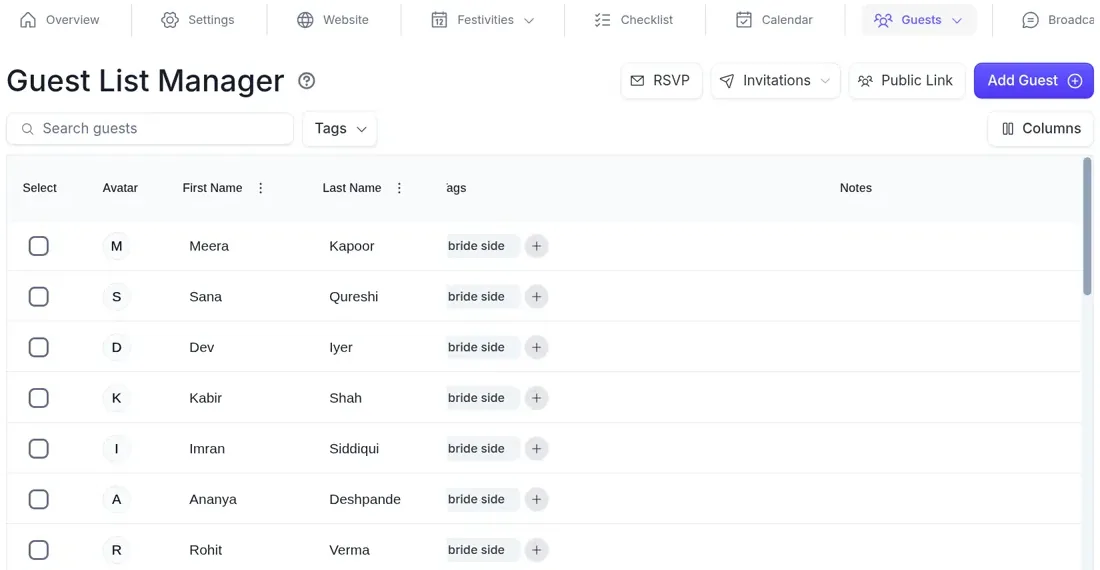
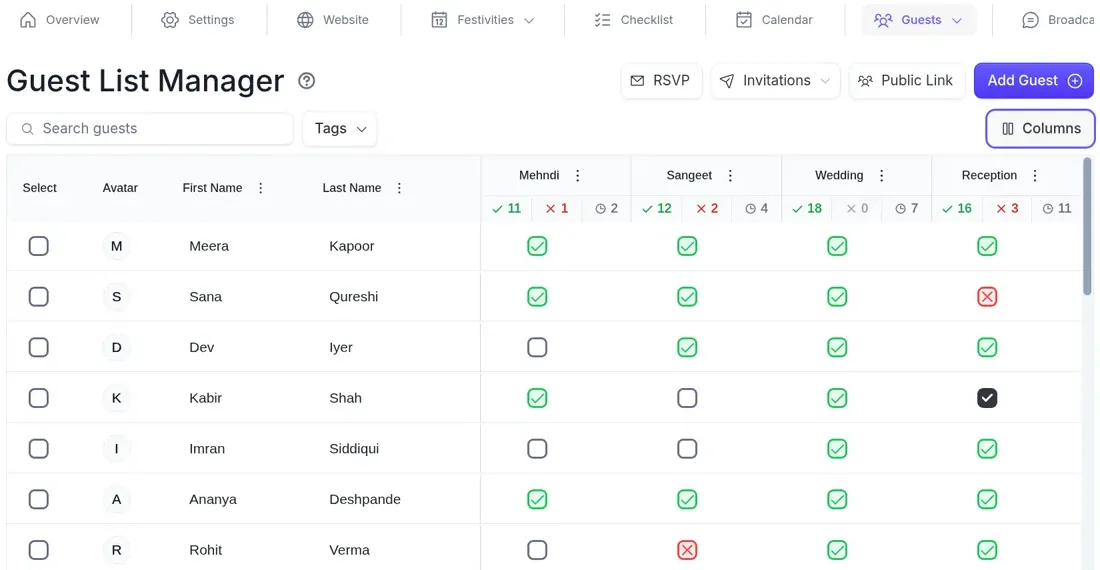
- One guest list for both families. Add every household once, tag it (bride’s side, groom’s side, colleagues), and invite it to just its events. Each guest RSVPs to each event they’re invited to, so the ceremony and the reception keep their own counts. See guest management.
- Messages by tag or RSVP status. Send email or SMS broadcasts to guests you pick by tag or by RSVP status, for example everyone on the groom’s side who hasn’t replied yet. Tag your ceremony guests if you want to remind only them about the 6 AM shuttle. See guest email and SMS.
- A wedding website with a schedule. Publish the itinerary and the hotels guests can stay at on your wedding website, and each guest sees only the events they’re invited to.
- Seating for the reception. Build a seating chart from the guests who accepted. You place tables and guests yourself; nothing is seated automatically.
- Budget categories and vendor quotes for the wedding. Track the hall, priest, musicians and caterers as quotes by category inside the same wedding, and see what’s paid and what’s due. See budget.
What PlanMe doesn’t do, so you can plan around it: it doesn’t find priests or calculate a muhurtham, it doesn’t book halls or hotel rooms, and it sends by email and SMS, not WhatsApp. If you’re choosing between tools, compare PlanMe with Zola, Joy and The Knot, or read our roundup of the best South Asian wedding planning tools, which says where other tools beat us. Joy, for example, also lets you show each guest only the events they’re invited to.
Keep the checklist, the muhurtham morning and the guest lists in one plan
Add the nichayathartham, nalangu, wedding and reception with their own dates, venues, menus and schedules, put every task from the priest booking to the koorai saree on a shared checklist, and invite each household to just its events with an RSVP for each. Both families can work in the same plan. Free during beta.
Start planning in PlanMeSources
Checked November 5, 2026. Reddit quotes are as posted by the commenters and are not verified. The 380-guest invitation example, the morning itinerary and the budget category names are our own and use fictional data. Ritual names are spelled several ways; we’ve used common spellings.
- WeddingWire India: Decoding a Tamil Wedding: Rituals, Traditions, and Their Significance
- Aana Avanna: Tamil Hindu Weddings Explained
- Kalyan Shastra: Pre-Wedding Ritual for Iyengar Weddings, Nichayathartham
- itsmy.wedding: Tamil Wedding Traditions: Rituals, Meaning and Modern Adaptations
- itsmy.wedding: NRI South Indian Wedding Guide
- Tamil Cultural Association: A Sri Lankan Tamil Hindu Wedding (via Yumpu)
- The Knot: Indian Wedding Traditions You Should Know About
- Zola: What to Wear to an Indian Wedding
- Joy Help Center: Managing RSVPs and schedules when not everyone is invited to every event
- r/DesiWeddings: Finding muhurath for 2025
- r/DesiWeddings: Seattle Tamil wedding 2025
- r/DesiWeddings: Help (morning ceremony, lunch and reception)
- r/DesiWeddings: Nalangu Etiquette
- r/DesiWeddings: Need advice for nalangu
- r/DesiWeddings: UK Christian Tamil and Malayalee wedding advice
- r/WeddingsCanada: Sri Lankan Tamil Hindu Wedding Breakdown (Scarborough/Markham/Durham)
- r/DesiWeddings: Checklist
Common questions
What is the order of events at a Tamil wedding?
A common order for a Tamil Hindu wedding is the nichayathartham (engagement), the pandhakal or muhurtha kaal (a bamboo pole blessed to start the preparations), the vratham and kaapu (a protective thread tied on the couple’s wrists), the janavasam (the groom’s welcome procession) the evening before, then on the wedding morning the kashi yatra, maalai maatral (garland exchange), oonjal (swing), kanyadanam, the thali tying at the muhurtham and the saptapadi. Nalangu and a reception follow, the same day or later. Many of these, especially the kashi yatra and oonjal, are Tamil Brahmin customs, and other Tamil communities run a shorter sequence.
How far ahead should we start planning a Tamil wedding?
Start with the muhurtham, about 12 to 18 months out if you can, because the date and the exact time come from your priest or astrologer and everything else is booked around them. Diaspora couples on r/DesiWeddings report waiting months for a priest to release the next year’s dates: one couple had to wait until October 2022 for an August 2023 muhurtham. Once you have it, book a venue that allows early-morning access, then the priest, caterer, musicians and photographer.
Why are Tamil weddings held so early in the morning?
Because the thali is tied at a muhurtham, an auspicious time set by a priest or astrologer, and for many families that time falls in the early morning. itsmy.wedding’s Tamil traditions guide says the most auspicious times overwhelmingly fall between 5 and 9 AM. The ceremony then finishes by mid-morning, a meal follows, and the evening is free for a reception.
Is nalangu before or after the wedding?
Either, depending on the family. Aana Avanna’s guide to Tamil Hindu weddings says nalangu can happen before or after the main wedding, and WeddingWire India describes it both as a pre-wedding turmeric and oil ritual in Vanniyar weddings and as post-wedding games at the venue or the groom’s home in Iyer weddings. Either way it’s usually a small family event, so give it its own guest list.
How is a Sri Lankan Tamil wedding different?
Sri Lankan Tamil Hindu weddings share the thali, the sacred fire and much of the ceremony, but the pre-wedding rites and food differ. A Tamil Cultural Association guide describes the ponnurukku, a few days before the wedding, when the groom’s family gives a gold coin to the family goldsmith to make the thali; the bride doesn’t attend. Diaspora couples in Toronto and London also often plan a vegetarian Sri Lankan lunch after the ceremony and a separate reception. Ask your priest and elders which rites your family keeps.
Do we need a separate reception for a Tamil wedding?
No. WeddingWire India notes that a reception isn’t mandatory in Iyer weddings, though many families now hold one, and some couples on r/DesiWeddings skip it and serve a meal after the ceremony. In the diaspora, an evening reception is common when you want to invite colleagues and friends who won’t come to a 6 AM ceremony, which usually makes it the biggest list of the weekend.